
Effect of Deformation by Wire Drawing on the Mechanical and Electrical Properties of Aluminum
Article Sidebar
-
Aluminum 99.7%, ColdWire Drawing, Microhardness, Ultimate Tensile Strength, Conductivity, Resistivity
Abstract
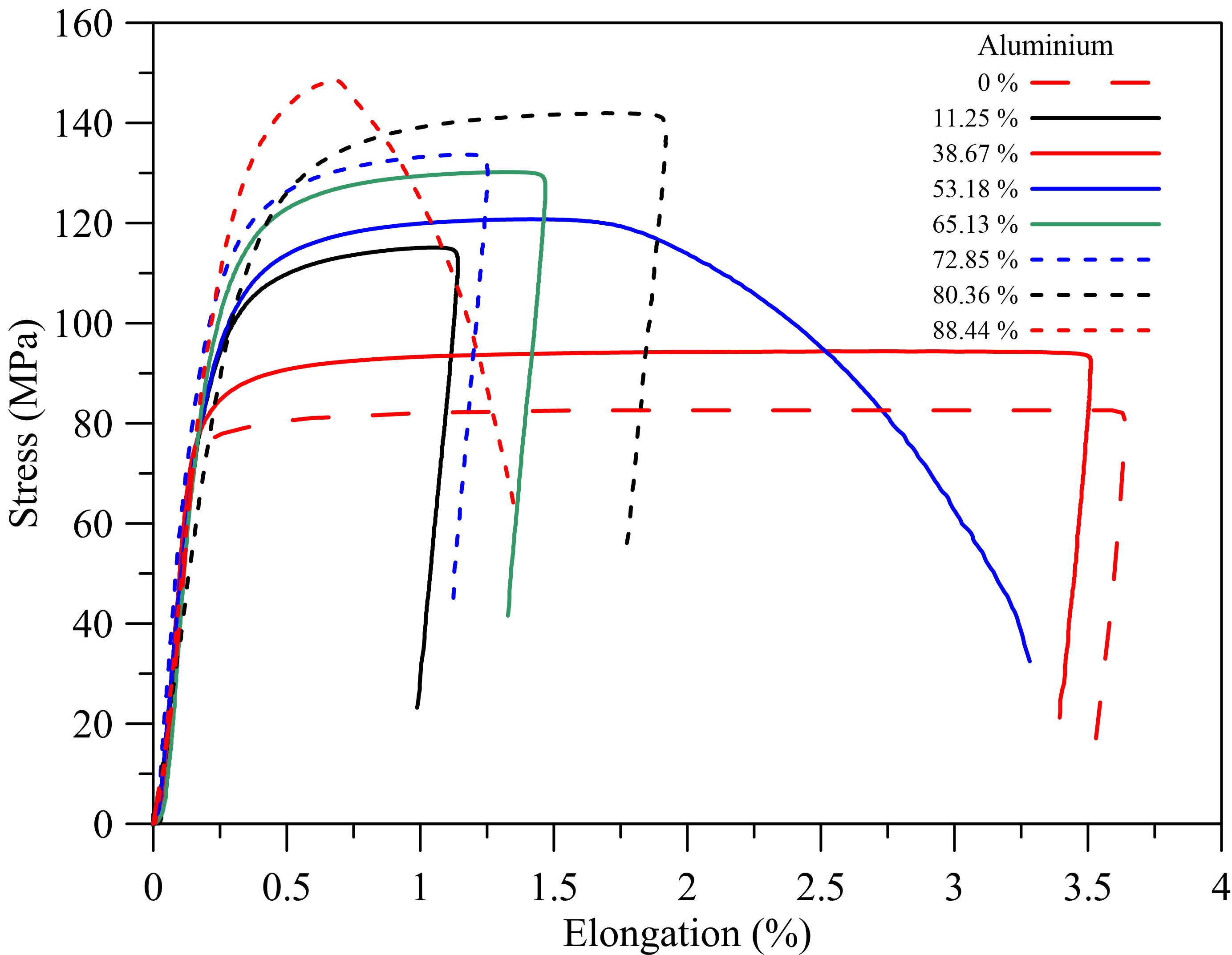
This research investigates the influence of cold wire drawing on the electromechanical properties of high-purity (99.7%) aluminum conductors. Aluminum wires were subjected to progressive plastic deformation, with cross-sectional reduction rates ranging from 11.25% to 88.44%. The results demonstrate that mechanical deformation significantly enhances the ultimate tensile strength, reaching a peak value of 116.14 MPa and a Vickers hardness of 57.63 HV at the maximum reduction rate. Conversely, a marked reduction in elongation at break was observed, indicating a loss of ductility due to intense work hardening. Regarding electrical performance, the study reveals that electrical resistivity increases by only 0.87% over the full deformation range, while electrical conductivity exhibits a proportional decline. This degradation in transport properties is physically attributed to the increased density of lattice defects (dislocations) acting as electron scattering centers. These findings highlight the critical trade-off between mechanical reinforcement and electrical efficiency, providing essential data for the optimization of high-performance conductors for power transmission.
References
Alley, P. and B. Serin (1959). Deviations from Matthiessen’s Rule in Aluminum, Tin, and Copper Alloys. Physical Review, 116(2); 334–338
Balogun, S. A., D. E. Esezobor, and S. O. Adeosun (2007). Effects of Deformation Processing on the Mechanical Properties of Aluminum Alloy 6063. Metallurgical and Materials Transactions A, 38(7); 1570–1574
Belov, N., M. Murashkin, N. Korotkova, T. Akopyan, and V. Timofeev (2020). Structure and Properties of Al–0.6wt.%Zr Wire Alloy Manufactured by Direct Drawing of Electromagnetically CastWire Rod. Metals, 10(6); 769
Bespalov, V. M., D. S. Voroshilov, V. A. Berngardt, S. B. Sidelnikov, and I. L. Konstantinov (2024). Influence of the Parameters of Combined Processing and Drawing on the Structure and Properties of Conductor Semi-Finished Products. Metals and Materials International, 30(3); 773–799
Brandt, R. and G. Neuer (2007). Electrical Resistivity and Thermal Conductivity of Pure Aluminum and Aluminum Alloys. International Journal of Thermophysics, 28(5); 1429–1446
Caruso, S. and G. Ambrogio (2021). Novel Drawing System Approach to Manufacture Performant Commercially Pure Aluminium FineWires. The International Journal of Advanced Manufacturing Technology, 117(3); 883–895
Çetinarslan, C. S. (2009). Effect of Cold Plastic Deformation on Electrical Conductivity of Various Materials. Materials & Design, 30(3); 671–673
Chen, X., G. S. Huang, S. S. Liu, T. Z. Han, B. Jiang, A. T. Tang, and F. S. Pan (2019). Grain Refinement andMechanical Properties of Pure Aluminum Processed by Accumulative Extrusion Bonding. Transactions of Nonferrous Metals Society of China, 29(3); 437–447
Cui, X., Y.Wu, G. Zhang, Y. Liu, and X. Liu (2017). Study on the Improvement of Electrical Conductivity and Mechanical Properties of Low Alloying Electrical Aluminum Alloys. Composites Part B: Engineering, 110; 130–137
Czerwinski, F. (2024). Aluminum Alloys for Electrical Engineering: A Review. Journal of Materials Science, 59(31); 14847–14892
Hou, J. P., Q.Wang, H. J. Yang, X. M.Wu, C. H. Li, X.W. Li, and Z. F. Zhang (2015). Microstructure Evolution and Strengthening Mechanisms of Cold-Drawn Commercially Pure AluminumWire. Materials Science and Engineering: A, 639; 103–106
Kiessling, F., P. Nefzger, U. Kaintzyk, and J. F. Nolasco (2003). Overhead Power Lines: Planning, Design, Construction. Springer, Berlin, Germany
Koprowski, P., M. Lech-Grega, Ł. Wodziński, B. Augustyn, S. Boczkal, M. Ożóg, and W. Szymański (2020). The Effect of Low Content Additives on Strength, Resistivity and Microstructural Changes in Wire Drawing of 1xxx Series Aluminium Alloys for Electrical Purposes. Materials Today Communications, 24; 101039
Lunn, K. F. and D. Apelian (2024). Thermal and Electrical Conductivity of Aluminum Alloys. Materials Science and Engineering: A, 924; 147766
Luo, X. M., Z. M. Song, M. L. Li, Q.Wang, and G. P. Zhang (2017). Microstructural Evolution and Service Performance of Cold-Drawn Pure Aluminum ConductorWires. Journal of Materials Science & Technology, 33(9); 1039–1043
Medvedev, A. E., M. Y. Murashkin, N. A. Enikeev, and R. Z. Valiev (2022). Mechanical Properties and Electrical Conductivity of Al–Fe Alloys. Frontiers in Materials Technologies, 3(1); 96–105
Murashkin, M., A. Medvedev, V. Kazykhanov, A. Krokhin, G. Raab, N. Enikeev, and R. Z. Valiev (2015). EnhancedMechanical Properties and Electrical Conductivity in Ultrafine-Grained Al 6101 Alloy Processed via ECAP-Conform. Metals, 5(4); 2148–2164
Omeje, C. O. (2020). Corona Loss Minimization on High Voltage Transmission Line Network Using Bundled Conductors. International Journal of Engineering and Advanced Technology, 9(3); 1545–1550
Parvizi, P., S. Karabay, M. Erdem, and S. Altintas (2025). Mechanical and Physical Properties of Aluminum and Its Alloys for Electrical Conductors. Next Materials, 9; 101090
Reinke, G., R. K. Badibanga, M. S. Pestana, J. L. De Almeida Ferreira, J. A. Araujo, and C. R. Moreira da Silva (2020). Failure Analysis of Aluminum Wires in All Aluminum Alloy Conductors-AAAC. Engineering Failure Analysis, 107; 104197
Riba, J. R., S. Bogarra, Á. Gómez-Pau, and M. Moreno-Eguilaz (2020). Uprating of Transmission Lines by Means of HTLS Conductors for a Sustainable Growth: Challenges, Opportunities, and Research Needs. Renewable and Sustainable Energy Reviews, 134; 110334
Subedi, K. N., S. Bhandari, and S. F. P. Parker (2022). Electrical Conduction Processes in Aluminum: Defects and Phonons. Physical Review B, 105(10); 104114
Volokitin, A. V., I. E. Volokitina, and G. G. Kurapov (2021). Effect of Extrusion and Drawing Deformation Method on Aluminum Alloy 6101 Structure and Mechanical Properties. Metal Science and Heat Treatment, 63; 341–344
Zhu, Y. K., Q. Y. Chen, Q.Wang, H. Y. Yu, R. Li, J. P. Hou, and Z. F. Zhang (2018). Effect of Stress Profile on Microstructure Evolution of Cold-Drawn Commercially Pure Aluminum Wire Analyzed by Finite Element Simulation. Journal of Materials Science & Technology, 34(7); 1214–1221
Zisman, A. A., V. V. Rybin, S. Van Boxel, M. Seefeldt, and B. Verlinden (2006). Equal Channel Angular Drawing of Aluminum Sheet. Materials Science and Engineering: A, 427; 123–129
Authors

This work is licensed under a Creative Commons Attribution 4.0 International License.