
Numerical Solution of the Gardner Equation Using the Method of Lines and an Improved Fifth-Order Runge-Kutta Scheme
Article Sidebar
-
Gardner Equation, Method of Lines, Improved Runge-Kutta Method, Solitary Pulse, Kink-LikeWave, Numerical Simulation
Abstract
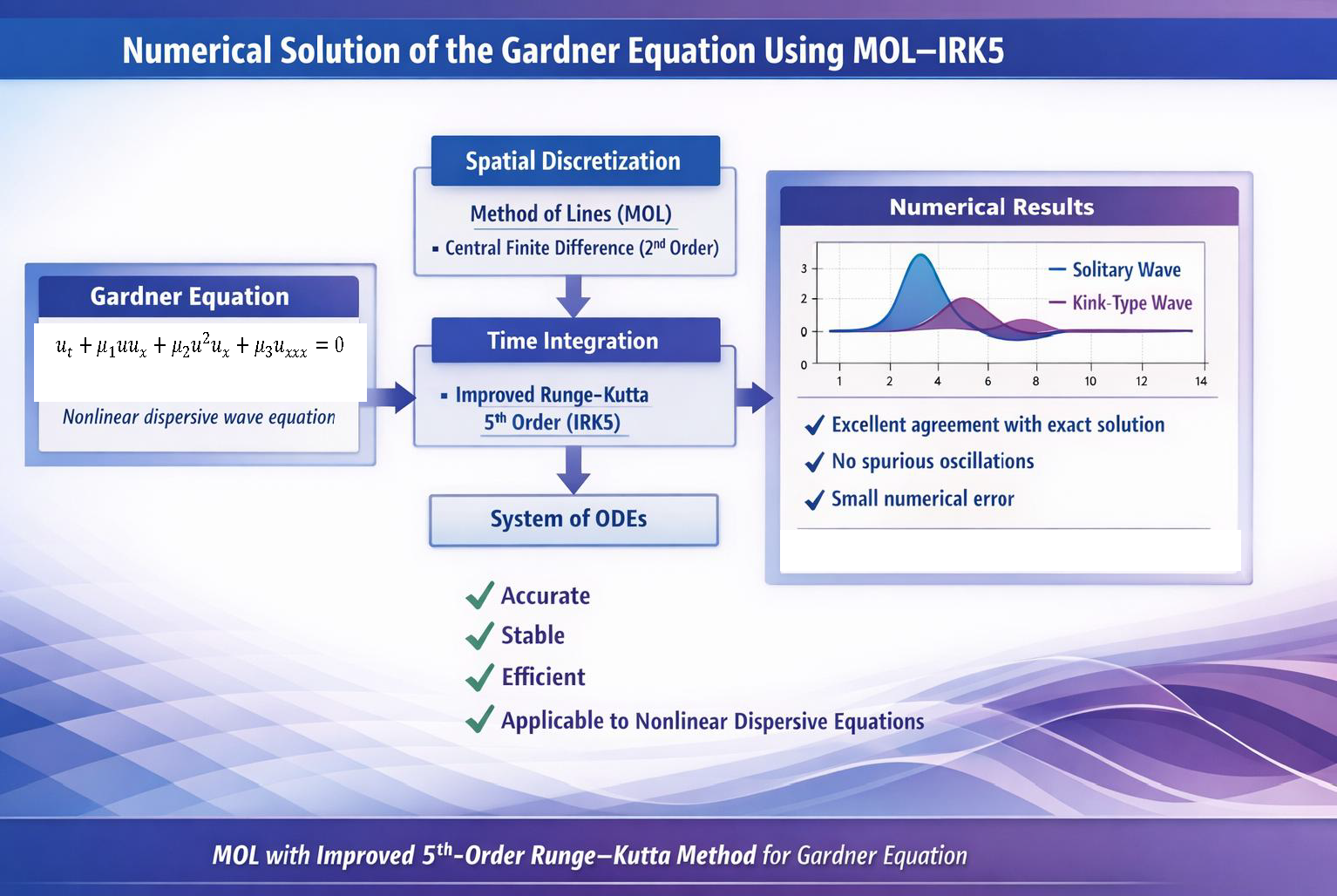
The Gardner equation is a nonlinear partial differential equation that arises in the modeling of nonlinear dispersive wave phenomena. Analytical solutions of this equation are limited to specific cases, which motivates the development of reliable numerical approaches. This study presents a numerical scheme based on the Method of Lines combined with an Improved Runge-Kutta method of order five to solve the Gardner equation. Spatial discretization is performed using second-order central finite difference schemes, which transform the governing equation into a system of ordinary differential equations. The resulting system is integrated in time using the fifth-order Improved Runge-Kutta method to achieve high accuracy and computational efficiency. Simulations targeting solitary pulse and kink-like wave solutions reveal that the MOL-IRK5 scheme consistently outperforms the classical MOL-RK4 method. The numerical results show strong agreement with the exact solutions at all observed time levels. Wave profiles are preserved during propagation, and no spurious oscillations are observed. Global error measures, including the maximum error, mean absolute error, and root mean square error, remain small throughout the simulation interval, indicating stable numerical performance. The results demonstrate that the proposed MOL-IRK5 scheme provides accurate and efficient approximations for different types of Gardner equation solutions. The numerical approach presented in this study offers a reliable framework for solving nonlinear dispersive equations and can be extended to more complex mathematical models in applied science and engineering.
References
Boyce,W. E. and R. C. DiPrima (2012). Elementary Differential Equations and Boundary Value Problems. JohnWiley & Sons, Inc., New Jersey, 10 edition
Cox, S. M. and P. C. Matthews (2002). Exponential Time Differencing for Stiff Systems. Journal of Computational Physics, 176(2); 430–455
Dahiya, S., A. Singh, and S. P. Singh (2023). Study of the Gardner Equation with Homogeneous Boundary Conditions via Fourth OrderModified Cubic B-Spline CollocationMethod. Computational Mathematics and Mathematical Physics, 63(12); 2474–2491
Degon, L. and A. Chowdhury (2022). Approximate Solutions to the Gardner Equation by Spectral Modified Exponential Time Differencing Method. Partial Differential Equations in Applied Mathematics, 5; 100310
Gardner, C. L. (2024). Numerical Methods for Mixed Type PDEs. In Applied Numerical Methods for Partial Differential Equations. Springer Nature Switzerland, Cham, pages 185–200
Habibah, U., F. F. Medrano, A. C. Permana, D. Ardiana, and Trisilowati (2025). An Improved Fifth-Order Runge-Kutta Method with Higher Accuracy and Efficiency for Solving Initial Value Problems. Science and Technology Indonesia, 10(3); 802–816
Hepson, O. E., A. Korkmaz, and I. Dag (2018). Numerical Solutions of the Gardner Equation by Extended Form of the Cubic B-Splines. Pramana, 91(4); 1–13
Hepson, O. E., A. Korkmaz, and I. Dag (2020). Exponential B-Spline Collocation Solutions to the Gardner Equation. International Journal of Computer Mathematics, 97(4); 837–850
Ji, Y. and Y. Xing (2023). Highly Accurate and Efficient Time Integration Methods with Unconditional Stability and Flexible Numerical Dissipation. Mathematics, 11(3); 593
Kai, Y., S. Chen, K. Zhang, and Z. Yin (2024). A Study of the ShallowWaterWaves with Some Boussinesq-Type Equations. Waves in Random and Complex Media, 34(3); 1251–1268
Kassam, A. K. and L. N. Trefethen (2005). Fourth-Order Time-Stepping for Stiff PDEs. SIAM Journal on Scientific Computing, 26(4); 1214–1233
Keppens, R., B. P. Braileanu, Y. Zhou, W. Ruan, C. Xia, Y. Guo, and F. Bacchini (2023). MPI-AMRVAC 3.0: Updates to an Open-Source Simulation Framework. Astronomy & Astrophysics, 673; A66
Khater, M. M. (2024). Dynamics of Nonlinear Time Fractional Equations in ShallowWaterWaves. International Journal of Theoretical Physics, 63(4); 92
Liu, Y., J. N. Kutz, and S. L. Brunton (2022). Hierarchical Deep Learning of Multiscale Differential Equation Time-Steppers. Philosophical Transactions of the Royal Society A, 380(2229); 20210200
Mandikas, V. G. and A. Voulgarakis (2025). High-Resolution Numerical Scheme for Simulating Wildland Fire Spread. Mathematics, 13(22); 3721
Mihalache, D. (2021). Localized Structures in Optical and Matter-Wave Media: A Selection of Recent Studies. Romanian Reports in Physics, 73(2); 403
Neto, A. B.,W. J. Mansur, andW.G. Ferreira (2022). Spurious Oscillations Reduction in Transient Diffusion and Wave Propagation Problems Discretized with the Finite Element Method. Scientific Reports, 12(1); 18887
Qi, Y., Y. Tian, and Y. Jiang (2024). Existence of Traveling Wave Solutions for the Perturbed Modified Gardner Equation. Qualitative Theory of Dynamical Systems, 23(3); 106
Rugg, N., J. F. Mahlmann, and A. Spitkovsky (2024). Safety First: Stability and Dissipation of Line-Tied Force-Free Flux Tubes in Magnetized Coronae. The Astrophysical Journal, 966(2); 173
Shu, C.-W. (2009). High-Order Methods for Hyperbolic PDEs. SIAM Review, 51(1); 82–126
Tiong, W. K., K. G. Tay, C. T. Ong, and S. N. Sze (2017). Numerical Solution of the Gardner Equation. In Proceedings of the International Conference on Computational Mathematics and Statistics (iCMS 2015). Springer, Singapore, pages 243–251
Trisilowati, I., U. Darti, U. Habibah, and O. D.Wijaya (2021). Metode Numerik dengan MATLAB. UB Press, Malang, 1 edition
Wazwaz, A. M. (2009). Partial Differential Equations and Solitary Waves Theory. Springer, Heidelberg
Wu, X. L. and Y. Zhao (2024). A Novel Heat Pulse Method in Determining “Effective” Thermal Properties in Frozen Soil. Water Resources Research, 60(12); e2024WR037537
Yang, H. (2024). Improving Prediction Accuracy of Laser-Induced ShockWave Velocity Prediction Using Neural Networks. Scientific Reports, 14(1); 13576
Zhang, Y., L. Gui, and B. Feng (2025). Solutions of Cauchy Problems for the Gardner Equation in Three Spatial Dimensions. Symmetry, 17(1); 102
Authors

This work is licensed under a Creative Commons Attribution 4.0 International License.