
Clustering in Chemical Characteristics and Contaminant Metal Levels of Indonesian Sago Starch: A Comprehensive Analysis of Purity and Quality
Article Sidebar
-
Clustering Analysis, Contaminant Metals, Indonesia, Quality, Sago Starch
Abstract
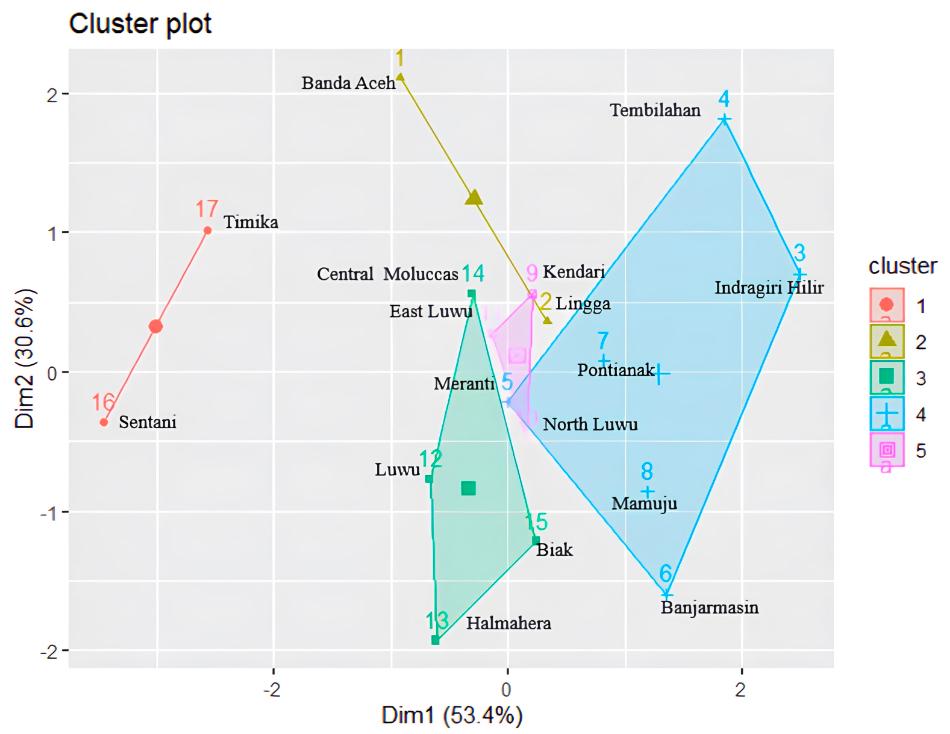
Indonesia has the most sago plantations in the world, which means that sago can be used for a wide range of things, including food, animal feed, fuel, fiber, and fertilizer. However, Indonesian sago starch can’t be used more widely in either domestic or international markets because there isn’t enough information about its chemical composition and contaminant levels. This study examines the chemical composition and heavy metal levels of sago starch from various regions of Indonesia. The results show that the chemical properties of sago starch vary from province to province. For example, the carbohydrate content ranges from 84.26% to 94.93%, while the fat and protein content are relatively low. There are also reports of differences in the amounts of amylose and amylopectin. The levels of heavy metals are very low and meet international safety standards, which means that Indonesian sago starch is safe to eat. Sago starch from Indragiri Hilir, Banjarmasin, and Lingga exhibits chemical properties similar to those from Meranti, Indonesia’s primary sago-producing region, suggesting their potential as alternative sources. The appropriate amounts of amylose and amylopectin in these areas make it suitable for food products that require very high flexibility. These results support improving the use of sago starch and help raise the quality and safety standards for Indonesian sago products.
References
AOAC (1995). Official Methods of Analysis of AOAC International. AOAC International, 16 edition
Azman, W. M. F. B. W., R. Shamsudin, M. Z. M. Nor, and A. Hamzah (2021). Evaluation and Optimization of Disc Grating Machine for Sago Starch Production (Metroxylon spp.). Advances in Agricultural and Food Research Journal, 2(2); 1–12
Baasandorj, T., J. B. Ohm, and S. Simsek (2021). Physicochemical and Bread-Making Characteristics of Millstreams Obtained from an Experimental Long-Flow Mill in Hard Red Spring Wheat. Cereal Chemistry, 98(3); 517–531
Budiyanto, A., M. Hadipernata, M. Ainuri, W. Supartono, A. Arif, and T. Sulistiyani (2023). Variations of Washing Agent on The Physicochemical And Microbiology Properties of Sago Starch. In IOP Conference Series: Earth and Environmental Science, volume 1246. IOP Publishing, page 012049
Bunyasetthakun, T., Q. Huang, K. Sureepisan, M. Suphantharika, N. Tangsrianugul, and R. Wongsagonsup (2020). Effects of Dual Pullulanase-Debranching and Temperature-Cycling Treatments on Physicochemical Properties and In Vitro Digestibility of Sago Starch and Its Application in Chinese Steamed Buns. Starch/Stärke, 72(9–10)
Burakorn, J., P. Pinthong, M. Aimkaew, P. Tongbai, and K. Srithai (2024). The Effect of Glucose Syrup on Rheological Properties of Sago Starch. Trends in Sciences, 21(3); 7253–7253
Cammerata, A., R. Marabottini, E. Allevato, G. Aureli, and S. R. Stazi (2021). Content of Minerals and Deoxynivalenol in the Air-Classified Fractions of Durum Wheat. Cereal Chemistry, 98(5); 1101–1111
Chua, S. N. D., E. P. Kho, S. F. Lim, and M. H. Hussain (2022). Sago Palm (Metroxylon sagu) Starch Yield, Influencing Factors and Estimation from Morphological Traits. Advances in Materials and Processing Technologies, 8(2); 1845–1866
Cipto and D. Parenden (2022). Sago Extraction Machine Design. MATEC Web of Conferences, 372; 01002
de Almeida, C. C., D. d. S. Baião, P. d. A. Rodrigues, T. D. Saint’Pierre, R. A. Hauser-Davis, K. C. Leandro, V. M. F. Paschoalin, M. P. da Costa, and C. A. Conte-Junior (2022). Toxic Metals and Metalloids in Infant Formulas Marketed in Brazil, and Child Health Risks According to the Target Hazard Quotients and Target Cancer Risk. International Journal of Environmental Research and Public Health, 19(18); 11178
Devi, K., P. Vijayalakshmi, V. Shilpa, and B. Kumar (2015). Optimization of Cultural Parameters for Cost Effective Production of Kojic Acid by Fungal Species Isolated from Soil. British Microbiology Research Journal, 7(5); 255–268
Dewayani, W., Suryani, R. Arum, and E. Septianti (2022). Potential of Sago Products Supporting Local Food Security in South Sulawesi. In IOP Conference Series: Earth and Environmental Science, volume 974. IOP Publishing, page 012114
Du, C., F. Jiang, W. Jiang, W. Ge, and S. K. Du (2020). Physicochemical and Structural Properties of Sago Starch. International Journal of Biological Macromolecules, 164; 1785–1793
Ehara, H., Y. Toyoda, and D. V. Johnson (2018). Sago Palm: Multiple Contributions to Food Security and Sustainable Livelihoods. Springer
Everitt, B. and T. Hothorn (2011). An Introduction to Applied Multivariate Analysis with R. Springer Science & Business Media
Fadhallah, E. G., S. E. R. Rinjani, A. K. S. Anantasya, A. Pranata, R. Triharto, and A. H. Dameswary (2023). Potency of Betacyanin from Beetroot (Beta vulgaris) Peel Waste as Chicken Meat Freshness Indicator in Sago Starch-Based Biodegradable Smart Packaging. MOJ Ecology & Environmental Sciences, 8(5); 186–190
Genchi, G., M. S. Sinicropi, G. Lauria, A. Carocci, and A. Catalano (2020). The Effects of Cadmium Toxicity. International Journal of Environmental Research and Public Health, 17(11); 3782
Grace, N. C. and C. Jeyakumar Henry (2020). The Physicochemical Characterization of Unconventional Starches and Flours Used in Asia. Foods, 9(2); 182
Hammado, N., S. Utomo, and Budiyono (2020). Characteristic Lignocellulose of Sago Solid Waste for Biogas Production. Journal of Applied Engineering Science, 18(2); 157–164
Horstmann, S. W., K. M. Lynch, and E. K. Arendt (2017). Starch Characteristics Linked to Gluten-Free Products. Foods, 6(4); 29
Hu, A., Y. Liu, and S. Wu (2024). A Review on Polysaccharide-Based Jelly: Gell Food. Food Chemistry: X, 23; 101562
Ismail, H. and N. F. Zaaba (2014). Effect of Unmodified and Modified Sago Starch on Properties of (Sago Starch)/Silica/PVA Plastic Films. Journal of Vinyl and Additive Technology, 20(3); 185–192
ISO-1666 (1996). Starch – Determination of Moisture Content – Oven-Drying Method
Jading, A., N. Bintoro, L. Sutiarso, and J. N. W. Karyadi (2017). Artificial Neural Network-Based Modelling and Optimization to Estimate the Fineness Modulus of the Drying Process of Sago Starch Using a Pneumatic Conveying Recirculated Dryer. International Journal of Engineering and Technology, 9(4); 3281–3291
Jahiding, M., M. Mashuni, F. H. Hamid, W. O. S. Ilmawati, and R. Hamdana (2024). The Production of Renewable Fuels Sago Dregs and Low-Density Polyethylene by Pyrolysis and Its Characterization. Science and Technology Indonesia, 9(3); 565–576
Kamal, M. M., R. Baini, S. Lim, M. Rahman, S. Mohamaddan, and H. Hussain (2019). Drying Effect on the Properties of Traditionally Processed Sago Starch. International Food Research Journal, 26(6); 1861–1869
Kusumawati, R., Syamdidi, A. H. D. Abdullah, R. C. Nissa, B. Firdiana, R. Handayani, I. Munifah, F. R. Dewi, J. Basmal, and S. Wibowo (2025). Physical Properties of Biodegradable Chitosan-Cassava Starch Based Bioplastic Film Mechanics. Science and Technology Indonesia, 10(1); 191–200
Lee, J.-S., J. H. Akanda, S. L. Fong, C. K. Siew, and A. L. Ho (2022). Effects of Annealing on the Properties of Gamma-Irradiated Sago Starch. Molecules, 27(15); 4838
Lin, S.-D. (2025). Effects of Processing and Cooking on Physicochemical, Sensory, and Functional Properties of Food.
Litaay, C., A. Indriati, N. K. I. Mayasti, R. I. Tribowo, Y. Andriana, R. C. E. Andriansyah, and Others (2022). Physical, Chemical, and Sensory Quality of Noodles Fortification with Anchovy (Stolephorus sp.) Flour. Food Science and Technology, 42; e75421
Marhamah, S. Surono, and E. Darmawan (2023). The Risk Cluster in Type 2 Diabetes Mellitus Based on Risk Parameters Using Fuzzy C-Means Algorithm. Science and Technology Indonesia, 8(1); 17–24
Miao, M., B. Jiang, S. W. Cui, T. Zhang, and Z. Jin (2015). Slowly Digestible Starch-A Review. Critical Reviews in Food Science and Nutrition, 55(12); 1642–1657
Nasir, N. M., E. Abdulmalek, and N. Zainuddin (2020). Preparation and Optimization of Water-Soluble Cationic Sago Starch with a High Degree of Substitution Using Response Surface Methodology. Polymers, 12(11); 1–13
Ng, J. Q., C. K. Siew, H. Mamat, P. Matanjun, and J. S. Lee (2018). Effect of Acid Methanol Treatment and Heat Moisture Treatment on In Vitro Digestibility and Estimated Glycemic Index of Raw and Gelatinized Sago (Metroxylon sagu) Starch. Starch/Stärke, 70(9–10)
Novianti, F., N. Mayasti, A. Indriati, C. Litaay, R. Andriansyah, E. Br Ketaren, and T. Widiantara (2024). Techno-Economic Analysis of Dry Noodle Products Based on Sago Flour Enriched with Anchovy Flour. In IOP Conference Series: Earth and Environmental Science, volume 1338. IOP Publishing, page 012068
Oliveira, D. C. d., H. A. Maieves, C. Bernardo, I. C. Bellettini, B. B. Remor, R. Moresco, et al. (2020). Evaluation of Cassava Starch as Raw Material According to the Characteristics of the Granules. Research, Society and Development, 9(12); e8491210879
Pandiangan, F. I. and K. A. Audah (2022). Heavy Metal Contamination Status in the Soil-Water-Rice System near Coal-Fired Power Plants in Cilacap, Indonesia. Jurnal Ilmiah Pertanian, 19(3); 145–154
Paramitasari, D., M. Musa, O. N. Putra, S. Suparman, Y. S. Pramana, S. Elisa, T. Hidayat, A. E. Tjahjono, D. P. Meidiawati, and K. Pudjianto (2024). Hydroxypropylation for Functional Enhancement of Sago Starch: The Effects of Low Propylene Oxide Concentration Using Response Surface Methodology. Journal of Agriculture and Food Research, 15; 100933
Pinyo, J., P. Luangpituksa, M. Suphantharika, C. Hansawasdi, and R. Wongsagonsup (2017). Improvement of Sago Starch Extraction Process Using Various Pretreatment Techniques and Their Pretreatment Combination. Starch/Stärke, 69(9–10)
Pratiwi, W. S. W., A. K. Anal, and S. R. Putra (2015). Production by Lintnerization-Autoclaving and Physicochemical Characterization of Resistant Starch III from Sago Palm (Metroxylon sagu Rottb). Indonesian Journal of Chemistry, 15(3); 295–304
Punia Bangar, S., K. Sunooj, M. Navaf, Y. Phimolsiripol, and W. S. Whiteside (2024). Recent Advancements in Cross-Linked Starches for Food Applications-A Review. International Journal of Food Properties, 27(1); 411–430
Puspantari, W., P. T. Cahyana, A. Saepudin, Budiyanto, I. Kurniasari, A. D. Kusumasmarawati, et al. (2023). Sago Rice as an Environmentally Sustainable Food. In BIO Web of Conferences, volume 69. EDP Sciences, page 03012
R Development Core Team (2011). R: A Language and Environment for Statistical Computing. R Foundation for Statistical Computing, Vienna, Austria
Rickard, J. E., M. Asaoka, and J. M. V. Blanshard (1991). The Physicochemical Properties of Cassava Starch. Tropical Science, 31; 189–207
Romero-Rosales, M., H. E. Romero-Luna, D. Cantú-Lozano, I. Andrade-González, and G. Luna-Solano (2025). Functionality and Modifications of Food Hydrocolloids: An Approach to Starch. Starch-Stärke, 77(9); e70083
Sabirin, A. B. Sitanggang, S. Budijanto, M. B. Kusarpoko, A. Darussalam, A. S. Purwoto, and Y. S. Pramana (2024). Characteristics of Partially Pregelatinized Sago Starch from Bangka, Riau, and Papua Extruded Using Twin-Screw Extruder. Journal of Food Measurement and Characterization, 18(5); 3793–3805
Santos, T. B. d., C. W. P. d. Carvalho, L. A. d. Oliveira, E. J. d. Oliveira, F. Villas-Boas, C. M. L. Franco, and D. W. H. Chávez (2021). Functionality of Cassava Genotypes for Waxy Starch. Pesquisa Agropecuária Brasileira, 56; e02414
Sarungallo, Z. L., B. Santoso, and A. M. Puspita (2021). Physicochemical and Functional Properties of Spineless, Short-Spines, and Long-Spines Sago Starch. Biodiversitas, 22(1); 137–143
Seet Chi, Y., H. Kamilah, Y. Nor Shariffa, and U. Utra (2021). Phosphorylation of Sago (Metroxylon sagu) Starch Cross-Linked with Sodium Triphosphate and the Physicochemical Properties of the Potential Application in Batter. Journal of Food Processing and Preservation, 45(6); e15491
Setiawan, B., F. Fetriyuna, S. M. A. Letsoin, R. C. Purwestri, and I. R. A. Jati (2022). A Sago Positive Character: A Literature Review. A Sago Positive Character: A Literature Review, 11(2); 145–155
Siau, C. L., A. A. Karim, M. H. Norziah, and W. D. Wan Rosli (2004). Effects of Cationization on DSC Thermal Profiles, Pasting and Emulsifying Properties of Sago Starch. Journal of the Science of Food and Agriculture, 84(13); 1722–1730
Simatupang, D. F. and M. Simbolon (2023). Fabrication of Biobriquettes from Mixture of Palm Fronds and Palm Shells with Varying Binders of Tapioca and Sago Flour. International Journal of Applied Research and Sustainable Sciences, 1(4); 319–330
SNI-3729 (2008). Sago Starch. National Standardization Agency
SNI-3729 (2023). Sago Starch. National Standardization Agency
Sondari, D. and I. Iltizam (2018). Karakteristik Edible Coating dari Modifikasi Pati Sagu Dengan Metoda Cross Link. Jurnal Teknologi Industri Pertanian, 28(3); 286–294
Statistik-Perkebunan (2023). Statistik Perkebunan Jilid I (2022–2024)
Steinley, D. (2008). Stability Analysis in K-Means Clustering. British Journal of Mathematical and Statistical Psychology, 61(2); 255–273
Sulaiman, T. N. S., W. Wahyuono, A. N. Bestari, and F. N. Aziza (2023). Preparation and Characterization of Pregelatinized Sago Starch (PSS) from Native Sago Starch (NSS) (Metroxylon sp.) and Its Evaluation as Tablet Disintegrant and Filler-Binder on Direct Compression Tablet. Indonesian Journal of Pharmacy, 33(2)
Sumardiono, S., B. Jos, I. Pudjihastuti, A. M. Yafiz, M. Rachmasari, and H. Cahyono (2021). Physicochemical Properties of Sago Ozone Oxidation: The Effect of Reaction Time, Acidity, and Concentration of Starch. Foods, 10(6); 1309
Susanto, B., Y. T. Tosuli, H. Nami, A. Surjosatyo, D. Alandro, A. D. Nugroho, M. I. Rashyid, and M. A. Muflikhun (2024). Characterization of Sago Tree Parts from Sentani, Papua, Indonesia for Biomass Energy Utilization. Heliyon, 10(1)
Tabari, M. (2017). Effect of Carboxymethyl Cellulose on the Mechanical and Barrier Properties of Sago Starch Based Films. academia. edu, 1; 1–7
Tchounwou, P. B., C. G. Yedjou, A. K. Patlolla, and D. J. Sutton (2012). Heavy Metal Toxicity and the Environment. Molecular, Clinical and Environmental Toxicology, 101; 133–164
Trisia, M. A., M. Tachikawa, and H. Ehara (2021). The Role of the Sago Supply Chain for Rural Development in Indonesia. Reviews in Agricultural Science, 9; 143–156
Uthumporn, U., N. Wahidah, and A. Karim (2014). Physicochemical Properties of Starch from Sago (Metroxylon sagu) Palm Grown in Mineral Soil at Different Growth Stages. In IOP Conference Series: Materials Science and Engineering, volume 62. page 012026
Wardono, H. P., A. Agus, A. Astuti, N. Ngadiyono, and B. Suhartanto (2021). Potential of Sago Hampas for Ruminants Feed. In E3S Web of Conferences, volume 306. EDP Sciences, page 05012
Yadav, R. and G. Garg (2013). A Review on Indian Sago Starch And Its Pharmacuetical Applications. International Journal of Pharmaceutical and Life Sciences, 2(3); 99–106
Yusuf, M., M. Romli, Suprihatin, and E. Wiloso (2019). Potential of Traditional Sago Starch: Life Cycle Assessment (LCA) Perspective. In IOP Conference Series: Materials Science and Engineering, volume 507. IOP Publishing, page 012014
Zailani, M. A., H. Kamilah, A. Husaini, A. Z. R. A. Seruji, and S. R. Sarbini (2023). The Digestibility and Bacterial Growth Rates of Microwave Treated Sago (Metroxylon sagu) Starch. Pertanika Journal of Science and Technology, 31(5); 2283–2290
Zhang, W., R. He, Z. Yu, G. Zhao, H. Zhang, C. Hou, and L. Yang (2024). Preparation Conditions Optimization and Functional Characteristics Investigation of Cationic-Acetylated Glutinous Rice Starch. Lwt, 201; 116239
Authors

This work is licensed under a Creative Commons Attribution 4.0 International License.