
Shearing Stress-Induced Lipid Accumulation in Chlorella Cultivated in CO₂-Enriched Medium Modified with NaOH
Article Sidebar
-
Chlorella, Fatty Acid, Lipid Accumulation, Shear Stress
Abstract
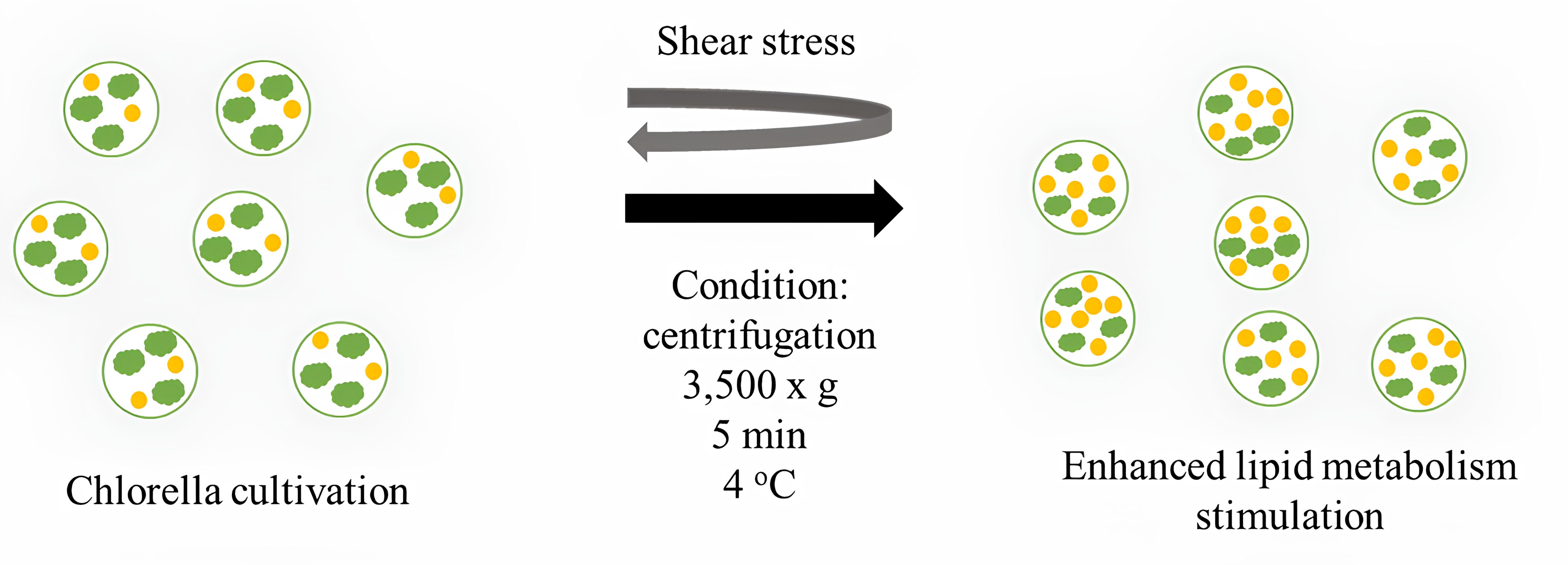
Chlorella can produce MUFA and PUFA, such as linolenic acid, with an ideal ω-3: ω-6 ratio content (1:1). This study investigates the effects of centrifugation-induced shear stress on lipid metabolism and fatty acid composition in Chlorella sorokiniana and Chlorella vulgaris cultivated in CO2-enriched TAP medium modified with NaOH as an inorganic carbon source. Shear stress was applied during the exponential growth phase to assess its influence on biomass productivity, biochemical composition, and lipid accumulation under nutrient-rich (P1) and nutrient-deficient (P2) conditions. Results revealed that C. sorokiniana showed superior adaptability to shear stress compared to C. vulgaris, showing a 64.7% increase in lipid content and maintaining higher unsaturated fatty acid (UFA) proportions, particularly polyunsaturated fatty acids (PUFAs). In contrast, nutrient deprivation in P2 promoted saturated fatty acid (SFA) accumulation as an energy storage adaptation. Biomass recovery in P1 indicated the need for nutrient availability in sustaining growth following mechanical treatments. The fatty acid profile of C. sorokiniana was dominated by UFA (67.2%), including ω-3 and ω-6 PUFAs, whereas C. vulgaris showed a higher SFA (42.2%). These findings suggest that moderate shear stress can stimulate lipid biosynthesis and improve the nutritional quality of microalgal lipids without compromising cell viability, provided sufficient nutrients are available. The combination of shear stress induction and optimized nutrient management offers a promising strategy to enhance microalgal lipid production for functional food and nutraceutical applications.
References
Anam, K. and R. P. Sadewo (2023). Biomass Production of Green Microalgae Chlorella vulgaris Through CO2 Sequestration. In AIP Conference Proceedings. pages 1–6
Barten, R., Y. Djohan,W. Evers, R.Wijffels, and M. Barbosa (2021). Towards Industrial Production of MicroalgaeWithout Temperature Control: The Effect of Diel Temperature Fluctuations on Microalgal Physiology. Journal of Biotechnology, 336; 56–63
Bonnefond, H., G. Grimaud, J. Rumin, G. Bougaran, A. Telec, M. Gachelin, M. Boutoute, E. Pruvost, O. Bernard, and A. Sciandra (2017). Continuous Selection Pressure to Improve Temperature Acclimation of Tisochrysis lutea. PLoS ONE, 12(9); e0183547
Cao, Y., X. Xu, S. Zhi, K. Phyu, H. Wang, J. Liu, C.-C. Chang, and K. Zhang (2025). Microalgal-Bacterial System Responses to Nitrogen Forms in Dairy Farm Wastewater: Focusing on the Phycosphere and Nitrogen Transformation. Environmental Research, 276; 121451
Chen, H. and Q. Wang (2021). Regulatory Mechanisms of Lipid Biosynthesis in Microalgae. Biological Reviews, 96(5); 2373–2391
Chen, J. and H. Liu (2020). Nutritional Indices for Assessing Fatty Acids: A Mini-Review. International Journal ofMolecular Sciences, 21(16); 5695
Czumaj, A. and T. Śledziński (2020). Biological Role of Unsaturated Fatty Acid Desaturases in Health and Disease. Nutrients, 12(2); 356
Ding, N., C. Li, T.Wang, M. Guo, A. Mohsin, and S. Zhang (2021). Evaluation of an Enclosed Air-Lift Photobioreactor (ALPBR) for Biomass and Lipid Biosynthesis of Microalgal Cells Grown Under Fluid-Induced Shear Stress. Biotechnology and Biotechnological Equipment, 35(1); 139–149
Dohan Ehrenfest, D. M., N. R. Pinto, A. Pereda, P. Jiménez, M. D. Corso, B.-S. Kang, M. Nally, N. Lanata, H.-L.Wang, and M. Quirynen (2018). The Impact of the Centrifuge Characteristics and Centrifugation Protocols on the Cells, Growth Factors, and Fibrin Architecture of a Leukocyte-and Platelet-Rich Fibrin (L-PRF) Clot and Membrane. Platelets, 29(2); 171–184
Forghani, B., J. J. Mayers, E. Albers, and I. Undeland (2022). Cultivation of Microalgae Chlorella sorokiniana and Auxenochlorella protothecoides in Shrimp Boiling Water Residue. Algal Research, 65; 102753
Kapoor, B., D. Kapoor, S. Gautam, R. Singh, and S. Bhardwaj (2021). Dietary Polyunsaturated Fatty Acids (PUFAs): Uses and Potential Health Benefits. Current Nutrition Reports, 10(3); 232–242
Kim, E. J., S. Kim, H. G. Choi, and S. J. Han (2020). Co-Production of Biodiesel and Bioethanol Using Psychrophilic Microalga Chlamydomonas sp. KNM0029C Isolated from Arctic Sea Ice. Biotechnology for Biofuels, 13(1); 1–13
Li, J., C. Li, C. Q. Lan, and D. Liao (2018). Effects of Sodium Bicarbonate on Cell Growth, Lipid Accumulation, and Morphology of Chlorella vulgaris. Microbial Cell Factories, 17(1); 1–10
Liu, Y., X. Ren, C. Fan, W. Wu, W. Zhang, and Y. Wang (2022). Health Benefits, Food Applications, and Sustainability of Microalgae-Derived N-3 PUFA. Foods, 11(13); 1883
Lorenzo, K., G. Santocildes, J. R. Torrella, J. Magalhães, T. Pagès, G. Viscor, J. L. Torres, and S. Ramos-Romero (2023). Bioactivity of Macronutrients from Chlorella in Physical Exercise. Nutrients, 15(9); 2168
Mitra, M., K. M.-A.-K. Nguyen, T.W. Box, T. L. Berry, and M. Fujita (2021). Isolation and Characterization of a Heavy Metal- and Antibiotic-Tolerant Novel Bacterial Strain from a Contaminated Culture Plate of Chlamydomonas reinhardtii, a Green Micro-Alga. F1000Research, 10; 533
Mohadi, R., Z. Hanafiah, H. Hermansyah, and H. Zulkifli (2017). Adsorption of Procion Red and Congo Red Dyes Using Microalgae Spirulina sp. Science and Technology Indonesia, 2(4); 102–104
Molina-Miras, A., L. López-Rosales, M. C. Cerón-García, A. Sánchez-Mirón, F. García-Camacho, A. Contreras-Gómez, and E. Molina-Grima (2019). A New Approach to Finding Optimal Centrifugation Conditions for Shear-Sensitive Microalgae. Algal Research, 44; 101677
Montone, C. M., A. L. Capriotti, C. Cavaliere, G. La Barbera, S. Piovesana, R. Zenezini Chiozzi, and A. Laganà (2018). Peptidomic Strategy for Purification and Identification of Potential ACE-Inhibitory and Antioxidant Peptides in Tetradesmus obliquus Microalgae. Analytical and Bioanalytical Chemistry, 410(15); 3573–3586
Mtaki, K., M. S. Kyewalyanga, and M. S. P. Mtolera (2021). SupplementingWastewater with NPK Fertilizer as a Cheap Source of Nutrients in Cultivating Live Food (Chlorella vulgaris). Annals of Microbiology, 71(1); 1–10
Murata, N., H.Wada, and Z. Gombos (1992). Modes of Fatty-Acid Desaturation in Cyanobacteria. Plant and Cell Physiology, 33; 933–941
Nguyen, N. K. Q., X. T. Bui, T. S. Dao, M. D. T. Pham, H. H. Ngo, C. Lin, K. Y. A. Lin, P. D. Nguyen, K. P. H. Huynh, T. K. Q. Vo, V. T. Tra, and T. S. Le (2024). Influence of Hydrodynamic Shear Stress on Activated Algae Granulation Process forWastewater Treatment. Environmental Technology and Innovation, 33; 103494
Nunes, E., K. Odenthal, N. Nunes, T. Fernandes, I. A. Fernandes, and M. A. P. de Carvalho (2024). Protein Extracts from Microalgae and Cyanobacteria Biomass. Techno-Functional Properties and Bioactivity: A Review. Algal Research, 82; 103638
Okabe, Y., Y. Tsujimoto-Inui, S. Maruyama, K. Tsuneizumi, T. Takeshita, M. Sato, K. Toyooka, T. Abe, and S. Matsunaga (2026). Heavy-Ion Beam-Induced Mutants of Medakamo hakoo Indicate Potential Associations Between Photosynthesis and Cell Size, Cell Cycle, and Cell Wall Morphology. Journal of Plant Research, 139; 119–132
Padhi, D., N. Das, R. Dineshkumar, A. Guldhe, and M. Nayak (2025). Enhanced Carbon Dioxide Biofixation and Lipid Production of Chlorella sp. Using Alkali Absorber and Strategic Carbon Dioxide Supply. BioEnergy Research, 18(1); 1–14
Paik, S. M., E. S. Jin, S. J. Sim, and N. L. Jeon (2018). Vibration-Induced Stress Priming During Seed Culture Increases Microalgal Biomass in High Shear Field-Cultivation. Bioresource Technology, 254; 340–346
Pandur, Ž., I. Dogsa, M. Dular, and D. Stopar (2020). Liposome Destruction by Hydrodynamic Cavitation in Comparison to Chemical, Physical and Mechanical Treatments. Ultrasonics Sonochemistry, 61; 104826
Papapanagiotou, G., A. Charisis, C. Samara, E. P. Kalogianni, and C. Chatzidoukas (2024). Linking Cultivation Conditions to the Fatty Acid Profile and Nutritional Value of Chlorella sorokiniana Lipids. Processes, 12(12); 2770
Qu, D. and X. Miao (2021). Carbon Flow Conversion Induces Alkali Resistance and Lipid Accumulation Under Alkaline Conditions Based on Transcriptome Analysis in Chlorella sp. BLD. Chemosphere, 265; 129046
Quilodrán, B., G. Cortinez, A. Bravo, and D. Silva (2020). Characterization and Comparison of Lipid and PUFA Production by Native Thraustochytrid Strains Using Complex Carbon Sources. Heliyon, 6(11); e05404
Remize, M., Y. Brunel, J. L. Silva, J. Y. Berthon, and E. Filaire (2021). Microalgae n-3 PUFAs Production and Use in Food and Feed Industries. Marine Drugs, 19(2); 113
Sadewo, R. P., N. Hidhayati, L. Ambarsari, and K. Anam (2022). CO2 Sequestration Using Sodium Hydroxide and Its Utilization for Chlorella sorokiniana Biomass Production. Biosaintifika, 14(3); 391–399
Saini, R. K., P. Prasad, R. V. Sreedhar, K. A. Naidu, X. Shang, and Y. S. Keum (2021). Omega-3 Polyunsaturated Fatty Acids (PUFAs): Emerging Plant and Microbial Sources, Oxidative Stability, Bioavailability, and Health Benefits—A Review. Antioxidants, 10(10); 1627
Sierra, L. S., C. K. Dixon, and L. R.Wilken (2017). Enzymatic Cell Disruption of the Microalgae Chlamydomonas reinhardtii for Lipid and Protein Extraction. Algal Research, 25; 149–159
Song, Y., F.Wang, L. Chen, andW. Zhang (2024). Engineering Fatty Acid Biosynthesis in Microalgae: Recent Progress and Perspectives. Marine Drugs, 22(5); 216
Vijay, A. P., K. Chakraborty, and S. K. Pai (2025). Nutritional Profiling of Chlorella salina, Dunaliella salina, and Arthrospira platensis as Sustainable Functional Foods for Human Nutrition. Journal of Food Measurement and Characterization, 19(7); 4769–4782
Wang, C. and C. Q. Lan (2018). Effects of Shear Stress on Microalgae—A Review. Biotechnology Advances, 36(4); 986–1002
Yaakob, M. A., R. M. S. R. Mohamed, A. Al-Gheethi, G. A. Ravishankar, and R. R. Ambati (2021). Influence of Nitrogen and Phosphorus on Microalgal Growth, Biomass, Lipid, and Fatty Acid Production: An Overview. Cells, 10(2); 393
Yan, C.-x., S. Zhang, L.-w. Xu, H. Gao, Z.-x. Zhang,W. Ma, and X.-m. Sun (2025). Advances in Multi-Omics Technologies for Identifying Metabolic Engineering Targets and Improving Lipid Production in Microalgae. Bioresource Technology, 429; 132501
Yang, W., S. Li, M. Qv, D. Dai, D. Liu, W. Wang, C. Tang, and L. Zhu (2022). Microalgal Cultivation for the Upgraded Biogas by Removing CO2, Coupled with the Treatment of Slurry from Anaerobic Digestion: A Review. Bioresource Technology, 364; 128118
Yu, B. S., Y. J. Sung, M. E. Hong, and S. J. Sim (2021). Improvement of Photoautotrophic Algal Biomass Production After Interrupted CO2 Supply by Urea and KH2PO4 Injection. Energies, 14(3); 778
Yun, H. S., Y. S. Kim, and H. S. Yoon (2020). Characterization of Chlorella sorokiniana and Chlorella vulgaris Fatty Acid Components Under a Wide Range of Light Intensity and Growth Temperature for Their Use as Biological Resources. Heliyon, 6(7); e04447
Zhang, P., Q. Sun, Y. Dong, and S. Lian (2023). Effects of Different Bicarbonate on Spirulina in CO2 Absorption and Microalgae Conversion Hybrid System. Frontiers in Bioengineering and Biotechnology, 10; 1119111
Zhihrotulwida, D., W. Soeratri, T. Erawati, and N. Rosita (2025). Stability and Antiaging Effectiveness Studies of Astaxanthin-Loaded Nanostructured Lipid Carriers Using a Combination of Cetyl Palmitate and Soybean Oil. Science and Technology Indonesia, 10(2); 473–481
Authors

This work is licensed under a Creative Commons Attribution 4.0 International License.