
Modeling and Forecasting of Sulfur Dioxide (SO₂) Emissions in Several ASEAN Countries (Using State Space Multivariate Time Series Analysis)
Article Sidebar
-
Sulfur Dioxide (SO2) Emissions, Air Pollution, VAR Model, State Space Model, Forecasting
Abstract
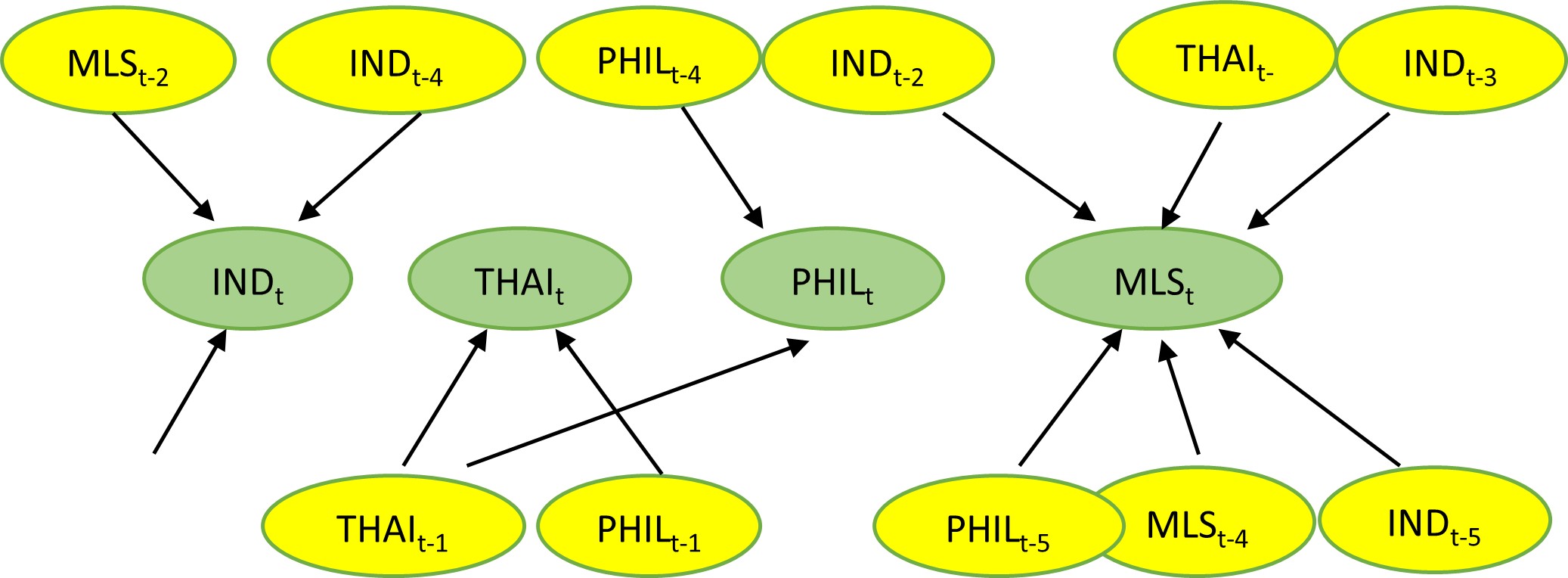
Sulfur dioxide (SO2) emissions (ton/year) produced from coal combustion, household heating, motor vehicles, and volcanic eruptions, has been considered as a dangerous air pollutant that causes many respiratory diseases and increases the mortality rate. Many studies have been conducted generally in developed countries and industrialized countries that are aware of the adverse effects of increasing SO2 emissions in the air. Many studies have been conducted to measure the level of air pollution caused by SO2 emissions and research on the relationship of SO2 emissions with public health and mortality rates. The problem in this study is how to build the best State Space Multivariate Time Series model for SO2 emissions data in several ASEAN countries, Indonesia, Thailand, Philippines and Malaysia. This study aims to build the best State Space Multivariate Time Series model that fits the data and uses the best state space model for forecasting SO2 emissions for the next few years. The analysis method that will be used is State Space Multivariate Time Series Analysis (Autoregressive Vector modeling, and State Space Model). The results show that SO2 emissions in Indonesia are significantly influenced by emission conditions in Indonesia four years earlier and SO2 emissions in Malaysia two and four years earlier; SO2 emissions in Thailand are significantly influenced by SO2 emission conditions in Thailand and the Philippines one year prior; SO2 emissions in the Philippines are significantly influenced by SO2 emission conditions in Thailand one years prior and SO2 emission conditions in the Philippines four years prior; SO2 emissions in Malaysia are significantly influenced by SO2 emissions conditions in Indonesia two, three, and five years prior, SO2 emissions conditions in Malaysia four years prior, SO2 emissions conditions in Thailand and Philippines five years prior. Forecasting results using the state space model indicate a downward trend in SO2 emissions in Indonesia, Thailand, the Philippines, and Malaysia over the next ten years.
References
Akaike, H. (1976). Canonical Correlation Analysis of Time Series and the Use of an Information Criterion. In R. K. Mehra and D. G. Lainiotis, editors, Systems Identification: Advances and Case Studies. Academic Press, New York
Bell, M. L., J. M. Samet, and F. Dominici (2004). Time-Series Studies of Particulate Matter. Annual Review of Public Health, 25; 247–280
Castelli, M., F. M. Clemente, A. Popovič, S. Silva, and L. Vanneschi (2020). A Machine Learning Approach to Predict Air Quality in California. Complexity, 2020; 8049504
Chang, C., G. Li, S. Zhang, and K. Yu (2019). Employing a Fuzzy-Based Grey Modeling Procedure to Forecast China’s Sulfur Dioxide Emissions. International Journal of Environmental Research and Public Health, 16; 2504
Chen, J. and M. Gao (2021). Prediction Method of Sulfur Dioxide Emission. IEEE Access, PP; 1–1
Craig, K. (2019). A Review of the Chemistry, Pesticide Use, and Environmental Fate of Sulfur Dioxide, as Used in California. Reviews of Environmental Contamination and Toxicology, 246; 33–64
Darynova, Z., M. Amouei Torkmahalleh, T. Abdrakhmanov, S. Sabyrzhan, S. Sagynov, P. K.Hopke, and J. Kushta (2020). SO2 and HCHO Over the Major Cities of Kazakhstan from 2005 to 2016: Influence of Political, Economic and Industrial Changes. Scientific Reports, 10(1); 12635
Djordjevic, P., D. Nikolic, I. Jovanovic, I. Mihajlovic, M. Savic, and Z. Zivkovic (2013). Episodes of Extremely High Concentrations of SO2 and Particulate Matter in the Urban Environment of Bor, Serbia. Environmental Research, 126; 204–207
Fisher, J. A., D. J. Jacob, Q.Wang, R. Bahreini, C. C. Carouge, M. J. Cubison, J. E. Dibb, T. Diehl, J. L. Jimenez, E. M. Leibensperger, Z. Lu, M. B. Meinders, H. O. Pye, P. K. Quinn, S. Sharma, D. G. Streets, A. van Donkelaar, and R. M. Yantosca (2011). Sources, Distribution, and Acidity of Sulfate–Ammonium Aerosol in the Arctic inWinter–Spring. Atmospheric Environment, 45; 7301–7318
Francis, T., M. M. Sarin, and R. Rengarajan (2016). Atmospheric SO2 Oxidation Efficiency Over a Semi-Arid Region: Seasonal Patterns from Observations and GEOS-Chem Model. Atmospheric Environment, 125; 383–395
Gomez, V. (2016). Multivariate Time Series with Linear State Space Structure. Springer, New York
Hamilton, H. (1994). Time Series Analysis. Princeton University Press, Princeton, New Jersey
Heng, Y., L. Hoffmann, S. G. Griessbach, T. Rössler, and O. Stein (2016). Inverse Transport Modeling of Volcanic Sulfur Dioxide Emissions Using Large-Scale Simulations. Geoscientific Model Development, 9; 1627–1645
Jenner, S. and B. J. Abiodun (2013). The Transport of Atmospheric Sulfur Over Cape Town. Atmospheric Environment, 79; 248–260
Kelly, F. J. and J. C. Fussell (2015). Air Pollution and Public Health: Emerging Hazards and Improved Understanding of Risk. Environmental Geochemistry and Health, 37; 631–649
Lelieveld, J., J. S. Evans, M. Fnais, D. Giannadaki, and A. Pozzer (2015). The Contribution of Outdoor Air Pollution Sources to Premature Mortality on a Global Scale. Nature, 525(7569); 367–371
Li, Z., Y.Wang, Z. Xu, and Y. Cao (2021). Characteristics and Sources of Atmospheric Pollutants in Typical Inland Cities in Arid Regions of Central Asia: A Case Study of Urumqi City. PLoS ONE, 16(4); e0249563
Lim, S. S., T. Vos, A. D. Flaxman, G. Danaei, K. Shibuya, H. Adair-Rohani, and P. M. Pelizzari (2012). A Comparative Risk Assessment of Burden of Disease and Injury Attributable to 67 Risk Factors and Risk Factor Clusters in 21 Regions, 1990–2010: A Systematic Analysis for the Global Burden of Disease Study 2010. The Lancet, 380(9859); 2224–2260
McLinden, C. A., V. E. Fioletov, M. W. Shephard, N. A. Krotkov, C. Li, R. V. Martin, M. D. Moran, and J. Joiner (2016). Space-Based Detection of Missing Sulfur Dioxide Sources of Global Air Pollution. Nature Geoscience, 9; 496–500
Moolgavkar, S. H., R. O. McClellan, A. Dewanji, J. Turim, E. G. Luebeck, and M. Edwards (2012). Time-Series Analyses of Air Pollution and Mortality in the United States: A Subsampling Approach. Environmental Health Perspectives, 121; 73–78
Nairobi, A., E. Russel, S. Paujiah, D. N. Pratama,Wamiliana, and M. Usman (2022). Analysis ofData Inflation Energy and Gasoline Price by Vector AutoregressiveModel. International Journal of Energy Economics and Policy, 12(2); 120–126
Nieto, P. J., E. F. Combarro, J. J. Díaz, and E.Montañés (2013). A SVM-Based Regression Model to Study the Air Quality at Local Scale in Oviedo Urban Area (Northern Spain): A Case Study. Applied Mathematics and Computation, 219; 8923–8937
O’Brien, E. P., P. Masselot, F. Sera, D. Royé, S. Breitner, C. F. Ng, M. De Sousa Zanotti Stagliorio Coelho, J. Madureira, A. Tobías, A. M. Vicedo-Cabrera, M. Bell, E. Lavigne, H. Kan, and A. Gasparrini (2023). Short-Term Association between Sulfur Dioxide and Mortality: A Multicountry Analysis in 399 Cities. Environmental Health Perspectives, 131(3); 037002
OECD (2014). The Cost of Air Pollution: Health Impacts of Road Transport. OECD Publishing
Parreno, S. J. E. (2024). Assessing the Stationarity of Per Capita Electricity Consumption: Time Series Analysis in ASEAN Countries. International Journal of Energy Economics and Policy, 14(2); 46–52
Prüss-Üstün, A., J.Wolf, C. Corvalán, R. Bos, and M. Neira (2016). Preventing Disease through Healthy Environments: A Global Assessment of the Burden of Disease from Environmental Risks. World Health Organization
Russel, E., Wamiliana, Warsono, Nairobi, M. Usman, and F. A. M. Elfaki (2023). Analysis Multivariate Time Series Using State Space Model for Forecasting Inflation in Some Sectors of Economy in Indonesia. Science and Technology Indonesia, 8(1); 144–150
Seinfeld, J. H. and S. N. Pandis (2016). Atmospheric Chemistry and Physics: From Air Pollution to Climate Change. John Wiley & Sons, New York
Shen, J., D. Valagolam, and S. McCalla (2020). Prophet ForecastingModel: A Machine Learning Approach to Predict the Concentration of Air Pollutants (PM2 · 5, PM10, O3, NO2, SO2, CO) in Seoul, South Korea. PeerJ, 8
Tsay, R. S. (2010). Analysis of Financial Time Series. JohnWiley & Sons, New York
Tsay, R. S. (2014). Multivariate Time Series Analysis. JohnWiley & Sons, New York
Unal, Y. S., S. Incecik, Y. Borhan, and S. Mentes (2000). Factors Influencing the Variability of SO2 Concentrations in Istanbul. Journal of the Air & Waste Management Association, 50(1); 75–84
Vernier, J. P., L.W. Thomason, T. D. Fairlie, P. Minnis, R. Palikonda, and K. M. Bedka (2013). Comment on: Large Volcanic Aerosol Load in the Stratosphere Linked to Asian Monsoon Transport. Science, 339; 647–647
Warsono, E. Russel, Wamiliana, Widiarti, and M. Usman (2019). Modeling and Forecasting by the Vector Autoregressive Moving Average Model for Export of Coal and Oil Data (Case Study from Indonesia over the Year 2002–2017). International Journal of Energy Economics and Policy, 9(4); 240–247
Wei, W. W. S. (2006). Time Series Analysis: Univariate and Multivariate Methods. Addison-Wesley Publishing Company, California
Wei, W. W. S. (2019). Multivariate Time Series Analysis and Application. JohnWiley & Sons, New York
Yang, C., P. Chen, C.Wu, C. Yang, and L. Chuang (2024a). Deep Learning-Based Air Pollution Analysis on Carbon Monoxide in Taiwan. Ecological Informatics, 80; 102477
Yang, C., P. Chen, C. Yang, and L. Chuang (2024b). Analysis and Forecasting of Air Pollution on Nitrogen Dioxide and Sulfur Dioxide Using Deep Learning. IEEE Access, 12; 165236–165252
Yang, S.,W. Yuesi, and Z. Changchun (2009). Measurement of the Vertical Profile of Atmospheric SO2 during the Heating Period in Beijing on Days of High Air Pollution. Atmospheric Environment, 43(2); 468–472
Yang, X., S. Wang, W. Zhang, D. Zhan, and J. Li (2017). The Impact of Anthropogenic Emissions and Meteorological Conditions on the Spatial Variation of Ambient SO2 Concentrations: A Panel Study of 113 Chinese Cities. Science of the Total Environment, 584–585; 318–328
Zhang, H., S. Zhang, P.Wang, Y. Qin, and H.Wang (2017). Forecasting of Particulate Matter Time Series UsingWavelet Analysis and Wavelet-ARMA/ARIMA Model in Taiyuan, China. Journal of the Air & Waste Management Association, 67; 776–788
Zhao, C., Y. Sun, Y. Zhong, S. Xu, Y. Liang, S. Liu, X. He, J. Zhu, T. Shibamoto, and M. He (2021). Spatio-Temporal Analysis of Urban Air Pollutants throughout China during 2014–2019. Air Quality, Atmosphere & Health, 14; 1619–1632
Authors

This work is licensed under a Creative Commons Attribution 4.0 International License.