
Nano-Enhanced Tri-Organotin (IV) Complexes from a Ciprofloxacin Hybrid: Synthesis, Characterization, and Superior Antifungal Activity
Article Sidebar
-
Tri-Organotin (IV) Complexes, Triangular Silver Nanoparticles, Nanocarrier, Antifungal Activity
Abstract
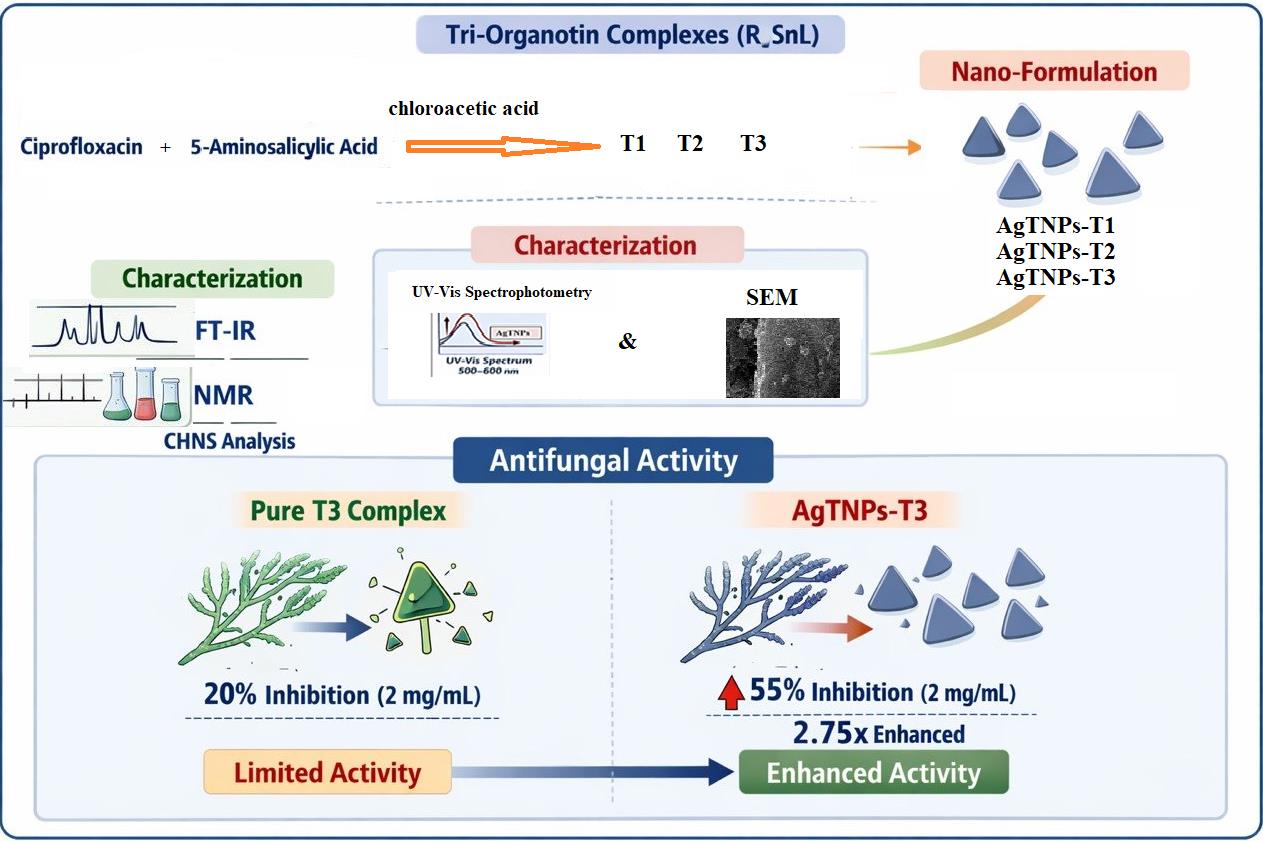
Organotin (IV) compounds are of significant interest in both the chemical and medicinal sectors. Among these, tri-organotin (IV) derivatives (R3SnX) stand out due to their potent biological activity and their distorted trigonal bipyramidal geometry. The present study details the synthesis, nano-formulation, and improved antifungal activity of three new tri-organotin (IV) complexes. These complexes have been synthesized from a hybrid ligand, formed from ciprofloxacin and 5-aminosalicylic acid, followed by modification of the carboxylate functional group with chloroacetic acid. These compounds have been completely characterized by FT-IR, multinuclear NMR spectroscopy (¹H, ¹³C, ¹¹⁹Sn), and CHNS analysis. To enhance their biological activity, the synthesized complexes have been nano-formulated with triangular silver nanoparticles (AgTNPs). The antifungal activity of both pure and nano-formulated complexes has been investigated against Fusarium spp. In vitro antifungal assays against Fusarium spp. revealed that the triphenyltin complex (T3) was the most active among the pure compounds, achieving a 20% inhibition rate at 2 mg/mL, attributed to its high lipophilicity and aromatic content. Remarkably, the nano-formulated version (AgTNPs-T3) demonstrated a significant synergistic effect, increasing the inhibition rate to 55% at the same concentration, a 2.75-fold enhancement compared to the unmodified complex. This superior performance is attributed to the high surface area-to-volume ratio and sharp vertices of the AgTNPs, which facilitate better membrane penetration and ROS generation.
References
Al-Refaia, R. A. K., L. Ahmed, A. A. Alkarimi, S. S. Al-Obaidy, F. A. Hussein, and D. N. Taha (2019). New Approaches for Preparation of Silver Nanoparticles Using Quince Plant Extract as Antibacterial Agents. Journal of Global Pharma Technology, 11(9): 140–143
Al-Refaia, R. A. K., E. Alrikabi, A. A. Alkarimi, and R. Vasiliadou (2024). A New Synthesis of Copper Nanoparticles and Its Application as a Beta-Hematin Inhibitor. Indonesian Journal of Chemistry, 24(1): 152–159
Al-Shemary, R. S., H. Jasem, A. G. Hadi, and S. J. Baqir (2024). Boosted Antibacterial Efficacy: Di and Triorganotin Complexes via 2-[(2,3-Dimethylphenyl)Amino] Benzoic Acid. Bulletin of the Chemical Society of Ethiopia, 38(3): 647–655
Ali, A. R., H. A. A. Anani, and F. M. Selim (2021). Biologically Formed Silver Nanoparticles and In Vitro Study of Their Antimicrobial Activities on Resistant Pathogens. Iranian Journal of Microbiology, 13(6): 848–861
Ali, S. A. R., R. A. Al Refaia, E. Alrikabi, K. O. Ali, A. N. Hussein, A. A. Alkarimi, and A. R. Al Shujairi (2025). Synthesis, Characterization of Silver Nanoparticles Using Rosemary Extract and Their Application as Antioxidant, Antifungal and Antibacterial Agents. Journal of Nanostructures, 15(3): 885–895
Arraq, R. R., and A. G. Hadi (2022). Enhanced the Antioxidant Activity of Tri Organotin (IV) Complexes Derived from Cephalexin. Azerbaijan Medical Journal, 62(06): 2197–2209
Chandrakala, V., V. Aruna, and G. Angajala (2022). Review on Metal Nanoparticles as Nanocarriers: Current Challenges and Perspectives in Drug Delivery Systems. Emergent Materials, 5(6): 1593–1615
Dias, L. C., G. M. De Lima, J. A. Takahashi, and J. D. Ardisson (2015). New Di- and Triorganotin (IV) Carboxylates Derived from a Schiff Base: Synthesis, Characterization and In Vitro Antimicrobial Activities. Applied Organometallic Chemistry, 29(5): 305–313
Du, D., Z. Jiang, C. Liu, A. M. Sakho, D. Zhu, and L. Xu (2011). Macrocyclic Organotin (IV) Carboxylates Based on Benzenedicarboxylic Acid Derivatives: Syntheses, Crystal Structures and Antitumor Activities. Journal of Organometallic Chemistry, 696(13): 2549–2558
Erfan, A., E. Yousif, A. Alshanon, and G. El-Hiti (2024). Organotin(IV) Complexes as Chemotherapeutic Drugs Against Different Types of Cancer Cell Lines: A Review. Al-Nahrain Journal of Science, 27(5): 70–77
Fithri, N. A., A. Fadilah, A. Pratiwi, S. S. Alisyahbana, M. F. Alhafiz, and N. Puan (2025). Uncaria gambir Based Green Synthesis of Inorganic Nanoparticles for Photothermal Induced Thrombolytic and Antibacterial Applications. Science and Technology Indonesia, 10(1): 1–15
Hadi, A. G., S. J. Baqir, D. S. Ahmed, G. A. El-Hiti, H. Hashim, A. Ahmed, B. M. Kariuki, and E. Yousif (2021). Substituted Organotin Complexes of 4-Methoxybenzoic Acid for Reduction of Poly(Vinyl Chloride) Photodegradation. Polymers, 13(22): 1–17
Hadi, A. G., K. Jawad, E. Yousif, and G. A. El-Hiti (2019). Synthesis of Telmisartan Organotin(IV) Complexes and Their Use as CO₂ Capture Media. Molecules, 24(8): 1631
Han, M., Z. Xia, Y. Zou, P. Hu, M. Zhang, X. Yang, M. G. Ma, and R. Yang (2024). Comparative Study and Transcriptomic Analysis on the Antifungal Mechanism of Ag Nanoparticles and Nanowires Against Trichosporon asahii. International Journal of Nanomedicine, 19: 11789–11804
Hano, C., and B. H. Abbasi (2022). Plant-Based Green Synthesis of Nanoparticles: Production, Characterization and Applications. Biomolecules, 12(1): 1–9
Hashim, D. J., E. H. Al-Rikabi, A. G. Hadi, and S. J. Baqir (2023a). 4-Aminoantipyrine-New Organotin Complexes, Synthesis, Structure and Antioxidant Activity. Bulletin of the Chemical Society of Ethiopia, 37(5): 1163–1170
Hashim, D. J., E. J. Waheed, A. G. Hadi, and S. J. Baqir (2023b). Exploring the Biological Activity of Organotin Carboxylate Complexes with 4-Sulfosalicylic Acid. Bulletin of the Chemical Society of Ethiopia, 37(6): 1–23
Joshi, R., A. Kumari, K. Singh, H. Mishra, and S. Pokharia (2020). Triorganotin(IV) Complexes of Schiff Base Derived from 1,2,4-Triazole Moiety: Synthesis, Spectroscopic Investigation, DFT Studies, Antifungal Activity and Molecular Docking Studies. Journal of Molecular Structure, 1206: 127639
Li, N., J. Ma, X. Du, Y. Shi, P. Zhao, Q. Li, and C. Ma (2025). Syntheses, Structures, In Vitro Cytostatic Activity and Antifungal Activity Evaluation of Six Organotin(IV) Complexes Based on Quinoline-6-Carboxylic Acid. Journal of Organometallic Chemistry, 1035: 123685
Mahdi, I. J., N. S. Saddam, A. G. Hadi, S. J. Baqir, Y. F. Al-Khafaji, and A. S. Abbas (2023). Identification and Antioxidant Activity of Di and Tri-Organotin Complexes Derived from Cinnamic Acid. Egyptian Journal of Chemistry, 66(4): 213–218
Malathi, S., D. Manikandan, R. Nishanthi, E. G. Jagan, S. U. M. Riyaz, P. Palani, and J. Simal-Gandara (2022). Silver Nanoparticles Synthesized Using Hyptis suaveolens (L.) Poit and Their Antifungal Activity Against Candida spp. ChemistrySelect, 7(47): e202203050
Mohsin, A. D., R. A. K. Al-Refaia, and A. G. Hadi (2026). Green Synthesis of Triangular Silver Nanoparticles Using Garden Cress Seed Extract Based on Gallic Acid and Their Antifungal Activity. Journal of Nanostructures, 16(1): 474–483
Nopitasari, T., T. Suhartati, S. Suharso, D. Herasari, K. D. Pandiangan, and S. Hadi (2021). Synthesis, Characterization, and Antioxidant Activity of Some Organotin(IV) 2-Nitrobenzoate Using the 2,2-Diphenyl-1-Picryl-Hydrazyl (DPPH) Method. Journal of Physics: Conference Series, 1751(1): 012098
Polinarski, M. A., A. L. B. Beal, F. E. B. Silva, J. Bernardi-Wenzel, G. R. M. Burin, G. I. B. de Muniz, and H. J. Alves (2021). New Perspectives of Using Chitosan, Silver, and Chitosan–Silver Nanoparticles Against Multidrug-Resistant Bacteria. Particle & Particle Systems Characterization, 38(4): 2100009
Preethi, A. C., V. Hariharakrishnan, and V. Saraswathi (2024). The Optical and Electrochemical Characteristics of Silver Nanoparticles, Besides Antibacterial and Antifungal Properties Using Crocus sativus L. Petal. Journal of Optoelectronic and Biomedical Materials, 16(4): 199–209
Qiao, W., Y. Liu, X. Fan, Y. Yang, W. Liu, L. Wang, and Z. Hu (2023). Rapid and Sensitive Determination of Ascorbic Acid Based on Label-Free Silver Triangular Nanoplates. Current Research in Food Science, 7: 100548
Radulescu, D. M., V. A. Surdu, A. Ficai, D. Ficai, A. M. Grumezescu, and E. Andronescu (2023). Green Synthesis of Metal and Metal Oxide Nanoparticles: A Review of the Principles and Biomedical Applications. International Journal of Molecular Sciences, 24(20): 15397
Raji, S. Q., and A. T. Bader (2024). Synthesis and Characterization of Ni²⁺ Schiff Base Complex as a Precursor for NiO Nanoparticles and an Investigation of Their Corrosion Inhibition. Science and Technology Indonesia, 9(4): 914–928
Rodriguez Barroso, L. G., E. L. Garcia, M. Mojicevic, M. Huerta, R. Pogue, D. M. Devine, and M. Brennan-Fournet (2023). Triangular Silver Nanoparticles Synthesis: Investigating Potential Application in Materials and Biosensing. Applied Sciences, 13(14): 8100
Saputra, K., M. Masruroh, H. Susanto, and R. Apsari (2024). Tapping into the Power of Sol-Gel Method for Enhanced Antimicrobial Activity of Titania Nanoparticles. Science and Technology Indonesia, 9(3): 546–555
Soleimani, P., A. Mehrvar, J. P. Michaud, and N. Vaez (2022). Optimization of Silver Nanoparticle Biosynthesis by Entomopathogenic Fungi and Assays of Their Antimicrobial and Antifungal Properties. Journal of Invertebrate Pathology, 190: 107749
Yin, M., X. Xu, H. Han, J. Dai, R. Sun, L. Yang, J. Xie, and Y. Wang (2022). Preparation of Triangular Silver Nanoparticles and Their Biological Effects in the Treatment of Ovarian Cancer. Journal of Ovarian Research, 15(1): 1–14
Authors

This work is licensed under a Creative Commons Attribution 4.0 International License.