
Root-Derived Phytochemicals from Inula confertiflora for Antioxidant and Antibacterial Activities
Article Sidebar
-
Inula confertiflora, Phytochemicals, Antioxidant, Antibacterial Activities
Abstract
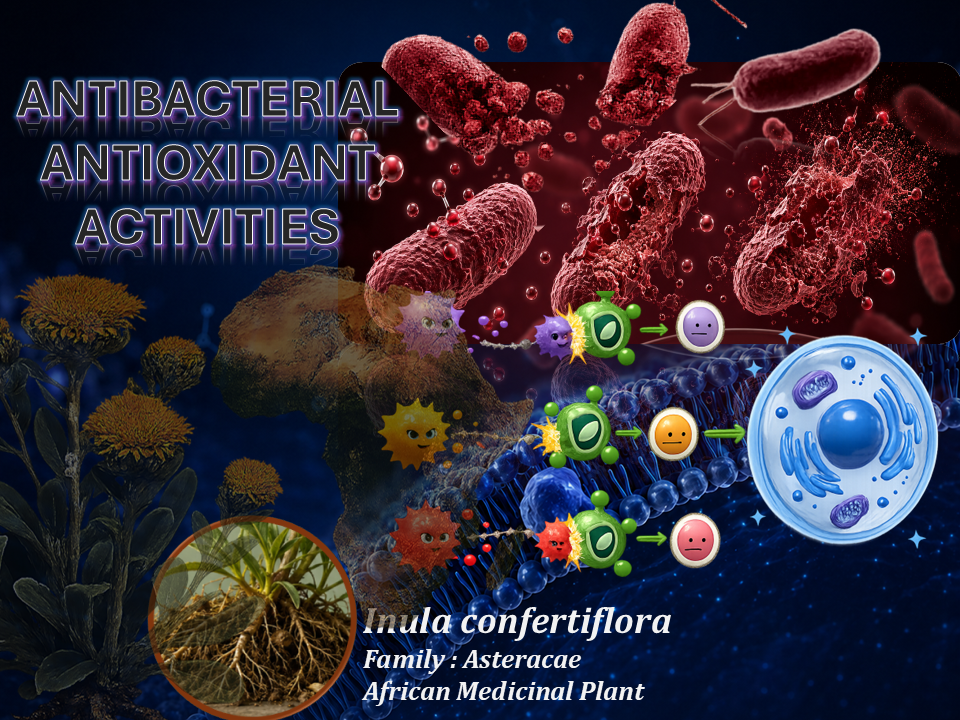
Inula confertiflora, a medicinal herb indigenous to Ethiopia, often used in traditional treatments for inflammatory and pain-related conditions. The root of I. confertiflora was soaked with n-hexane, ethyl ether, and acetone solvents. The proportion of crude extracts derived from ethyl ether extracts was 1.4 times higher than that of n-hexane and 1.2 times higher than that of acetone. Analytical detection results of crude extracts confirmed that I. confertiflora contained a variety of different preliminary phytochemicals. The higher concentrations of total flavonoids and other polar phytoconstituents present in the ethyl ether extracts were associated with greater radical-scavenging effectiveness in the DPPH solution. More than half of the bacterial growth efficiency was restricted by phytochemicals derived from I. confertiflora root extracts using non-polar, medium-polar, and high-polar solvents. It is crucial to note that medium-polar extracts of I. confertiflora root decreased the inhibitory effect on the development of both gram-positive and gram-negative bacterial strains at a concentration of 100 μg/mL using acetone as the solvent. Additionally, they exhibited improved radical scavenging against a DPPH solution. Moreover, molecular docking simulation clearly revealed that I. confertiflora extracts have a strong binding affinity toward four key bacterial target proteins (LasB (-7.9kcal/mol), PBP2a (-8.0kcal/mol), FabH (-11.3kcal/mol), and MurA1 (-4.7kcal/mol)). Collectively, these findings suggest that I. confertiflora extracts exhibit substantial potential as antibacterial agents by targeting diverse and functionally important bacterial proteins.
References
Agidew, M. G. (2022). Phytochemical Analysis of Some Selected Traditional Medicinal Plants in Ethiopia. Bulletin of the National Research Centre, 46(1); 87
Ahmed, B. H., M. A. Desta, A. A.Wami, G. T. Beyene, and K. G. Bedane (2024). Sesquiterpene Acids and Lactones from Inula confertiflora with Their Antibacterial Activities. Chemistry & Biodiversity, 21(5); e202400265
Aiyegoro, O. A. and A. I. Okoh (2010). Preliminary Phytochemical Screening and In Vitro Antioxidant Activities of the Aqueous Extract of Helichrysum longifolium DC. BMC Complementary and Alternative Medicine, 10; 21
Ajeethan, N., L. Abbey, and S. N. Yurgel (2026). Role of Plant Growth-Promoting Microbes in Plant Growth and Development. Applied Microbiology, 6(2); 34
Ali, M., T. Khan, K. Fatima, Q. u. A. Ali, M. Ovais, A. T. Khalil, I. Ullah, A. Raza, Z. K. Shinwari, and M. Idrees (2018). Selected Hepatoprotective Herbal Medicines: Evidence from Ethnomedicinal Applications, Animal Models, and Possible Mechanism of Actions. Phytotherapy Research, 32(2); 199–215
Aribisala, J. O. and S. Sabiu (2022). Cheminformatics Identification of Phenolics as Modulators of Penicillin-Binding Protein 2a of Staphylococcus aureus: A Structure–Activity–Relationship-Based Study. Pharmaceutics, 14(9); 1818
Atina, I. Royani, Assa’idah, and F. S. Arsyad (2025). Antibacterial Properties of Taro: Extraction, Antibacterial Testing Method, Modification and Application. Science and Technology Indonesia, 10; 374–401
Ayele, A. H., A. Seid, A. B. Mekonnen, W. W. Adnew, and G. Yemata (2024). Ethnobotanical Study of the Traditional Use of Medicinal Plants Used for Treating Human Diseases in Selected Districts ofWest Gojjam Zone, Amhara Region, Ethiopia. Phytomedicine Plus, 4(3); 100620
Bensen, D. C., S. Rodriguez, J. Nix, M. L. Cunningham, and L. W. Tari (2012). Structure of MurA (UDP-NAcetylglucosamine Enolpyruvyl Transferase) from Vibrio fischeri in Complex with SubstrateUDP-N-Acetylglucosamine and the Drug Fosfomycin. Acta Crystallographica Section F: Structural Biology and Crystallization Communications, 68(4); 382–385
Braca, A., N. De Tommasi, L. Di Bari, C. Pizza, M. Politi, and I. Morelli (2001). Antioxidant Principles from Bauhinia tarapotensis. Journal of Natural Products, 64(7); 892–895
Brown, T. M., M. Cueto, and E. Fee (2006). TheWorldHealth Organization and the Transition From “International” to “Global” Public Health. American Journal of Public Health, 96(1); 62–72
Carreno-Quintero, N., T. Tohge, R. Van Acker, L. S. McKee, Q. Zhou, A. Bolze, X. Xing, M. Özparpucu, M. Rüggeberg, T. Piofczyk, Y. Koram, V. Bulone, W. Boerjan, A. R. Fernie, and P. D. Fraser (2024). Non-Targeted Discovery of High-Value Bio-Products in Nicotiana glauca L.: A Potential Renewable Plant Feedstock. Bioresources and Bioprocessing, 11(1); 12
Cathcart, G. R. A., D. Quinn, B. Greer, P. Harriott, J. F. Lynas, B. F. Gilmore, and B.Walker (2011). Novel Inhibitors of the Pseudomonas aeruginosa Virulence Factor LasB: A Potential Therapeutic Approach for the Attenuation of Virulence Mechanisms in Pseudomonal Infection. Antimicrobial Agents and Chemotherapy, 55(6); 2670
Eshete, M. A. and E. L. Molla (2021). Cultural Significance of Medicinal Plants in Healing Human Ailments Among Guji Semi-Pastoralist People, Suro Barguda District, Ethiopia. Journal of Ethnobiology and Ethnomedicine, 17(1); 61
Faccio, G. (2020). Plant Complexity and Cosmetic Innovation. iScience, 23(8); 101358
Fathalla, R. K., W. Fröhner, C. D. Bader, P. D. Fischer, C. Dahlem, D. Chatterjee, S. Mathea, A. K. Kiemer, H. Arthanari, R. Müller, M. Abdel-Halim, C. Ducho, and M. Engel (2022). Identification and Biochemical Characterization of Pyrrolidinediones as Novel Inhibitors of the Bacterial Enzyme MurA. Journal of Medicinal Chemistry, 65(21); 14740–14763
Feyisa, K., M. B. Yismaw, A. Yehualaw, C. Tafere, D. G. Demsie, B. Bahiru, and B. Kefale (2024). Medicinal Plants Traditionally Used to Treat Human Ailments in Ethiopia: A Systematic Review. Phytomedicine Plus, 4(1); 100516
Gashu, M. (2022). Epifriedelanol and Dammara-20,24-dien-3-yl Acetate from Ethiopian Inula confertiflora Root Extract. Journal of Chemistry, 2022(1); 2114595
Gebre-Mariam, T., R. Neubert, P. C. Schmidt, P.Wutzler, and M. Schmidtke (2006). Antiviral Activities of Some Ethiopian Medicinal Plants Used for the Treatment of Dermatological Disorders. Journal of Ethnopharmacology, 104(1); 182–187
Gedlu, M., T. Bizuayehu, A. Melese, and A. Sewnet (2024). A Comprehensive Review on Traditional Medicinal Plants in Ethiopia and Their Application for Treatment of Different Diseases. Advances in Public Health, 2024(1); 5542990
Habtamu, A., M. Esubalew, and S. Leshe (2024). Investigation of the Preliminary Compounds; Assessing the Antioxidant and In Vitro Antibacterial Activities of Inula confertiflora Leaf Extracts. Journal of Natural Product Research and Applications, 4(02); 19–31
Hudzicki, J. (2009). Kirby–Bauer Disk Diffusion Susceptibility Test Protocol. American Society for Microbiology, 15(1); 1–23
Kamtekar, S., V. Keer, and V. Patil (2014). Estimation of Phenolic Content, Flavonoid Content, Antioxidant and Alpha Amylase Inhibitory Activity of Marketed Polyherbal Formulation. Journal of applied pharmaceutical Science, 4(9); 061–065
Kawamoto, S., Y. Shibano, J. Fukushima, N. Ishii, K. Morihara, and K. Okuda (1993). Site-Directed Mutagenesis of Glu-141 and His-223 in Pseudomonas aeruginosa Elastase: Catalytic Activity, Processing, and Protective Activity of the Elastase Against Pseudomonas Infection. Infection and Immunity, 61(4); 1400–1405
Kibiti, C. M. and A. J. Afolayan (2015). Preliminary Phytochemical Screening and Biological Activities of Bulbine abyssinica Used in the Folk Medicine in the Eastern Cape Province, South Africa. Evidence-Based Complementary and Alternative Medicine, 2015(1); 617607
Kokate, C. K., A. P. Purohit, and S. B. Gokhale (2001). Carbohydrates and Derived Products, Drugs Containing Glycosides, Drugs Containing Tannins, Lipids, Proteins, and Alkaloids. 7 edition
Kozhantayeva, A., N. Tursynova, A. Kolpek, Y. Aibuldinov, A. Tursynova, T. Mashan, Z. Mukazhanova, M. Ibrayeva, A. Zeinuldina, A.Nurlybayeva, Z. Iskakova, and Y. Tashenov (2024). Phytochemical Profiling, Antioxidant and Antimicrobial Potentials of Ethanol and Ethyl Acetate Extracts of Chamaenerion latifolium L. Pharmaceuticals, 17(8); 996
Krakowska-Sieprawska, A., A. Kiełbasa, K. Rafińska, M. Ligor, and B. Buszewski (2022). Modern Methods of Pre-Treatment of Plant Material for the Extraction of Bioactive Compounds. Molecules, 27(3); 730
Krief, S., C. M. Hladik, and C. Haxaire (2005). Ethnomedicinal and Bioactive Properties of Plants Ingested by Wild Chimpanzees in Uganda. Journal of Ethnopharmacology, 101(1); 1–15
Langwick, S. A. (2015). Partial Publics: The Political Promise of Traditional Medicine in Africa. Current Anthropology, 56(4); 493–514
López-López, N., D. S. León, S. de Castro, R. Díez-Martínez, M. Iglesias-Bexiga, M. J. Camarasa, M. Menéndez, J. Nogales, and J. Garmendia (2022). Interrogation of Essentiality in the Reconstructed Haemophilus influenzae Metabolic Network Identifies Lipid Metabolism Antimicrobial Targets: Preclinical Evaluation of a FabH ????-Ketoacyl-ACP Synthase Inhibitor. mSystems, 7(2); e01459–21
Mallhi, T. H., M. I. Qadir, and Y. H. Khan (2018). Determination of Phytoconstituents of N-Hexane Extract of Leaves of Morus Nigra and Evaluation of Their Effects on Biochemical and Histopathological Parameters in Paracetamol Intoxicated Mice Liver. Brazilian Journal of Pharmaceutical Sciences, 54; e18101
Manayia, A. H., F. B. Ilhami, and S. Puspitarini (2025). Investigation of Phytochemicals and Antibacterial Efficacy in Flower Extracts of Vernonia amygdalina: Complemented Molecular Docking Analysis. Journal of the Indian Chemical Society, 102(3); 101604
Masfria, Sumaiyah, H. Syahputra, and M.Witarman (2023). Formulation and Evaluation of Antibacterial and Anti-Inflammatory Capsules Containing Phyllanthus emblica L. Fruit Nanoparticles. Science and Technology Indonesia, 8(4); 607–615
Moges, A. and Y. Moges (2019). Ethiopian Common Medicinal Plants: Their Parts and Uses in Traditional Medicine-Ecology and Quality Control. IntechOpen
Nabi, M. H. B., M. M. Ahmed, M. S. Mia, S. Islam, and W. Zzaman (2025). Essential Oils: Advances in Extraction Techniques, Chemical Composition, Bioactivities, and Emerging Applications. Food Chemistry Advances, 8; 101048
Nesbitt, M., R. P. H. McBurney, M. Broin, and H. J. Beentje (2010). Linking Biodiversity, Food and Nutrition: The Importance of Plant Identification and Nomenclature. Journal of Food Composition and Analysis, 23(6); 486–498
Okoduwa, S. I. R., I. Abdulwaliyu, B. E. Igiri, S.O. Arekemase, U. J. Okoduwa, J. F. Itiat, M. N. Egbule, and R. A.Mustapha (2024). Multi-Therapeutic Potential of Flavonoids as an Essential Component in Nutraceuticals for the Treatment and Management of Human Diseases. Phytomedicine Plus, 4(2); 100558
Pinho, M. G. and J. Errington (2005). Recruitment of Penicillin-Binding Protein PBP2 to the Division Site of Staphylococcus aureus Is Dependent on Its Transpeptidation Substrates. Molecular Microbiology, 55(3); 799–807
Plaatjie, M. T. A., T. E. Onyiche, T. Ramatla, J. J. Bezuidenhout, L. Legoabe, N. I. Nyembe, and O. Thekisoe (2024). A Scoping Review on Efficacy and Safety of Medicinal Plants Used for the Treatment of Diarrhea in Sub-Saharan Africa. Tropical Medicine and Health, 52(1); 6
Rathod, S. and D. M. Sihare (2024). Phytochemical Standardization of Aegle marmelos Leaves Extract by Using High Performance Thin Layer Chromatography Fingerprinting (HPTLC). Journal of Advanced Zoology, 45(2); 801–806
Samatha, T., R. Shyamsundarachary, P. Srinivas, and N. R. Swamy (2012). Quantification of Total Phenolic and Total Flavonoid Contents in Extracts of Oroxylum indicum L. Kurz. Asian J Pharm Clin Res, 5(4); 177–179
Seca, A. M. L., A. Grigore, D. C. G. A. Pinto, and A. M. S. Silva (2014). The Genus Inula and Their Metabolites: From Ethnopharmacological to Medicinal Uses. Journal of Ethnopharmacology, 154(2); 286–310
Sun, C.-P., Z.-L. Jia, X.-K. Huo, X.-G. Tian, L. Feng, C.Wang, B.-J. Zhang,W.-Y. Zhao, and X.-C. Ma (2021). Medicinal Inula Species: Phytochemistry, Biosynthesis, and Bioactivities. The American journal of Chinese medicine, 49(02); 315–358
Talebi, M., M. Khoramjouy, A. Feizi, Z. Ali, I. A. Khan, N. A. Ayatollahi, S. A. Ayatollahi, and M. Faizi (2023). Novel Multi-Target Therapeutic Potential of the Genus Inula: Advances and Opportunities for Neuroprotection. Pharmacological Research – Modern Chinese Medicine, 7; 100263
Tavares, A. C. F. M. G., A. K. G. de Melo, V. A. Cruz, V. A. de Souza, J. S. de Carvalho, K. L. L. L. Machado, L. D. de Azevedo Valadares, E. T. Dos Reis Neto, R. P. V. de Rezende, M. F. B. de Resende Guimarães, G. A. Ferreira, A. de Sousa Braz, R. M. R. de Abreu Vieira, M. de Medeiros Pinheiro, S. L. E. Ribeiro, B. E. G. R. Bica, K. L. Baptista, I. P. da Costa, C. D. L. Marques, et al. (2022). Guidelines on COVID-19 Vaccination in Patients with Immune-Mediated Rheumatic Diseases: A Brazilian Society of Rheumatology Task Force. Advances in Rheumatology, 62(1); 3
Waheeb, A. I., S. O. Gatia Almawla, M. A. Shehan, S. A. Awad, M. M. Ahmed, and S. S. Abduljaleel (2026). In Silico Interaction Profiling of Pseudomonas aeruginosa Elastase (LasB) with Structural Fragments of Synthetic Polymers. Applied Microbiology, 6(4); 51
Youn, J. S., Y.-J. Kim, H. J. Na, H. R. Jung, C. K. Song, S. Y. Kang, and J. Y. Kim (2019). Antioxidant Activity and Contents of Leaf Extracts Obtained from Dendropanax morbifera LEV Are Dependent on the Collecting Season and Extraction Conditions. Food Science and Biotechnology, 28(1); 201–207
Zuluaga, G. (2024). Potential of Bitter Medicinal Plants: A Review of Flavor Physiology. Pharmaceuticals, 17(6); 722
Authors

This work is licensed under a Creative Commons Attribution 4.0 International License.