
Integrated Cellular and Molecular Interaction Analysis of Turmeric and Black Rice Bran Extract in HeLa Cells as a Potential Anticancer
Article Sidebar
-
Cervical Cancer, Turmeric, Black Rice Bran, Combination Effect, HeLa Cell
Abstract
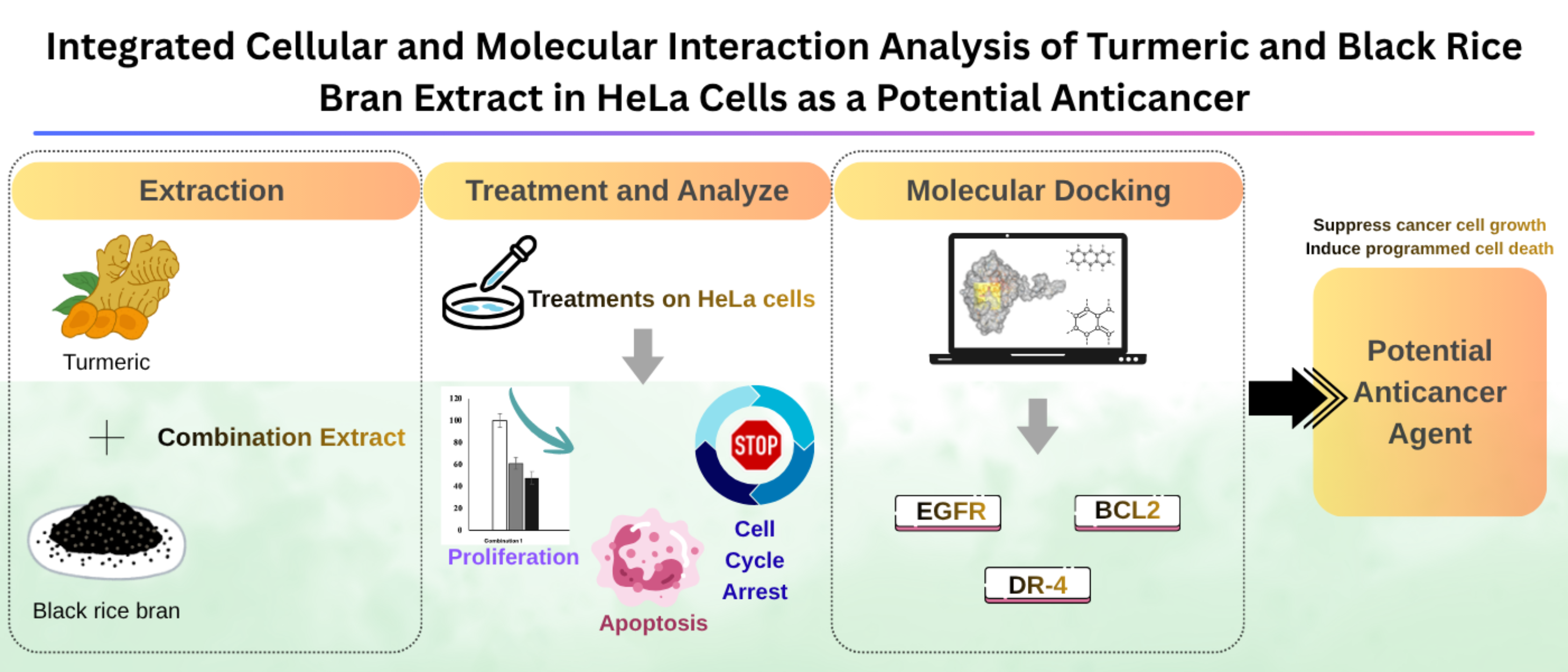
Cervical cancer continues to be a leading cause of female mortality due to multidrug resistance therapy associated with EGFR overexpression and evasion of apoptosis. Turmeric and black rice bran are recognized for their potential anticancer properties; however, the combined effects of these extracts and their predicted molecular interactions remain to be elucidated. This study investigated the potential enhanced effect of combined turmeric and black rice bran extracts using an integrated phenotypic and molecular docking approach. The antiproliferative effect of the combination of the ethanolic extract of turmeric and black rice bran was assessed in HeLa cells using the MTT assay, whereas cell cycle arrest and apoptosis were analyzed using flow cytometry. Several compounds in turmeric and black rice bran extract were docked against the growth signaling protein (EGFR) and death receptors (BCL-2, DR-4). The optimal formulation (Combination 1) demonstrated a progressive reduction in HeLa cell viability from 61.02% at 24 hours to 47.88% at 48 hours, inducing a distinct G2/M phase arrest. This growth inhibition was accompanied by cell clearance through early apoptosis (38.57%) and secondary necrosis (28.03%). Molecular docking supported these findings by suggesting that bisdemethoxycurcumin may interact with EGFR, with a binding affinity of -7.6 kcal/mol. Compounds derived from black rice bran were also predicted to complementarily target BCL-2 and DR-4, suggesting a potential multi-target mechanism. In summary, the combination extract demonstrates both growth signaling inhibition and apoptotic induction, offering a promising baseline for further validation in in vivo models.
References
Ameer, S. F., M. Y. Mohamed, Q. A. Elzubair, E. A. M. Sharif, and W. N. Ibrahim (2024). Curcumin as a Novel Therapeutic Candidate for Cancer: Can This Natural Compound Revolutionize Cancer Treatment? Frontiers in Oncology, 14; 1438040
Bertoli, C., J. M. Skotheim, and R. A. M. De Bruin (2013). Control of Cell Cycle Transcription During G1 and S Phases. Nature Reviews Molecular Cell Biology, 14(8); 518–528
Chen, J. (2016). The Cell-Cycle Arrest and Apoptotic Functions of p53 in Tumor Initiation and Progression. Cold Spring Harbor Perspectives in Medicine, 6(3); a026104
Chen, Q. H., L. Dejean, X. Zhang, R. Wang, and G. Chen (2015). The Effects of Curcumin-Based Compounds on Proliferation and Cell Death in Cervical Cancer Cells. Anticancer Research, 35(10); 5293–5298
Dho, S. H., M. Cho, W. Woo, S. Jeong, and L. K. Kim (2025). Caspases as Master Regulators of Programmed Cell Death: Apoptosis, Pyroptosis and Beyond. Experimental and Molecular Medicine, 57; 1121–1132
Du, Y., F. Karatekin, W. K. Wang, W. Hong, and G. T. K. Boopathy (2025). Cracking the EGFR Code: Cancer Biology, Resistance Mechanisms, and Future Therapeutic Frontiers. Pharmacological Reviews, 77; 100076
Fisher, D. R., T. Zheng, D. F. Bielinski, M. E. Kelly, D. S. Cahoon, and B. Shukitt-Hale (2022). Phytochemical Combination Is More Effective Than Individual Components in Reducing Stress Signaling in Rat Hippocampal Neurons and Microglia In Vitro. International Journal of Molecular Sciences, 23(20); 12651
Garrido, A., A. Lepailleur, S. M. Mignani, P. Dallemagne, and C. Rochais (2020). hERG Toxicity Assessment: Useful Guidelines for Drug Design. European Journal of Medicinal Chemistry, 195; 112290
Hartati, F. K. and Andryanto (2022). Black Rice Extract Induced Apoptosis and Cell Cycle Arrest on Human Cancer Cell Lines. Current Research in Nutrition and Food Science, 10(3); 971–979
Hu, A., J. J. Huang, J. F. Zhang, W. J. Dai, R. L. Li, Z. Y. Lu, J. L. Duan, J. P. Li, X. P. Chen, J. P. Fan, W. H. Xu, and H. L. Zheng (2017). Curcumin Induces G2/M Cell Cycle Arrest and Apoptosis of Head and Neck Squamous Cell Carcinoma In Vitro and In Vivo Through ATM/Chk2/p53-Dependent Pathway. Oncotarget, 8(31); 50747–50760
Huang, Y. P. and H. M. Lai (2016). Bioactive Compounds and Antioxidative Activity of Colored Rice Bran. Journal of Food and Drug Analysis, 24(3); 564–574
Hyun, J. W. and H. S. Chung (2004). Cyanidin and Malvidin from Oryza sativa cv. Heugjinjubyeo Mediate Cytotoxicity Against Human Monocytic Leukemia Cells by Arrest of G2/M Phase and Induction of Apoptosis. Journal of Agricultural and Food Chemistry, 52(8); 2213–2217
Ilyas, S. and D. Lee (2025). Exploring the Role of BCL2 Interactome in Cancer: A Protein/Residue Interaction Network Analysis. Biology, 14(3); 261
Jan, R. and G. E. S. Chaudhry (2019). Understanding Apoptosis and Apoptotic Pathways Targeted Cancer Therapeutics. Advanced Pharmaceutical Bulletin, 9(2); 205–218
Kania, N., E. Y. Rahman, D. Priyandoko, A. H. N. Sabrina, W. Widowati, R. Azis, A. Annaba, D. S. Hadiprasetyo, and G. Alexandro (2025). The Potential of Ethanol Extract of Pasak Bumi Roots (Eurycoma longifolia Jack) as an Anti-Prostate Cancer In Vitro Against PC-3 Cells. Science and Technology Indonesia, 10(2); 452–466
Kurniawan, C., J. W. Siagian, and S. Hutomo (2016). Sitotoksisitas Ekstrak Etanolik Curcuma longa pada Sel HeLa: Studi In Vitro. Berkala Ilmiah Kedokteran Duta Wacana, 1(3); 165–171
Länger, R., E. Stöger, W. Kubelka, and K. Helliwell (2018). Quality Standards for Herbal Drugs and Herbal Drug Preparations—Appropriate or Improvements Necessary? Planta Medica, 84(6–7); 350–360
Laureanti, E. J. G., T. S. Paiva, L. M. de Matos Jorge, and R. M. M. Jorge (2023). Microencapsulation of Bioactive Compound Extracts Using Maltodextrin and Gum Arabic by Spray and Freeze-Drying Techniques. International Journal of Biological Macromolecules, 253; 126969
Lemmadi, S., E. Dumas, F. Adoui, G. Agusti, S. Vessot-Crastes, W. Medfai, and A. Gharsallaoui (2025). Spray-Drying Microencapsulation of Artemisia herba-alba Phenolic Extract: Physicochemical Properties, Structural Characterization, and Bioactivity. Molecules, 30(19); 3904
Li, Q., J. Chai, S. Deng, J. Xu, Y. Feng, R. Yang, and W. Li (2025). The Comparison of the Profile of Phenolic Compounds in Noni (Morinda citrifolia L.) Fruit by Different Drying Methods. Foods, 14(8); 1398
Mardani, M., S. Siahtiri, M. Besati, M. Baghani, M. Baniassadi, and A. Mahdavi Nejad (2024). Microencapsulation of Natural Products Using Spray-Drying: An Overview. Journal of Microencapsulation, 41(7); 649–678
Mardiyanto, M., I. Solihah, and T. G. Jaya (2020). The Chitosan-Sodium Alginate Submicro Particles Loading Herbal of Ethanolic Extract of Leaves Senna alata L. for Curing of Bacterial Infection on Skin. Science and Technology Indonesia, 5(3); 85–89
Mehta, N., P. Kumar, A. K. Verma, P. Umaraw, Y. Kumar, O. P. Malav, A. Q. Sazili, R. Domínguez, and J. M. Lorenzo (2022). Microencapsulation as a Noble Technique for the Application of Bioactive Compounds in the Food Industry: A Comprehensive Review. Applied Sciences, 12(3); 1424
Nemickaite, E., U. Zlabiene, A. Mazurkeviciute, M. Marksa, and J. Bernatoniene (2025). Formulation of W/O/W Emulsion-Based Chitosan-Alginate Microcapsules for Encapsulation of Cannabidiol and A. annua L. Extract Containing Luteolin and Apigenin: A Response Surface Optimization Approach. Pharmaceutics, 17(3); 309
Nguyen, C. T., K. Nguyen Di, H. C. Phan, T. C. Kha, and H. C. Nguyen (2024). Microencapsulation of Noni Fruit Extract Using Gum Arabic and Maltodextrin: Optimization, Stability and Efficiency. International Journal of Biological Macromolecules, 269(Part 2); 132217
Porras-Yepes, M., A. C. Rojas-Arias, and J. Hernández-Torres (2020). Microencapsulation of Bioactive Compounds: Techniques and Applications in Pharmaceutical and Food Industries. Journal of Food Process Engineering, 43(8); e13417
Pudziuvelytė, L., M. Marksa, V. Jakštas, L. Ivanauskas, A. Laukevičienė, J. Bernatonienė, and D. M. Kopustinskienė (2022). Influence of Technological Factors on the Quality of Chitosan Microcapsules with Boswellia serrata L. Essential Oil. Molecules, 27(13); 4217
Pudžiuvelytė, L., E. Petrauskaitė, J. Stabrauskienė, and J. Bernatonienė (2025). Spray-Drying Microencapsulation of Natural Bioactives: Advances in Sustainable Wall Materials. Pharmaceuticals, 18(7); 963
Purwaningsari, D., S. Tehupuring, N. Pranitasari, S. Hayaza, L. Dewi, and D. Ardiana (2021). The Antioxidant Effect of Noni Fruits Extract on HDL and LDL Level of Wistar Rat Induced by High Fat Diet. Indian Journal of Forensic Medicine & Toxicology, 15(2); 2235–2239
Safitri, A., D. R. T. Sari, and C. Mahdi (2022). Microencapsulation of Ruellia tuberosa L. Aqueous Root Extracts Using Chitosan–Sodium Tripolyphosphate and Their In Vitro Biological Activities. Scientifica, 2022; 9522463
Saqueti, B. H., E. S. Alves, M. C. Castro, P. D. dos Santos, N. Sinosaki, C. E. Senes, J. V. Visentainer, and O. O. Santos (2021). Shelf Life of Bioactive Compounds from Acerola Pulp (Malpighia spp.) Through Freeze-Drying and Microencapsulation. Journal of the Brazilian Chemical Society, 32; 2009–2016
Song, Y., Y. Gu, A. Ren, X. Li, S. Wu, Y. Gong, and Y. Luo (2025). Optimization and Comprehensive Characterization of the Microencapsulation Process for Taro Essence. Foods, 14(5); 754
Sreekumar, S., F. M. Goycoolea, B. M. Moerschbacher, and G. R. Rivera-Rodriguez (2018). Parameters Influencing the Size of Chitosan-TPP Nano- and Microparticles. Scientific Reports, 8; 4695
Sulistiawanti, N., H. Hairunnisa, N. Ningrum, and S. Fitriyanti (2025). Review: Perbedaan Penggunaan Pelarut terhadap Nilai Rendemen yang Dihasilkan dengan Berbagai Metode Ekstraksi dalam Proses Ekstraksi. An-Najat, 3(3); 213–231. (in Indonesian)
Tasfiyati, A. N., L. D. Antika, R. T. Dewi, A. W. Septama, A. Sabarudin, and T. Ernawati (2022). An Experimental Design Approach for the Optimization of Scopoletin Extraction from Morinda citrifolia L. Using Accelerated Solvent Extraction. Talanta, 238; 123010
Undale, V., N. Chaudhari, S. Bharud, and S. M. Firdous (2026). Comparative Analysis of Traditional and Modern Extraction Methods. In Advances in Extraction Science. CRC Press, pages 28–33
Villate, A., M. San Nicolas, M. Olivares, O. Aizpurua-Olaizola, and A. Usobiaga (2023). Chitosan-Coated Alginate Microcapsules of a Full-Spectrum Cannabis Extract: Characterization, Long-Term Stability, and In Vitro Bioaccessibility. Pharmaceutics, 15(3); 859
Widjastuti, T., L. Nurlaeni, A. Hasbuna, I. Setiawan, I. Yudaasmara, and W. Tanwiriah (2023). The Microencapsulation of Noni Fruit Extract (Morinda citrifolia L.) with Maltodextrin and Its Implementation as Feed Additive on Carcass Quality and Histology of Intestinal Sentul Chicken. International Journal on Advanced Science, Engineering and Information Technology, 13(1); 104–109
Wigati, D. and K. Anwar (2017). Hypotensive Activity of Ethanolic Extracts of Morinda citrifolia L. Leaves and Fruit in Dexamethasone-Induced Hypertensive Rat. Journal of Evidence-Based Complementary & Alternative Medicine, 22(1); 107–111
Wu, M., W. Zhang, H. Song, Y. Hu, and W. Li (2025). pH-Responsive Chitosan-Alginate Microcapsules as a Delivery System for Food-Medicine Homologous Plant Bioactives in Lung Cancer Therapy. Food Bioscience, 71; 107364
Zhang, C., X. Chen, J. Zhang, P. A. Kilmartin, and S. Y. Quek (2020a). Fabrication of Spray-Dried Microcapsules Containing Noni Juice Using Blends of Maltodextrin and Gum Acacia: Physicochemical Properties of Powders and Bioaccessibility of Bioactives During In Vitro Digestion. Foods, 9(9); 1316
Zhang, Y., L. Cui, X. Che, H. Zhang, N. Shi, C. Li, Y. Chen, and W. Kong (2020b). Preparation and Properties of Chitosan-Based Microspheres by Spray Drying. Food Science & Nutrition, 8(3); 1374–1383
Authors

This work is licensed under a Creative Commons Attribution 4.0 International License.