
Sustainable Fabrication of Banana Pseudo-stem (Musa paradisiaca L.)-derived ZnO/Carbon Composite as a Photo-antibacterial Agent
Article Sidebar
-
Photo-Antibacterial Agent, ZnO/Carbon Nanomaterial Composite, Banana Pseudo-Stem
Abstract
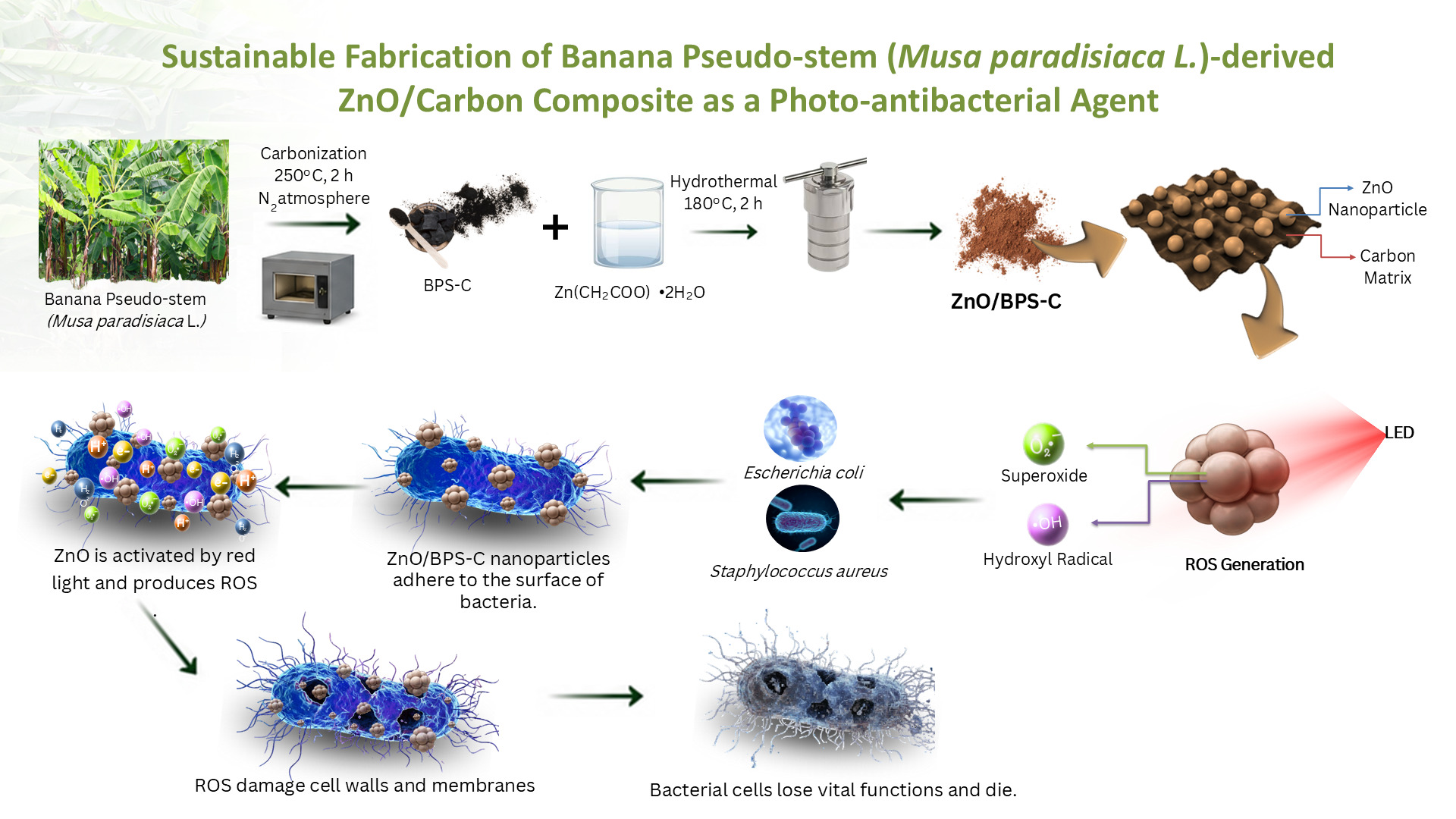
Bacterial infections and antimicrobial resistance (AMR) represent critical global health challenges, necessitating sustainable antibacterial alternatives. This study presents the hydrothermal synthesis of ZnO nanoparticles integrated with banana pseudo-stem-derived carbon (BPS-C) nanocomposite as a photo-antibacterial agent. Structural characterization confirmed crystalline hexagonal wurtzite ZnO formation (XRD), with ZnO nanoparticles distributed within the amorphous BPS-C matrix (broad halo 2θ ≈ 20–30°), verified by FTIR, SEM-EDS (C, O, and Zn peaks), and DLS analysis. These composites exhibited a significantly reduced hydrodynamic diameter (377 nm) compared to pure ZnO (826 nm) and BPS-C (19,602 nm), suggesting that the incorporation of BPS-C influenced the dispersion behavior of the composite particles. Furthermore, the incorporation of BPS-C influenced the optical properties and charge-carrier behavior of the composite material. More importantly, antibacterial activity was assessed using Staphylococcus aureus (Gram-positive) and Escherichia coli (Gram-negative) as representative bacterial strains. The ZnO/BPS-C composite demonstrated antibacterial effects against the Gram-positive Staphylococcus aureus, whereas its impact on the Gram-negative Escherichia coli was lower compared to pure ZnO. The observed photo-antibacterial activity may be associated with reactive oxygen species (ROS) generation from the ZnO phase under light irradiation. The lower sensitivity of E. coli (maximum inhibition zone of 7.23 mm) may be associated with its protective lipopolysaccharide-rich outer membrane, while pristine BPS-C showed no antibacterial activity (6.00 mm). These findings demonstrate the feasibility of utilizing banana pseudo-stem as a sustainable biomass precursor for ZnO/carbon composite fabrication. Moreover, the ZnO/BPS-C nanocomposite emerges as a promising sustainable candidate for photo-antibacterial applications.
References
Baig, A., M. Siddique, and S. Panchal (2025). A Review of Visible-Light-Active Zinc Oxide Photocatalysts for Environmental Application. Catalysts, 15(2); 100
Balouiri, M., M. Sadiki, and S. K. Ibnsouda (2016). Methods for in Vitro Evaluating Antimicrobial Activity: A Review. Journal of Pharmaceutical Analysis, 6(2); 71–79
Chaves Fernandes, B. C., K. Ferreira Mendes, A. F. Dias Júnior, V. P. da Silva Caldeira, T. M. da Silva Teófilo, T. Severo Silva, V. Mendonça, M. de Freitas Souza, and D. Valadão Silva (2020). Impact of Pyrolysis Temperature on the Properties of Eucalyptus Wood-Derived Biochar. Materials, 13(24); 5841
De Oliveira, B. P. and F. O. M. da Silva Abreu (2021). Carbon Quantum Dots Synthesis from Waste and By-Products: Perspectives and Challenges. Materials Letters, 282; 128764
Dong, X., A. E. Bond, N. Pan, M. Coleman, Y. Tang, Y. P. Sun, and L. Yang (2018). Synergistic Photoactivated Antimicrobial Effects of Carbon Dots Combined with Dye Photosensitizers. International Journal of Nanomedicine, 13; 8025–8035
Ebbensgaard, A., H. Mordhorst, F. M. Aarestrup, and E. B. Hansen (2018). The Role of Outer Membrane Proteins and Lipopolysaccharides for the Sensitivity of Escherichia coli to Antimicrobial Peptides. Frontiers in Microbiology, 9; 2153
Fivenson, E. M., P. D. A. Rohs, A. Vettiger, M. F. Sardis, G. Torres, A. Forchoh, and T. G. Bernhardt (2023). A Role for the Gram-Negative Outer Membrane in Bacterial Shape Determination. Proceedings of the National Academy of Sciences of the United States of America, 120(35); e2301987120
Hao, Y., Y. Wang, L. Zhang, F. Liu, Y. Jin, J. Long, S. Chen, G. Duan, and H. Yang (2024). Advances in Antibacterial Activity of Zinc Oxide Nanoparticles against Staphylococcus aureus (Review). Biomedical Reports, 21(5); 161
Ilhami, F. B., Munasir, N. S. Gultom, and C.-C. Cheng (2024). Zinc Oxide/Carbon Material-Embedded Supramolecular Drug Delivery System with Photoswitching Properties for Highly Selective and Effective Chemotherapy. ACS Applied Bio Materials, 7(8); 5506–5518
Khan, T. A., A. S. Saud, S. S. Jamari, M. H. Ab Rahim, J. W. Park, and H. J. Kim (2019). Hydrothermal Carbonization of Lignocellulosic Biomass for Carbon-Rich Material Preparation: A Review. Biomass and Bioenergy, 130; 105384
Lestari, D., I. Masriaha, A. Y. P. Hasibuana, and P. B. Pratiwi (2026). FTIR Analysis of ZnO-Functionalized Activated Carbon Derived from Oil Palm Empty Fruit Bunches for Potential Photocatalytic Applications. Jurnal Bio-Geo Material dan Energi, 6(1); 51–57
Li, R., Y. Zhou, W. Li, J. Zhu, and W. Huang (2020). Structure Engineering in Biomass-Derived Carbon Materials for Electrochemical Energy Storage. Research, 2020; 8685436
Mendes, C. R., G. Dilarri, C. F. Forsan, V. M. R. Sapata, P. R. M. Lopes, P. B. de Moraes, R. N. Montagnolli, H. Ferreira, and E. D. Bidoia (2022). Antibacterial Action and Target Mechanisms of Zinc Oxide Nanoparticles against Bacterial Pathogens. Scientific Reports, 12; 2658
Meziani, M. J., X. Dong, L. Zhu, L. P. Jones, G. E. LeCroy, F. Yang, and Y.-P. Sun (2016). Visible-Light-Activated Bactericidal Functions of Carbon “Quantum” Dots. ACS Applied Materials & Interfaces, 8(17); 10761–10766
Ministry of Health of the Republic of Indonesia (2024). Strengthening Antimicrobial Resistance Detection. Accessed: 2025-08-21
Nahda, D. P., A. R. Sanjaya, F. Rahmawati, A. Zulfia, A. Sumbodja, R. K. Pramadewandaru, and T. A. Ivandini (2025). Synthesis of Mesoporous Carbon from Banana Peels with Silica Gel 60 as the Hard Templates. RSC Advances, 15(6); 4536–4545
Ozdal, M. and S. Gurkok (2022). Recent Advances in Nanoparticles as Antibacterial Agent. ADMET & DMPK, 10(2); 115–129
Rabiee, N., S. Ahmadi, O. Akhavan, and R. Luque (2022). Silver and Gold Nanoparticles for Antimicrobial Purposes against Multi-Drug Resistance Bacteria. Materials, 15(5); 1799
Rahmat, A., S. Sutiharni, Y. Elfina, Y. Yusnaini, H. Latuponu, F. N. Minah, and A. Mutolib (2023). Characteristics of Tamarind Seed Biochar at Different Pyrolysis Temperatures as Waste Management Strategy: Experiments and Bibliometric Analysis. Indonesian Journal of Science and Technology, 8(3); 517–538
Salah, W., W. Djeridi, A. Houas, and L. Elsellami (2024). Synergy between Activated Carbon and ZnO: A Powerful Combination for Selective Adsorption and Photocatalytic Degradation. Materials Advances, 5(4); 1667–1675
Sharma, R., J. Thakur, V. B. Jaryal, D. S. Rana, S. Thakur, N. Gupta, and D. Singh (2024). Nitrogen and Sulfur Functionalized Microporous Carbon Nanomaterial Derived from Waste Coconut Husk for the Efficient Detection and Removal of Ofloxacin. Chemosphere, 346; 140653
Siddiqi, K. S., A. Ur Rahman, N. Tajuddin, and A. Husen (2018). Properties of Zinc Oxide Nanoparticles and Their Activity against Microbes. Nanoscale Research Letters, 13(1); 141
Sirelkhatim, A., S. Mahmud, A. Seeni, N. H. H. Kaus, L. C. Ann, S. Y. Bakhori, H. Hasan, and D. Mohamad (2015). Review on Zinc Oxide Nanoparticles: Antibacterial Activity and Toxicity Mechanism. Nano-Micro Letters, 7(3); 219–242
Turdini, S., D. Mulyadi, and L. M. Yuningsih (2025). Hydrothermal Synthesis of Carbon Dots Derived from Biomass: A Simple and Sustainable Approach. Jurnal Biologi Tropis, 25(3); 4206–4212
Tyasningsih, W., S. C. Ramandinianto, R. Ansharieta, A. M. Witaningrum, D. A. Permatasari, D. K. Wardhana, M. H. Effendi, and E. N. Ugbo (2022). Prevalence and Antibiotic Resistance of Staphylococcus aureus and Escherichia coli Isolated from Raw Milk in East Java, Indonesia. Veterinary World, 15(8); 2021–2028
Winarno, E. and C. Octavia (2025). Penyuluhan Kesehatan Pencegahan Infeksi Nosokomial di Rumah Sakit Mitra Medika Tanjung Mulia. Jurnal Nusantara Berbakti, 3(1); 191–198
Wu, J. G., Y. Z. Xu, C. W. Sun, R. D. Soloway, D. F. Xu, Q. G. Wu, and G. X. Xu (2001). Distinguishing Malignant from Normal Oral Tissues Using FTIR Fiber-Optic Techniques. Biopolymers: Original Research on Biomolecules, 62(4); 185–192
Yusof, N. A. A., N. M. Zain, and N. Pauzi (2019). Synthesis of ZnO Nanoparticles with Chitosan as Stabilizing Agent and Their Antibacterial Properties against Gram-Positive and Gram-Negative Bacteria. International Journal of Biological Macromolecules, 124; 1132–1136
Authors

This work is licensed under a Creative Commons Attribution 4.0 International License.