
Development of a Natural Antifungal Shampoo Containing Clove Bud Oil (Syzygium aromaticum): Formulation and in Vitro Evaluation
Article Sidebar
-
Cocamide DEA, Sodium Lauryl Sulfate, C. albicans, Optimization
Abstract
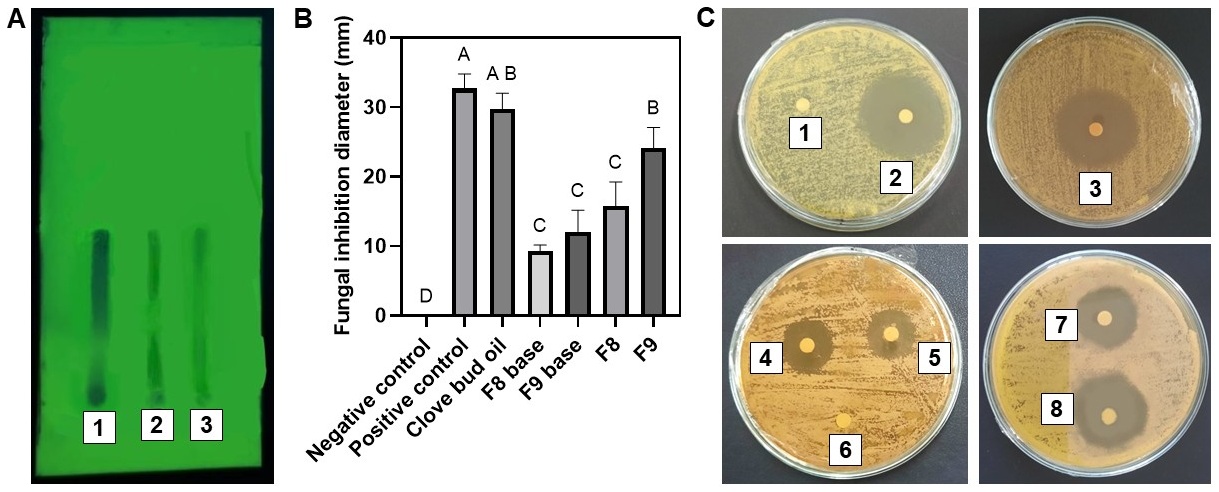
Dandruff affects approximately 50% of the global population during their lifetime. Clove bud oil (Syzygium aromaticum) (CBO), which is currently utilized mainly in the cigarette industry, has potential as an anti-dandruff agent because of its antifungal activity. This study aimed to optimize cocamide DEA and sodium lauryl sulfate (SLS) concentrations in CBO shampoo formulations and to evaluate the preliminary antifungal activity of the optimum formulation against Candida albicans as a model fungal organism, compared with a commercial ketoconazole shampoo (Ketomed®). CBO quality was characterized through organoleptic evaluation, specific gravity determination, ethanol solubility testing, Thin Layer Chromatography (TLC), and GC–MS analysis. GC–MS confirmed eugenol (76.88%) and β-caryophyllene (16.18%) as the major constituents of the oil. The shampoo formulations were prepared using the emulsification method followed by a two-stage surfactant optimization process. The first optimization identified 8% cocamide DEA as the optimum concentration, producing a viscosity of 3915 ± 59 cPs and foam height of 10.43 ± 0.20 cm. The second optimization demonstrated that 8% SLS provided the most favorable physicochemical characteristics and washing performance. The optimum formulation exhibited antifungal activity against C. albicans with an inhibition zone of 24.06 ± 3.01 mm, compared with 32.50 ± 1.44 mm for Ketomed®, which corresponded to approximately 74% relative antifungal efficacy. These findings suggest that CBO shampoo possesses promising potential as an antifungal anti-dandruff formulation while also providing an alternative value-added utilization of clove oil. This study was limited to in vitro evaluation against a single microorganism, C. albicans, and further in vivo and clinical studies remain necessary to confirm the efficacy and safety of the developed formulation.
References
Abozahra, A. K. E. A., N. O. Ahmed, Y. M. Mohamed, and T. A. El Naggar (2024). Study of Smoking Habit in Healthcare Workers in Police Academy Hospital. QJM: An International Journal of Medicine, 117(2).
Ahaik, I., J. C. Nunez-Rodriguez, S. Abelló-Cros, O. Yanes, S. Bouhdid, and T. Gabaldón (2026). Antifungal and Anti-Virulence Activities of Cinnamon, Thyme, and Clove Essential Oils Against Candida Species. Frontiers in Pharmacology, 17; 1756267.
Al-Rimawi, F., H. Imtara, J. Abbadi, S. Sawalha, M. Atiya, S. Mudalal, and G. Mauriello (2025). Evaluation of Antimicrobial Efficacy of Psidium guajava L. Leaf Extract in Ketoconazole Shampoo. Scientific Reports, 15(1); 39460.
Alharbi, G. G. and M. A. Abdulhamid (2023). Optimization of Water/Oil Emulsion Preparation: Impact of Time, Speed, and Homogenizer Type on Droplet Size and Dehydration Efficiency. Chemosphere, 335; 139136.
AlQuadeib, B. T., E. K. D. Eltahir, R. A. Banafa, and L. A. Al-Hadhairi (2018). Pharmaceutical Evaluation of Different Shampoo Brands in Local Saudi Market. Saudi Pharmaceutical Journal, 26(1); 98–106.
Atmanto, D. and N. S. S. Ambarwati (2023). Development of an Eco-Shampoo Formulation Using Local Environmental Plant Extracts for Healthy Hair as an Effort to Increase the Potential of Environmental Resources. Biology, Medicine, & Natural Product Chemistry, 12(1); 399–405.
Bejczi, R. and R. Nagy (2025). Thermodynamic and Interfacial Characterization of Petroleum Industry Surfactants: A Study on Critical Micelle Concentration and Interfacial Tension Behavior Under Mild Conditions. Chemistry Open, 14(9); e202500066.
Bennabi, L., F. Debab, F. Bennabi, I. Abdelmalek, K. Guemra, L. Belarbi, and M. Messori (2025). Optimization and Formulation of an Emulgel Based on Clove Oil in Order to Evaluate Its Antibacterial and Anti-Inflammatory Potential In Vitro and In Vivo for Topical Application. Applied Biochemistry and Biotechnology, 197(8); 4969–4986.
Benowitz, N. L. and E. Liakoni (2022). Tobacco Use Disorder and Cardiovascular Health. Addiction, 117(4); 1128–1138.
Biernasiuk, A., T. Baj, and A. Malm (2022). Clove Essential Oil and Its Main Constituent, Eugenol, as Potential Natural Antifungals Against Candida spp. Alone or in Combination with Other Antimycotics Due to Synergistic Interactions. Molecules, 28(1); 215.
Campelo, M. d. S., E. O. Melo, S. P. Arrais, F. B. S. A. d. Nascimento, N. V. Gramosa, S. d. A. Soares, and N. M. P. S. Ricardo (2021). Clove Essential Oil Encapsulated on Nanocarrier Based on Polysaccharide: A Strategy for the Treatment of Vaginal Candidiasis. Colloids and Surfaces A: Physicochemical and Engineering Aspects, 610; 125732.
Coleman-Cowger, V. H., E. A. Oga, E. N. Peters, and K. Mark (2018). Prevalence and Associated Birth Outcomes of Co-Use of Cannabis and Tobacco Cigarettes During Pregnancy. Neurotoxicology and Teratology, 68; 84–90.
Cornwell, P. A. (2018). A Review of Shampoo Surfactant Technology: Consumer Benefits, Raw Materials and Recent Developments. International Journal of Cosmetic Science, 40(1); 16–30.
Cunha, C., H. M. Ribeiro, M. Rodrigues, and A. R. T. S. Araujo (2022). Essential Oils Used in Dermocosmetics: Review About Its Biological Activities. Journal of Cosmetic Dermatology, 21(2); 513–529.
Ergin, C., O. Kurt, M. Turkoglu, H. Sevinc, and G. Akbaba (2024). Evaluation of Novel Cosmetic Shampoo Formulations Against Malassezia Species: Preliminary Results of Anti-Dandruff Shampoo Formulations. Journal of Cosmetic Dermatology, 23(6); 2078–2083.
Eryaputri, N. R. A. S., S. Triannisa, A. F. Damayanti, A. J. Za’ani, M. E. Fahlevy, M. Farhan, and A. Wulanawati (2023). Effect of the Addition Variations Cocamide Diethanolamine on Physical Characteristics Preparation of Citronella Oil Shampoo. Indonesian Journal of Chemical Science, 12(2); 119–129.
Filatov, V. A., O. Y. Kulyak, and E. I. Kalenikova (2023). The Development of Medical Shampoo with a Plant-Based Substance for the Treatment of Seborrheic Dermatitis. In The 2nd International Electronic Conference on Biomedicines, volume 51. MDPI, Basel, Switzerland.
Galizia, G., A. Belloni Fortina, and A. Semenzato (2024). Seborrheic Dermatitis: From Microbiome and Skin Barrier Involvement to Emerging Approaches in Dermocosmetic Treatment. Cosmetics, 11(6); 208.
Gamayel, A., M. Mohammed, M. Zaenudin, and E. Yusuf (2022). Droplet Combustion and Thermogravimetric Analysis of Pure Coconut Oil, Clove Oil, and Their Mixture. Science and Technology Indonesia, 7(3); 313–319.
George, N. M. and A. Potlapati (2021). Shampoo, Conditioner and Hair Washing. International Journal of Research in Dermatology, 8(1); 185–189.
Gholampour-Azizi, I., S. Rouhi, and F. Yahyayi (2015). In Vitro Antifungal Activity of Cucumis melo on Candida albicans. Zahedan Journal of Research in Medical Sciences, 17(7); 35–39.
Grimshaw, S. G., A. M. Smith, D. S. Arnold, E. Xu, M. Hoptroff, and B. Murphy (2019). The Diversity and Abundance of Fungi and Bacteria on the Healthy and Dandruff Affected Human Scalp. PLOS ONE, 14(12); e0225796.
Gul, U., M. I. Khan, A. Madni, M. F. Sohail, M. Rehman, A. Rasul, and L. Peltonen (2022). Olive Oil and Clove Oil-Based Nanoemulsion for Topical Delivery of Terbinafine Hydrochloride: In Vitro and Ex Vivo Evaluation. Drug Delivery, 29(1); 600–612.
Hameed, M., A. Rasul, M. Waqas, M. Saadullah, N. Aslam, G. Abbas, and P. Akhtar Shah (2021). Formulation and Evaluation of a Clove Oil-Encapsulated Nanofiber Formulation for Effective Wound-Healing. Molecules, 26(9); 2491.
Hemalatha, R., P. Nivetha, C. Mohanapriya, G. Sharmila, C. Muthukumaran, and M. Gopinath (2016). Phytochemical Composition, GC-MS Analysis, In Vitro Antioxidant and Antibacterial Potential of Clove Flower Bud (Eugenia caryophyllus) Methanolic Extract. Journal of Food Science and Technology, 53(2); 1189–1198.
Holipah, H., H. W. Sulistomo, and A. Maharani (2020). Tobacco Smoking and Risk of All-Cause Mortality in Indonesia. PLOS ONE, 15(12); e0242558.
Iryono (2017). Marketing Strategy for Tobacco and Its Industrial Products to Facing Global Market and Word Anti-Tobacco Campaign. In The 3rd International Conference on Economics, Business, and Accounting Studies (ICEBAST) 2017. Faculty of Economics and Business, Universitas Jember, Jember, pages 83–94.
Jain, A., R. Jain, and S. Jain (2020). Sterilization of Glassware; Preparation and Sterilization of Media. In Basic Techniques in Biochemistry, Microbiology and Molecular Biology. pages 291–300.
Jain, S., P. Arora, and L. M. Nainwal (2022). Essential Oils as Potential Source of Anti-Dandruff Agents: A Review. Combinatorial Chemistry & High Throughput Screening, 25(9); 1411–1426.
Kalinowska-Lis, U. and P. Mucha (2026). Overview of the Composition of Cosmetic Preparations for Intimate Hygiene. Applied Sciences, 16(5); 2293.
Krishnamoorthy, R., H. M. Yehia, M. M. Abdul Hameed, V. S. Periyasamy, M. A. Alshuniaber, A. Alzahrani, and A. A. Alshatwi (2022). Ultrasonic-Assisted Food Grade Nanoemulsion Preparation from Clove Bud Essential Oil and Evaluation of Its Antioxidant and Antibacterial Activity. Green Processing and Synthesis, 11(1); 974–986.
Kumari, K. U., N. P. Yadav, and S. Luqman (2022). Promising Essential Oils/Plant Extracts in the Prevention and Treatment of Dandruff Pathogenesis. Current Topics in Medicinal Chemistry, 22(13); 1104–1133.
Kurniawansyah, I. S., T. Rusdiana, I. Sopyan, and A. Subarnas (2021). A Review on Poloxamer and Hydroxy Propyl Methyl Cellulose Combination as Thermoresponsive Polymers in Novel Ophthalmic In Situ Gel Formulation and Their Characterization. International Journal of Applied Pharmaceutics, 13(1); 27–31.
Locker, K. C. S., R. A. Bacon, T. L. Caterino, L. Breyfogle, D. J. Alperet, P. Sarkar, and M. G. Davis (2025). Understanding the Dandruff Flare-Up: A Cascade of Measurable and Perceptible Changes to Scalp Health. International Journal of Cosmetic Science, 47(4); 703–717.
Lourenço-Lopes, C., M. Fraga-Corral, C. Jimenez-Lopez, A. G. Pereira, P. Garcia-Oliveira, M. Carpena, and J. Simal-Gandara (2020). Metabolites from Macroalgae and Its Applications in the Cosmetic Industry: A Circular Economy Approach. Resources, 9(9); 101.
Mawani, J. S., S. N. Mali, and A. P. Pratap (2023). Formulation and Evaluation of Antidandruff Shampoo Using Mannosylerythritol Lipid (MEL) as a Bio-Surfactant. Tenside Surfactants Detergents, 60(1); 44–53.
Mayser, P., F. Genrich, S. Gebhardt, L. Meunier, and S. Nordzieke (2026). Market Transformation in Dandruff Control: Recent Developments on Anti-Dandruff Active Ingredients. Cosmetics, 13(2); 84.
Mehta, R. and R. Paul Choudhury (2025). Cosmetic Foams: The Rheo-Tribological and Microstructural Effects of Hard Water. Cosmetics, 12(6); 270.
Nivón-Ramírez, D., L. I. Reyes-García, R. Oviedo-Roa, R. Gómez-Balderas, C. Zuriaga-Monroy, and J.-M. Martínez-Magadán (2022). Critical Micelle Concentration of SDS Through DPD Simulations Using COSMO-RS–Based Interaction Parameters, the Thermal Effects. Colloids and Surfaces A: Physicochemical and Engineering Aspects, 645; 128867.
Novaryatiin, S., R. Nuramanah, I. Isnawati, S. Susanti, D. S. Ryba Kanahuang, and S. D. Ardhany (2024). Formulation, Physical Characterization, and Antibacterial Activity of Modifications of Eleutherine bulbosa (Mill.) Urb. Anti-Acne Cream. Journal of Herbal Medicine, 45; 100869.
Pagaran, A. M., J. M. E. L, S. D. G. E. Dematingcal, A. M. A. Torre, R. M. M. Timario, and J. M. B. Querequincia (2023). An Overview of Herbal Ingredients with Anti-Dandruff Activity in Shampoo Formulations. International Journal of Research Publication and Reviews, 4(1); 795–812.
Paredes-Sulca, E., F. Castillo-Morales, A. Barrientos-Amau, L. Quispe-Rodriguez, A. Zanabria-Santos, D. Balbin-Inga, and B. Santiago-Trujillo (2026). Design and Development of a Shampoo with Dark Semi-Permanent Dyes for Gradual Gray Hair Coverage. Cosmetics, 13(3); 106.
Perazzo, A., V. Preziosi, and S. Guido (2015). Phase Inversion Emulsification: Current Understanding and Applications. Advances in Colloid and Interface Science, 222; 581–599.
Perinelli, D. R., M. Cespi, N. Lorusso, G. F. Palmieri, G. Bonacucina, and P. Blasi (2020). Surfactant Self-Assembling and Critical Micelle Concentration: One Approach Fits All? Langmuir, 36(21); 5745–5753.
Poddębniak, P. and U. Kalinowska-Lis (2024). A Survey of Preservatives Used in Cosmetic Products. Applied Sciences, 14(4); 1581.
Poojary, P. V., S. Sarkar, A. A. Poojary, P. Mallya, R. Selvaraj, A. Koteshwara, and S. Lewis (2024). Novel Anti-Dandruff Shampoo Incorporated with Ketoconazole-Coated Zinc Oxide Nanoparticles Using Green Tea Extract. Journal of Cosmetic Dermatology, 23(2); 563–575.
Pratama, A. P., D. H. Darwanto, and M. Masyhuri (2020). Indonesian Clove Competitiveness and Competitor Countries in International Market. Economics Development Analysis Journal, 9(1); 39–54.
Ravera, F., K. Dziza, E. Santini, L. Cristofolini, and L. Liggieri (2021). Emulsification and Emulsion Stability: The Role of the Interfacial Properties. Advances in Colloid and Interface Science, 288; 102344.
Rieger, M. (2017). Foams in Personal Care Products. Routledge.
Rosdianto, R. S., N. Zakiyah, R. N. Viviani, F. Saesarria Deisberanda, T. L. Nareswari, Satrialdi, and T. Suciati (2023). Novel Insight into Pickering Emulsion and Colloidal Particle Network Construction of Basil Extract for Enhancing Antioxidant and UV-B-Induced Antiaging Activities. ACS Omega, 8(18); 15932–15950.
Sachdev, M., N. Khunger, and N. Patrao (2023). Essentials for Aesthetic Dermatology in Ethnic Skin: Practice and Procedure. CRC Press.
Santos, A. J., L. T. S. Pina, J. G. Galvão, G. G. G. Trindade, R. K. V. Nunes, J. S. Santos, and R. S. Nunes (2020). Clay/PVP Nanocomposites Enriched with Syzygium aromaticum Essential Oil as a Safe Formulation Against Aedes aegypti Larvae. Applied Clay Science, 185; 105394.
Saracino, I. M., C. Foschi, M. Pavoni, R. Spigarelli, M. C. Valerii, and E. Spisni (2022). Antifungal Activity of Natural Compounds vs. Candida spp.: A Mixture of Cinnamaldehyde and Eugenol Shows Promising In Vitro Results. Antibiotics, 11(1); 73.
Sari, P. M., S. F. Lizmah, and R. A. Weihan (2026). Optimalization Characteristics of the Formulation Essential Oil Nanobiopesticide: Citrus hystrix, Melaleuca cajuputi, and Cymbopogon citratus from West Aceh, Indonesia. Science and Technology Indonesia, 11(1); 137–147.
Shahina, Z. and T. E. S. Dahms (2024). A Comparative Review of Eugenol and Citral Anticandidal Mechanisms: Partners in Crimes Against Fungi. Molecules, 29(23); 5536.
Singh, P., G. Kaur, and A. Singh (2023). Physical, Morphological and Storage Stability of Clove Oil Nanoemulsion Based Delivery System. Food Science and Technology International, 29(2); 156–167.
Sinko, P. (2023). Martin’s Physical Pharmacy and Pharmaceutical Sciences. Lippincott Williams & Wilkins, North America.
Sopyan, I., V. H. M. Siagian, J. Cung, and D. Wulandari (2025). An Emerging of Essential Oils with Antifungal Activities as Anti-Dandruff in Formulation. Indonesian Journal of Pharmacy.
Špaglová, M., P. Čermáková, P. Jackuliaková, and J. Piešťanský (2025). Role of Emulsifiers and SPF Booster in Sunscreen Performance: Assessing SPF, Rheological Behavior, Texture, and Stability. Cosmetics, 12(3); 118.
Syahadat, A. and A. Diningsih (2022). Identification of Specific Gravity and Solubility in Ethanol from Citronella Oil. Journal of Public Health and Pharmacy, 2(1); 1–3.
Tadros, T. F. (2018). Basic Theory of Interfacial Phenomena and Colloid Stability. De Gruyter.
Tao, R., R. Li, and R. Wang (2021). Skin Microbiome Alterations in Seborrheic Dermatitis and Dandruff: A Systematic Review. Experimental Dermatology, 30(10); 1546–1553.
Tao, R., R. Wang, Z. Wan, Y. Song, Y. Wu, and R. Li (2022). Ketoconazole 2% Cream Alters the Skin Fungal Microbiome in Seborrhoeic Dermatitis: A Cohort Study. Clinical and Experimental Dermatology, 47(6); 1088–1096.
Trüeb, R. M. and M. F. R. Gavazzoni Dias (2023). Fungal Diseases of the Hair and Scalp. In Hair in Infectious Disease. Springer International Publishing, Cham, pages 151–195.
Umar, H., T. Mahmood, T. Hussain, R. Aslam, Y. Shahzad, and A. M. Yousaf (2022). Formulation and In Vitro Characterization of Tea Tree Oil Anti-Dandruff Shampoo. Current Cosmetic Science, 1(1); E250521193009.
Yang, Y., J. Ye, C. Zhang, L. Gao, H. Lin, Q. Zhang, and R. Yu (2026). Impact of Xanthan Gum on the Storage Stability of Pickering Emulsions Stabilized by Myofibrillar Protein Microgel Particles. Foods, 15(8); 1398.
Yu, H., J. Li, Y. Wang, T. Zhang, T. Mehmood, and O. Habimana (2025). Dysbiosis and Genomic Plasticity in the Oily Scalp Microbiome: A Multi-Omics Analysis of Dandruff Pathogenesis. Frontiers in Microbiology, 16; 1595030.
Zhou, B., P. Yang, Q. Hou, B. Cui, H. Liang, B. Li, and X. Shi (2025). The Mechanism of Glutenin-Tannic Acid Nanoparticles in Improving the Storage Instability of Glutenin Emulsion: Based on Interactions, Nanoparticle Property, and Interface Property. Colloids and Surfaces A: Physicochemical and Engineering Aspects, 721; 137219.
Zhou, J., M. Srivastava, R. Hahn, A. Inouye, and V. Dwarakanath (2020). Evaluation of an Amphoteric Surfactant for CO₂ Foam Applications: A Comparative Study. In SPE Annual Technical Conference and Exhibition. Society of Petroleum Engineers, page D011S004R002.
Authors

This work is licensed under a Creative Commons Attribution 4.0 International License.