
Antibacterial Efficacy of Chitosan Nanoparticles from Musa paradisiaca L. Peel Ethanol Extract against Propionibacterium acnes: Characterization and Identification of the Compounds
Article Sidebar
-
Antibacterial Activity, Banana Peel, Chitosan, Nanoparticles, Propionibacterium acnes
Abstract
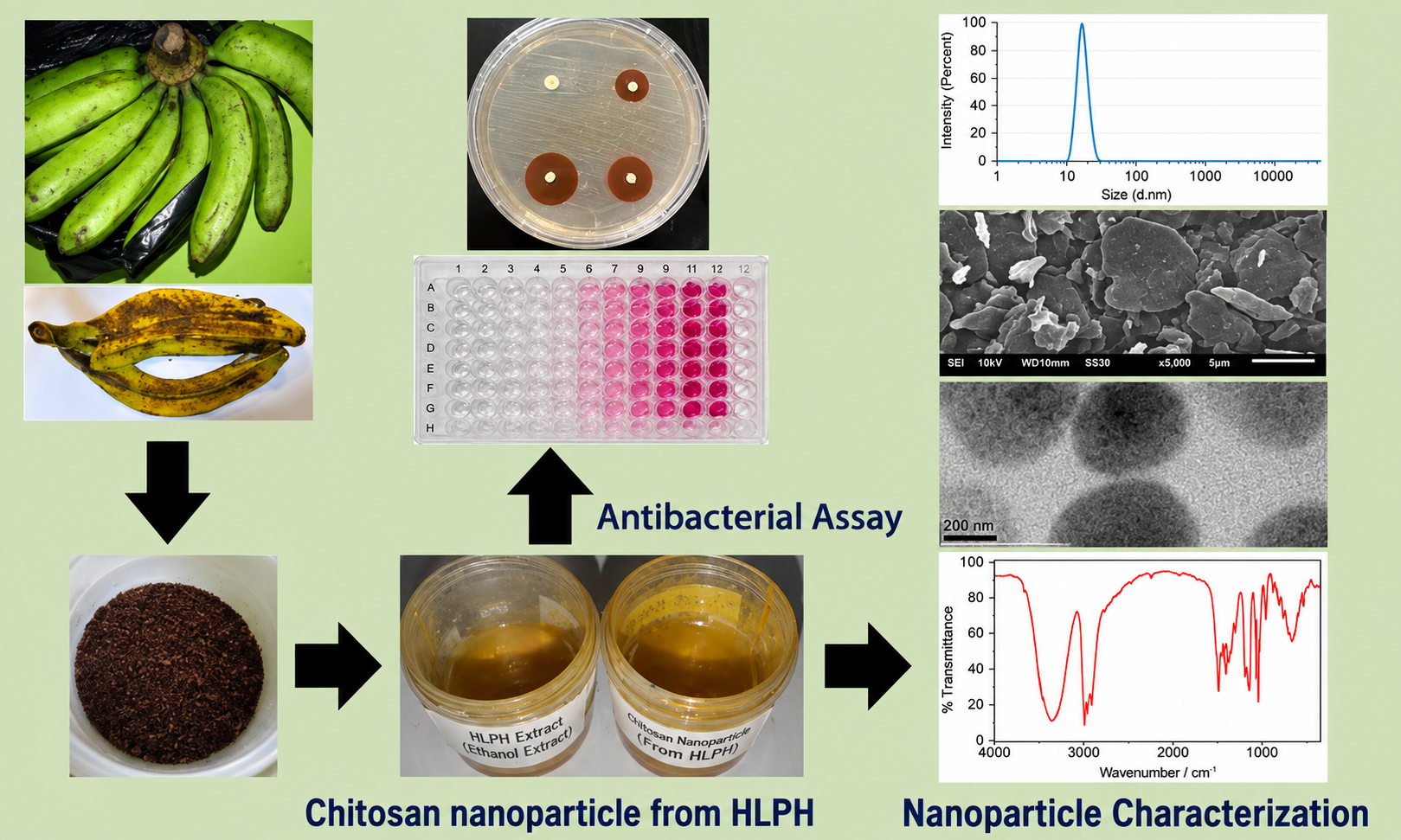
Hijau lumut banana peel (Musa × paradisiaca L.) contains bioactive compounds with antibacterial properties and has potential as a natural anti-acne agent. This study aimed to prepare and characterize chitosan-based nanoparticles incorporating hijau lumut banana peel (HLBP) ethanol extract, evaluate their antibacterial activity against Propionibacterium acnes, and identify their chemical constituents. HLBP extract was obtained by ethanol maceration and subsequently incorporated with chitosan and sodium tripolyphosphate (NaTPP) through an ionic gelation process to produce nanoparticles. The broth microdilution technique was used to determine the minimum inhibitory concentration (MIC) and minimum bactericidal concentration (MBC), while the agar diffusion assay was used to evaluate antibacterial activity. The nanoparticles were characterized using particle size analysis (PSA), scanning electron microscopy (SEM), transmission electron microscopy (TEM), Fourier-transform infrared spectroscopy (FTIR), and liquid chromatography–tandem mass spectrometry (LC–MS/MS). The nanoparticles exhibited strong antibacterial activity against P. acnes, with inhibition zones of 31.47 ± 0.03 mm and 28.15 ± 0.10 mm for formulations containing 0.5% and 1% chitosan, respectively. The MIC and MBC values were 1.25% and 2.50%, respectively. The optimal formulation containing 0.5% chitosan had a particle size of 721.9 ± 25.57 nm, a polydispersity index of 0.509 ± 0.018, and a zeta potential of −36.2 ± 0.60 mV. Morphological analysis revealed irregular, flattened particles. These findings suggest that chitosan nanoparticles loaded with HLBP exhibit promising antibacterial activity against P. acnes and have potential for use as a natural anti-acne formulation.
References
Abd-Allah, H., R. T. A. Abdel-Aziz, and M. Nasr (2020). Chitosan Nanoparticles Making Their Way to Clinical Practice: A Feasibility Study on Their Topical Use for Acne Treatment. International Journal of Biological Macromolecules, 156; 262–270
Akbari, B., M. P. Tavandashti, and M. Zandrahimi (2011). Particle Size Characterization of Nanoparticles: A Practical Approach. Iranian Journal of Materials Science and Engineering, 8; 48–56
Al-Darwesh, M. Y., S. S. Ibrahim, and A. M. Mohammed (2024). A Review on Plant Extract Mediated Green Synthesis of Zinc Oxide Nanoparticles and Their Biomedical Applications. Results in Chemistry, 7; 101368
Almeida, A. A. P., A. Farah, D. A. M. Silva, E. A. Nunan, and M. B. A. Gloria (2006). Antibacterial Activity of Coffee Extracts and Selected Coffee Chemical Compounds Against Enterobacteria. Journal of Agricultural and Food Chemistry, 54; 8738–8743
Antasionasti, I., I. Jayanto, S. S. Abdullah, and J. P. Siampa (2020). Characterization of Cinnamon (Cinnamomum burmanii) Ethanol Extract Nanoparticles with Chitosan Sodium Tripolyphosphate as an Antioxidant Candidate. Chemistry Progress, 13; 77–85
Chandrasekaran, M., K. D. Kim, and S. C. Chun (2020). Antibacterial Activity of Chitosan Nanoparticles: A Review. Processes, 8; 1173
Danaei, M., M. Dehghankhold, S. Ataei, F. Hasan-zadeh Davarani, R. Javanmard, A. Dokhani, S. Khorasani, and M. R. Mozafari (2018). Impact of Particle Size and Polydispersity Index on the Clinical Applications of Lipidic Nanocarrier Systems. Pharmaceutics, 10; 57
David, V., A.-N. Andrea, K. Aleksandr, J.-A. Lourdes, P. Eugenia, C. Nancy, W. Isabel, C. Jessica, and F. León-Tamariz (2021). Validation of a Method of Broth Microdilution for the Determination of Antibacterial Activity of Essential Oils. BMC Research Notes, 14; 439
Detsi, A., E. Kavetsou, I. Kostopoulou, I. Pitterou, A. R. N. Pontillo, A. Tzani, P. Christodoulou, A. Siliachli, and P. Zoumpoulakis (2020). Nano Systems for the Encapsulation of Natural Products: The Case of Chitosan Biopolymer as a Matrix. Pharmaceutics, 12; 1–48
Fatoni, A., V. F. Hidayah, Suyata, H. Diastuti, and M. D. Anggraeni (2023). Chitosan–Fe3O4 Nanoparticles Cryogel for Glucose Biosensor Development. Science and Technology Indonesia, 8; 52–58
Fitri, D., N. Z. W. Kiromah, and T. C. Widiastuti (2020). Formulation and Characterization of Bay Leaf (Syzygium polyanthum) Ethanol Extract Nanoparticles in Various Chitosan Compositions Using the Ionic Gelation Method. Journal of Pharmaceutical Science and Clinical Research, 5; 61–69
Irwandi, L. Azyenela, H. P. Sari, E. S. Wardi, and D. Sartika (2023). Isolation and Identification with 16S rRNA Gene of Endophytic Bacteria from Papaya (Carica papaya L.) and Test of Its Antibacterial Activity. Journal of Pharmaceutical and Sciences, 6; 1068–1078
Kuo, C.-W., Y.-F. Chiu, M.-H. Wu, M.-H. Li, C.-N. Wu, W. S. Chen, and C.-H. Huang (2021). Gelatin/Chitosan Bilayer Patches Loaded with Cortex Phellodendron amurense/Centella asiatica Extracts for Anti-Acne Application. Polymers, 13; 579
Lallemand, E. A., M. Z. Lacroix, P.-L. Toutain, S. Boullier, A. A. Ferran, and A. Bousquet-Melou (2016). In Vitro Degradation of Antimicrobials during Use of Broth Microdilution Method Can Increase the Measured Minimal Inhibitory and Minimal Bactericidal Concentrations. Frontiers in Microbiology, 7; 2051
Lim, K., W. Y. Li, A. Dinata, and E. T. Ho (2023). Comparing the Antibacterial Efficacy and Functionality of Different Commercial Alcohol-Based Sanitizers. PLoS One, 18; e0282005
Liu, F., Y. Zhang, Q.-Y. Sun, F.-M. Yang, W. Gu, J. Yang, H.-M. Niu, Y.-H. Wang, and C.-L. Long (2014). Diarylheptanoids and Phenylphenalenones from Musa itinerans Fruits. Phytochemistry, 103; 171–177
Lobiuc, A., N.-E. Pavˇal, I. I. Mangalagiu, R. Gheorghit, G.-C. Teliban, D. Amˇariucˇai-Mantu, and V. Stoleru (2023). Future Antimicrobials: Natural and Functionalized Phenolics. Molecules, 28; 1114
Luthfiyana, N., P. W. Ratrinia, I. Rhoinahda, T. Hidayat, and D. M. Wati (2024). The Antibacterial Effects of Chitosan Nanoparticles from Scylla sp. on Acne-Related Bacteria: Staphylococcus aureus and Staphylococcus epidermidis. In BIO Web of Conferences, volume 136. page 02003. The 13th International and National Seminar of Fisheries and Marine Science (ISFM XIII 2024)
Ly, P.-D., K.-N. Ly, H.-L. Phan, H. H. T. Nguyen, V.-A. Duong, and H. V. Nguyen (2024). Recent Advances in Surface Decoration of Nanoparticles in Drug Delivery. Frontiers in Nanotechnology, 6; 1456939
Mawazi, S. M., M. Kumar, N. Ahmad, Y. Ge, and S. Mahmood (2024). Recent Applications of Chitosan and Its Derivatives in Antibacterial, Anticancer, Wound Healing, and Tissue Engineering Fields. Polymers, 16; 1351
Nafee, N., S. Taetz, M. Schneider, U. F. Schaefer, and C.-M. Lehr (2007). Chitosan-Coated PLGA Nanoparticles for DNA/RNA Delivery: Effect of the Formulation Parameters on Complexation and Transfection of Antisense Oligonucleotides. Nanomedicine: Nanotechnology, Biology and Medicine, 3; 173–183
Nahrowi, R., S. Solehati, W. Widyastuti, N. L. G. R. Juliasih, K. D. Pandiangan, A. Setiawan, and J. Hendri (2024). New Encapsulation of Fucoxanthin Isolated from Cyclotella striata by Nano Chitosan–Pectin Using Ionic Gelation Method. Science and Technology Indonesia, 9; 515–528
Nalawade, T. M., K. Bhat, and S. H. Sogi (2015). Bactericidal Activity of Propylene Glycol, Glycerine, Polyethylene Glycol 400, and Polyethylene Glycol 1000 Against Selected Microorganisms. Journal of International Society of Preventive and Community Dentistry, 5; 114–119
Niederstebruch, N., D. Sixt, B. I. Benda, and N. Banboye (2017). A Suitable Blood Agar Containing Human Blood Especially for the Use in Laboratories of Developing Countries. The Journal of Infection in Developing Countries, 11; 399–406
Ningsih, N., S. Yasni, and S. Yuliani (2017). Synthesis of Red Mangosteen Peel Extract Nanoparticles and Study of the Functional Properties of the Encapsulated Products. Jurnal Teknologi dan Industri Pangan, 23; 27–35
Okorie, D. O., C. O. Eleazu, and P. Nwosu (2015). Nutrient and Heavy Metal Composition of Plantain (Musa paradisiaca) and Banana (Musa paradisiaca) Peels. Journal of Nutrition & Food Sciences, 5; 1000370
Palacios, H. A., A. Stefanello, M. S. G. Gavilánez, D. A. C. Demera, M. V. Garcia, W. A. V. Castillo, M. A. A. Marcano, I. R. S. Maigua, and M. V. Copetti (2022). Relationship Between the Fungal Incidence, Water Activity, Humidity, and Aflatoxin Content in Maize Samples from the Highlands and Coast of Ecuador. Toxins, 14; 196
Putri, A. I., A. Sundaryono, and I. N. Candra (2019). Characterization of Chitosan Nanoparticles from Sweet Potato (Ipomoea batatas L.) Leaf Extract Using Ionic Gelation Method. Jurnal Pendidikan dan Ilmu Kimia, 2; 203–207
Qiu, Z., F. Wu, H. Hu, J. Guo, C. Wu, P. Wang, J. Ling, Y. Cui, J. Ye, G. Fang, and X. Liu (2024). Deciphering the Microbiological Mechanisms Underlying the Impact of Different Storage Conditions on Rice Grain Quality. Foods, 13; 266
Rismana, E., S. Kusumaningrum, O. Bunga, Nizar, and Marhamah (2014). Anti-Acne Activity Testing of Chitosan Nanoparticles-Mangosteen Peel Extract (Garcinia mangostana). Media Litbangkes, 24(1); 19–27
Rita, W. S., I. M. D. Swantara, I. A. R. A. Asih, and N. M. Puspawati (2020). Antibacterial Activity and Antioxidant Capacity of Selected Local Banana Peel (Musa sp.) Methanol Extracts Cultivated in Bali. International Journal of Agriculture, Environment and Bioresearch, 5; 242–251
Rita, W. S., N. K. L. E. Yanti, and I. M. D. Swantara (2023). Antibacterial Activity and Characterization of Chitosan Nanoparticles Prepared from Hijau Lumut Banana (Musa paradisiaca L.) Peel Ethyl Acetate Extract. Nano Biomedicine and Engineering, 15(3); 278–287
Riwanti, P., I. K. Prasetyanti, and B. Ma’arif (2023). Metabolite Profiling of Compounds from Sargassum polycystum Using UPLC-QToF-MS/MS. Pharmacognosy Journal, 15; 321–333
Rudiyat, A., R. Yulianti, and I. Indra (2020). Formulation of an Anti-Acne Cream Containing Ethanol Extract of Kepok Banana Peel (Musa balbisiana Colla). Jurnal Kesehatan Bakti Tunas Husada: Jurnal Ilmu-Ilmu Keperawatan, Analis Kesehatan dan Farmasi, 20; 170–180
Samra, R., A. Othman, M. Elsbaey, Y. Amen, and K. Shimizu (2024). Comprehensive Review on Megastigmane Glycosides: Sources, Bioactivities, and 13C NMR Spectroscopic Data. Phytochemistry Letters, 60; 19–89
Santo, M. C. D., C. L. D’Antoni, A. P. D. Rubio, A. Alaimo, and O. E. Pérez (2021). Chitosan-Tripolyphosphate Nanoparticles Designed to Encapsulate Polyphenolic Compounds for Biomedical and Pharmaceutical Applications: A Review. Biomedicine & Pharmacotherapy, 142; 111970
Sathiyabama, M., R. V. Boomija, S. Muthukumar, M. Gandhi, S. Salma, T. K. Prinsha, and B. Rengasamy (2024). Green Synthesis of Chitosan Nanoparticles Using Tea Extract and Its Antimicrobial Activity Against Economically Important Phytopathogens of Rice. Scientific Reports, 14; 7381
Sekar, M. and F. H. A. Halim (2017). Formulation and Evaluation of Natural Anti-Acne Cream Containing Syzygium samarangense Fruit Extract. Annual Research & Review in Biology, 17(3); 1–7
Souza, T. G. F., V. S. T. Ciminelli, and N. D. S. Mohallem (2016). A Comparison of TEM and DLS Methods to Characterize Size Distribution of Ceramic Nanoparticles. In IOP Conference Series: Materials Science and Engineering, volume 733. page 012039
Stefanache, A., I. J. Lungu, N. Anton, D. Damir, C. Gutu, I. Olaru, A. P. Condratovici, M. Duceac, M. Constantin, G. Calin, L. D. Duceac, and M. Boev (2025). Chitosan Nanoparticle-Based Drug Delivery Systems: Advances, Challenges, and Future Perspectives. Polymers, 17; 1453
Ulusoy, U. (2023). A Review of Particle Shape Effects on Material Properties for Various Engineering Applications: From Macro to Nanoscale. Minerals, 13; 91
Verma, A., S. P. Gautam, K. K. Bansal, N. Prabhakar, and J. M. Rosenholm (2019). Green Nanotechnology: Advancement in Phytoformulation Research. Medicines, 6; 1–10
Wiegand, I., K. Hilpert, and R. E. W. Hancock (2008). Agar and Broth Dilution Methods to Determine the Minimal Inhibitory Concentration (MIC) of Antimicrobial Substances. Nature Protocols, 3; 163–175
Woziwodzka, A., M. Krychowiak-Mašnic, G. Gołuński, A. Łosiewska, A. Borowik, D. Wyrzykowski, and J. Piosik (2022). New Life of an Old Drug: Caffeine as a Modulator of Antibacterial Activity of Commonly Used Antibiotics. Pharmaceuticals, 15; 872
Ye, J., S. Mo, L. Jia, and Y. Chen (2022). Experimental Performance of a LED Thermal Management System with Suspended Microencapsulated Phase Change Material. Applied Thermal Engineering, 207; 118155
Zahed, N., R. E. Kenari, and R. Farahmandfar (2023). Effect of Different Extraction Methods on Antioxidant Properties and Encapsulation Efficiency of Anthocyanin of Pomegranate Peel. Food Science & Nutrition, 11; 3619–4352
Zambrano, M. V., B. Dutta, D. G. Mercer, H. L. MacLean, and M. F. Touchie (2019). Assessment of Moisture Content Measurement Methods of Dried Food Products in Small Scale Operations in Developing Countries: A Review. Trends in Food Science & Technology, 88; 484–496
Authors

This work is licensed under a Creative Commons Attribution 4.0 International License.