
Colorimetric Intelligent Film Based on Carboxymethyl Cellulose/Sodium Alginate Incorporated Black Rice Bran Anthocyanins Co-Pigments for Shrimp Spoilage Monitoring
Article Sidebar
-
Intelligent Packaging, pH-Sensitive, Juedanor Rice, Anthocyanin, Shrimp Spoilage, Carboxymethyl Cellulose (CMC)
Abstract
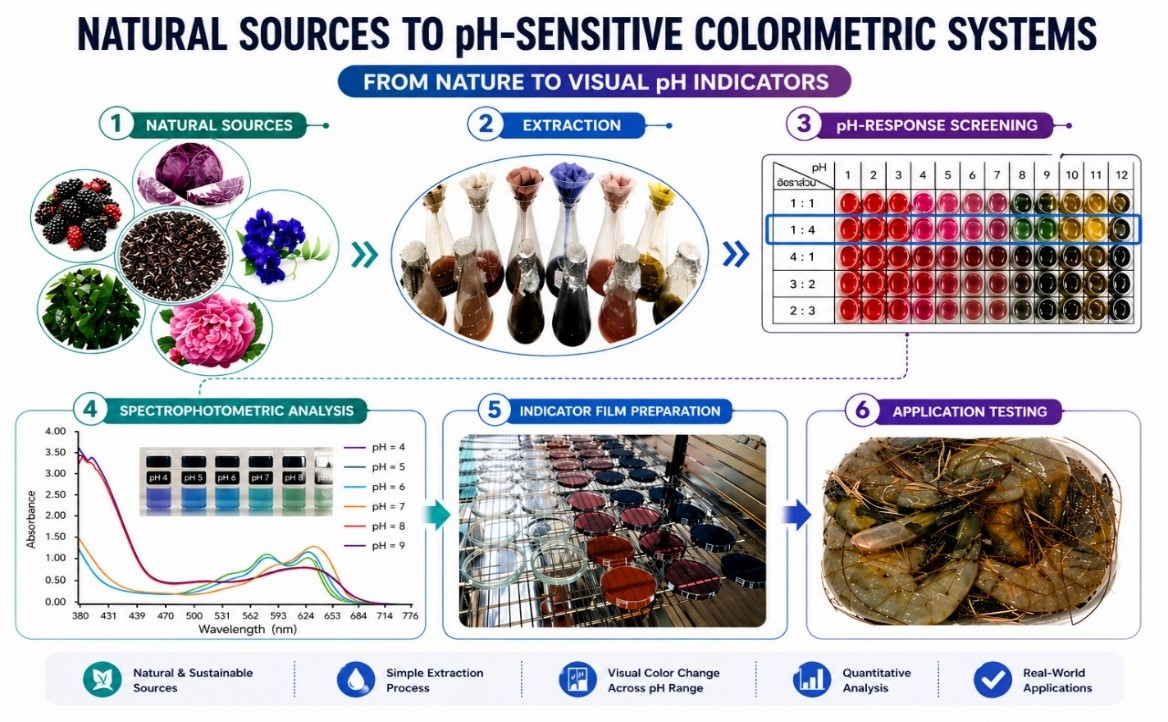
Colorimetric intelligent film for monitoring shrimp spoilage based on carboxymethyl cellulose (CMC)/sodium alginate (SA) and co-anthocyanin extract derived from natural source was fabricated. Juedanor (JD) rice, a black-purple variety cultivated and consumed in Pattani province, Southern Thailand, served as the primary source of anthocyanin in this study. Consequently, utilizing anthocyanin pigments from JD and other plants in indicator films for the detection of food deterioration is an effective approach. Mulberry (M) showed the highest anthocyanin content at 341.275 mg/L, followed by 170.730 mg/L in purple cabbage (PC) and 136.955 mg/L in JD rice. The intelligent films were then fabricated using CMC/SA loading with co-anthocyanin pigment (PC: JD) at a 1:4 ratio. The film incorporating JD extract and purple cabbage established the widespread colour change during pH sensitive test. Further tests were conducted on the film using an ammonia solution to assess shrimp spoilage. Film color (%S, ΔE) and pH showed a high association, suggesting that the films can be used as sensitive markers of shrimp freshness during storage time. The predicted ΔE values closely match the experimental values over the ammonia exposure duration, with a high R² coefficient of 0.985, which signifies a robust association. This study demonstrates the potential of utilizing anthocyanins from the indigenous JD rice variety for intelligent packaging and future food production. The value assigned to this native rice will aid in its utilization, conservation, and additional benefit to the community.
References
Cai, D., X. Li, J. Chen, X. Jiang, X. Ma, J. Sun, L. Tian, S. K. Vidyarthi, J. Xu, Z. Pan, and W. Bai (2022). A Comprehensive Review on Innovative and Advanced Stabilization Approaches of Anthocyanin by Modifying Structure and Controlling Environmental Factors. Food Chemistry, 366; 130611
Chen, L., W. Wang, W. Wang, and J. Zhang (2023). Effect of Anthocyanins on Colorimetric Indicator Film Properties. Coatings, 13(10); 1682
Chen, X., Q. Gao, S. Liao, Y. Zou, J. Yan, and Q. Li (2022). Co-Pigmentation Mechanism and Thermal Reaction Kinetics of Mulberry Anthocyanins with Different Phenolic Acids. Foods, 11(23); 3806
Enaru, B., G. Dreţcanu, T. D. Pop, A. Stănilă, and Z. Diaconeasa (2021). Anthocyanins: Factors Affecting Their Stability and Degradation. Antioxidants, 10(12); 1967
Estévez, L., M. Queizán, R. A. Mosquera, L. Guidi, E. Lo Piccolo, and M. Landi (2021). First Characterization of the Formation of Anthocyanin–Ge and Anthocyanin–B Complexes Through UV–Vis Spectroscopy and Density Functional Theory Quantum Chemical Calculations. Journal of Agricultural and Food Chemistry, 69(4); 1272–1282
Ferone, M., A. Gowen, S. Fanning, and A. G. M. Scannell (2019). A Novel pH-Sensing Indicator Based on Bacterial Cellulose Nanofibers and Black Carrot Anthocyanins for Monitoring Fish Freshness. Carbohydrate Polymers, 222; 115030
Ghoshal, G. (2018). Recent Trends in Active, Smart, and Intelligent Packaging for Food Products. In Food Packaging and Preservation. Academic Press, pages 343–374
Giusti, M. M. and R. E. Wrolstad (2001). Characterization and Measurement of Anthocyanins by UV-Vis Spectroscopy. In R. E. Wrolstad, editor, Current Protocols in Food Analytical Chemistry. John Wiley & Sons, pages F1.2.1–F1.2.13
Hidayaty, A. N., S. Fiddaroini, A. L. Fahmi, Q. Fardiyah, and A. Sabarudin (2026). Optimization and Stability Assessment of Chitosan/PVA Smart Sensor Films Incorporated with Roselle Anthocyanins for Real-Time Visual Monitoring of Chicken and Shrimp Freshness under Different Storage Conditions. Science and Technology Indonesia, 11(1); 217–234
Hosseini, H. and S. M. Jafari (2020). Fourier Transform Infrared (FT-IR) Spectroscopy of Nanoencapsulated Food Ingredients. In S. M. Jafari, editor, Characterization of Nanoencapsulated Food Ingredients, volume 4. Academic Press, pages 347–410
Hu, H., J. Chen, C. Lin, H. Sun, and Y. Chen (2025). Characterization of Edible pH-Responsive Ink Based on Carboxymethyl Chitosan and Purple Potato Anthocyanin/Curcumin for Monitoring Pork Freshness. Packaging Technology and Science, 38(3); 227–239
Huang, J., Z. Hu, G. Li, Y. Chin, Z. Pei, Q. Yao, and Y. Hu (2023). The Highly Stable Indicator Film Incorporating Roselle Anthocyanin Co-Pigmented with Oxalic Acid: Preparation, Characterization and Freshness Monitoring Application. Food Research International, 173; 113416
Kerbstadt, S., L. Eliasson, A. Mustafa, and L. Ahrné (2015). Effect of Novel Drying Techniques on the Extraction of Anthocyanins from Bilberry Press Cake Using Supercritical Carbon Dioxide. Innovative Food Science & Emerging Technologies, 29; 209–214
Kwak, M. and S.-C. Min (2024). Monitoring Meat Freshness with Intelligent Colorimetric Labels Containing Red Cabbage Anthocyanins Co-Pigmented with Gelatin and Gallic Acid. Foods, 13(21); 3464
Li, R., H. Feng, S. Wang, D. Zhuang, and J. Zhu (2024). A Colorimetry-Enhanced Tri-Functional Film with High Stability by Polyphenol–Anthocyanin Co-Pigmentation/Conjugate: New Prospect for Active Intelligent Food Packaging. Food Chemistry, 447; 138927
Liu, Z., Q. Liu, S. Wei, Q. Sun, Q. Xia, D. Zhang, W. Shi, H. Ji, and S. Liu (2021). Quality and Volatile Compound Analysis of Shrimp Heads During Different Temperature Storage. Food Chemistry: X, 12; 100156
Ma, Y., S. Li, T. Ji, W. Wu, D. E. Sameen, S. Ahmed, W. Qin, J. Dai, and Y. Liu (2020). Development and Optimization of Dynamic Gelatin/Chitosan Nanoparticles Incorporated with Blueberry Anthocyanins for Milk Freshness Monitoring. Carbohydrate Polymers, 247; 116738
Moradi, M., H. Tajik, H. Almasi, M. Forough, and P. Ezati (2020). Microbial Detection and Identification Methods: Bench Top Assays to Omics Approaches. Comprehensive Reviews in Food Science and Food Safety, 19(6); 3106–3129
Nadi, M., S. M. A. Razavi, and D. Shahrampour (2023). Fabrication of Green Colorimetric Smart Packaging Based on Basil Seed Gum/Chitosan/Red Cabbage Anthocyanin for Real-Time Monitoring of Fish Freshness. Food Science & Nutrition, 11; 6360–6375
Pawde, S. V., N. Khawmak, N. Janudom, K. Unboontham, N. Konsue, D. Wu, W. Zhang, Y. H. Jung, and S. Rawdkuen (2026). Dual-Function Biodegradable Film Based on Gelatin–Chitosan Incorporating Careya sphaerica (Kradon) Extract and Red Cabbage Anthocyanins: Smart Antimicrobial and pH Indicator for Monitoring Fresh-Cut Pork Quality. Food Packaging and Shelf Life, 55; 101780
Phanumong, P. (2021). Characterization and Properties of Chitosan/PVA Bio-Based Film Incorporated with Clitoria ternatea L. (Butterfly Pea) Extract and Its Application in Foods. Journal of Food Health and Bioenvironmental Science, 14(3); 1–11
Prietto, L., T. C. Mirapalhete, V. Z. Pinto, J. F. Hoffmann, N. L. Vanier, L. T. Lim, A. R. G. Dias, and E. R. Zavareze (2017). pH-Sensitive Films Containing Anthocyanins Extracted from Black Bean Seed Coat and Red Cabbage. LWT – Food Science and Technology, 80; 492–500
Priyadarshi, R. and J.-W. Rhim (2020). Chitosan-Based Biodegradable Functional Films for Food Packaging Applications. Innovative Food Science & Emerging Technologies, 62; 102346
Remedio, L. N. and C. Parada Quinayá (2024). Intelligent Packaging Systems with Anthocyanin: Influence of Different Polymers and Storage Conditions. Polymers, 16(20); 2886
Rhim, J.-W. (2012). Physical-Mechanical Properties of Agar/κ-Carrageenan Blend Film and Derived Clay Nanocomposite Film. Journal of Food Science, 77(12); N66–N73
Rosalina, Y., E. Warsiki, A. M. Fauzi, and I. Sailah (2022). Study of Anthocyanin Extraction from Red Banana (Musa sapientum L. var. Rubra) Waste and Characteristics of Light Effects. Science and Technology Indonesia, 7(4); 522–529
Roy, S. and J.-W. Rhim (2020). Preparation of Gelatin/Carrageenan-Based Color-Indicator Film Integrated with Shikonin and Propolis for Smart Food Packaging Applications. ACS Applied Bio Materials, 4(1); 770–779
Roy, S. and J.-W. Rhim (2021). Preparation of Gelatin/Carrageenan-Based Color-Indicator Film Integrated with Shikonin and Propolis for Smart Food Packaging Applications. ACS Applied Bio Materials, 4(1); 770–779
Sobhan, A., K. Muthukumarappan, and L. Wei (2022). A Biopolymer-Based pH Indicator Film for Visually Monitoring Beef and Fish Spoilage. Food Bioscience, 46; 101523
Tang, B., Y. He, J. Liu, J. Zhang, J. Li, J. Zhou, Y. Ye, J. Wang, and X. Wang (2019). Kinetic Investigation into pH-Dependent Color of Anthocyanin and Its Sensing Performance. Dyes and Pigments, 170; 107643
Tavakoli, S., E. Mubango, L. Tian, Y. B. N'Dri, Y. Tan, H. Hong, and Y. Luo (2023). Novel Intelligent Films Containing Anthocyanin and Phycocyanin for Nondestructively Tracing Fish Spoilage. Food Chemistry, 402; 134203
Teng, Z., X. Jiang, F. He, and W. Bai (2020). Qualitative and Quantitative Methods to Evaluate Anthocyanins. eFood, 1(5); 339–346
Thevarajah, B., S. Piyatilleke, P. H. V. Nimarshana, S. Koushalya, A. Malik, and T. U. Ariyadasa (2024). Exploring Effective Light Spectral Conversion Techniques for Enhanced Production of Spirulina-Derived Blue Pigment Protein, C-Phycocyanin. Bioresource Technology, 399; 130612
Welch, C. R., Q. Wu, and J. E. Simon (2008). Recent Advances in Anthocyanin Analysis and Characterization. Current Analytical Chemistry, 4(2); 75–101
Xiong, G., X. Zhou, C. Zhang, and X. Xu (2024). A Comprehensive Review of Intelligent Packaging Materials Based on Biopolymers: Role of Anthocyanins, Type and Properties of Materials, and Their Application in Monitoring Meat Freshness. International Journal of Biological Macromolecules, 282; 137462
Yang, G.-M., X.-H. Fan, X.-L. Chen, L.-S. Yuan, X. Huang, and X. Li (2015). Interaction Mechanism Between Carboxylmethyl Cellulose and Iron Ore Concentrates in Iron Ore Agglomeration. Journal of Central South University, 22(4); 1241–1246
Yang, M., J. Lin, M. Zhang, Y. Zhuang, Y. Li, B. Wang, Z. Zhang, J. Liu, and P. Fei (2025). Recent Advances in the Development and Application of Anthocyanin-Based Intelligent Active Food Packaging: A Review. Food Chemistry, 492; 145309
Yang, Y., X. Yu, Y. Zhu, Y. Zeng, C. Fang, Y. Liu, and W. Jiang (2022). Preparation and Application of a Colorimetric Film Based on Sodium Alginate/Sodium Carboxymethyl Cellulose Incorporated with Rose Anthocyanins. Food Chemistry, 393; 133342
Yavari Maroufi, L., M. Ghorbani, M. Tabibiazar, M. Mohammadi, and A. Pezeshki (2021). Advanced Properties of Gelatin Film by Incorporating Modified Kappa-Carrageenan and Zein Nanoparticles for Active Food Packaging. International Journal of Biological Macromolecules, 183; 753–759
Yong, H. and J. Liu (2020). Recent Advances in the Preparation, Physical and Functional Properties, and Applications of Anthocyanins-Based Active and Intelligent Packaging Films. Food Packaging and Shelf Life, 26; 100550
Authors

This work is licensed under a Creative Commons Attribution 4.0 International License.