
A Residual-Based Hybrid SVR–Ordinary Kriging–IDW with Residual Correction for Spatial Interpolation of Seismicity Parameters in Sumatra
Article Sidebar
-
Absolute Residual Correction, Geostatistical Modeling, Hybrid Interpolation, Seismicity Parameters, SVR–Ordinary Kriging
Abstract
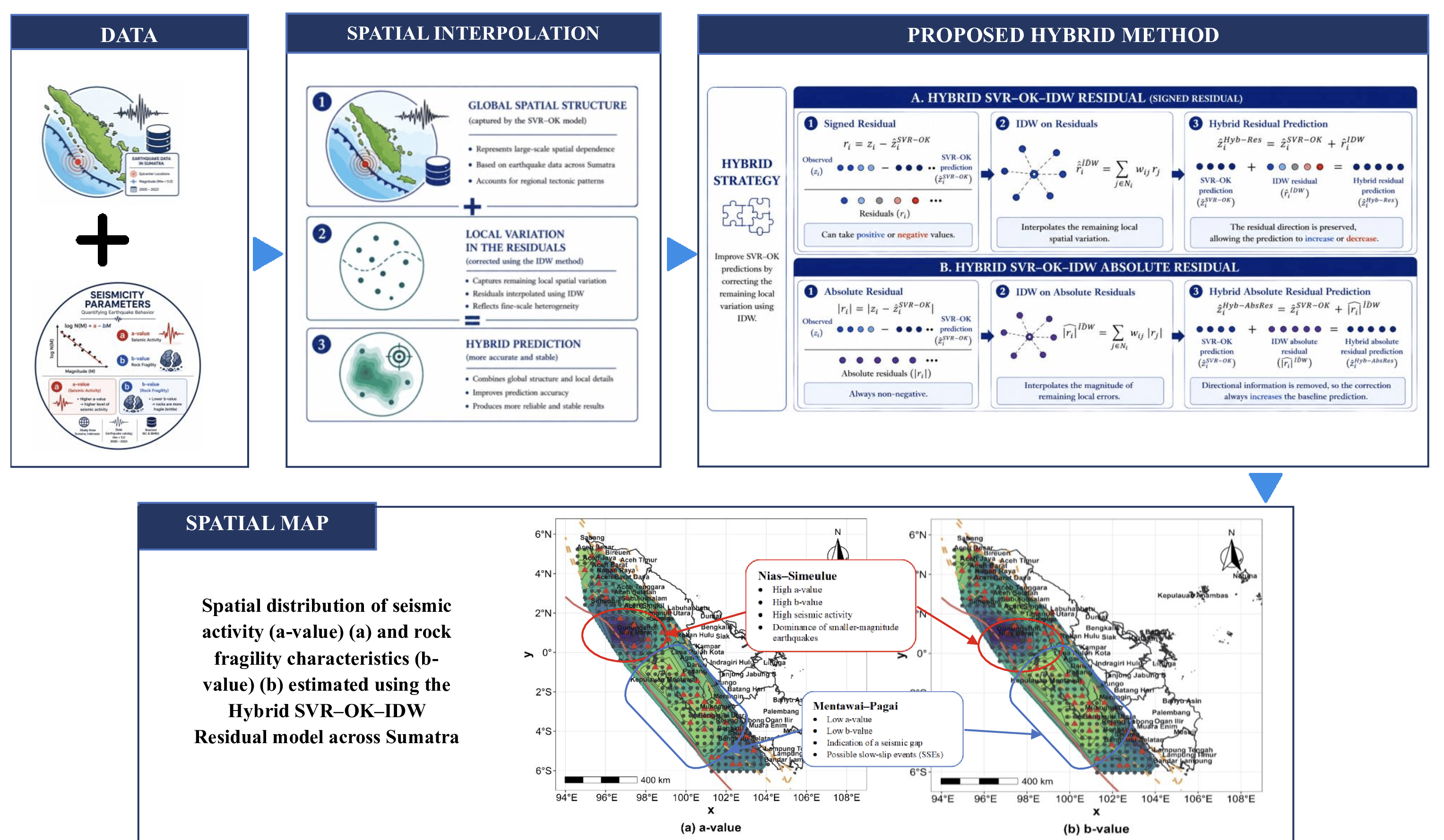
Accurate spatial prediction of seismicity parameters is important for characterizing seismotectonic behavior in tectonically complex regions. This study developed a hybrid spatial interpolation framework integrating Support Vector Regression–Ordinary Kriging (SVR–OK) with Inverse Distance Weighting (IDW) residual correction for estimating seismic activity (a-value) and rock fragility (b-value) across Sumatra. A total of 238 seismicity data points derived from ISC and BMKG earthquake catalogs (Mw > 5.0) for 2000–2023 were analyzed. SVR–OK was used to capture global spatial variation through flexible empirical semivariogram modeling, while IDW-based residual correction captured local variation remaining unexplained by the primary model. Performance was evaluated using LOOCV, independent testing, RMSE, MAE, RMSEP, residual diagnostics, and Moran’s I. The Hybrid SVR–OK–IDW Residual model achieved the lowest test RMSEP, reducing errors from 0.961 to 0.837 for the a-value and from 0.166 to 0.149 for the b-value, while reducing remaining positive spatial autocorrelation. Spatial contour maps identified distinct seismotectonic zonation, particularly in the Nias–Simeulue and Mentawai–Pagai segments. Simulation experiments showed that its advantage was most pronounced for clustered spatial patterns at small to moderate sample sizes (n = 64 and 225), whereas Gaussian–OK and SVR–OK performed better for unclustered patterns. These findings demonstrate the advantage of combining SVR–OK for global spatial variation with IDW residual correction for localized variation, particularly under clustered and spatially heterogeneous conditions.
References
Chasanah, U. and E. Handoyo (2021). Determination the Magnitude of Completeness, b-Value and a-Value for Seismicity Analysis in East Java, Indonesia. Journal of Physics: Conference Series, 1805(1); 012009
Chen, L., M. Ma, M. Wu, W. Pedrycz, and K. Hirota (2025). Extended Multi-Kernel Relevance Vector Machine Optimized Kriging Interpolation for Coal Seam Thickness Prediction in Coal-Bearing Strata. Engineering Applications of Artificial Intelligence, 145; 110093
Cressie, N. A. C. (1993). Statistics for Spatial Data. John Wiley & Sons, revised edition edition
de Mattos Neto, P. S. G., G. D. C. Cavalcanti, D. S. Domingos, and E. G. Silva (2022). Hybrid Systems Using Residual Modeling for Sea Surface Temperature Forecasting. Scientific Reports, 12(1)
Ding, X., J. Liu, F. Yang, and J. Cao (2021). Random Radial Basis Function Kernel-Based Support Vector Machine. Journal of the Franklin Institute, 358(18); 10121–10140
Dragert, H., K. Wang, and T. S. James (2001). A Silent Slip Event on the Deeper Cascadia Subduction Interface. Science, 292(5521); 1525–1528
Elen, A., S. Baş, and C. Közkurt (2022). An Adaptive Gaussian Kernel for Support Vector Machine. Arabian Journal for Science and Engineering, 47(8); 10579–10588
Erdogan Erten, G., M. Yavuz, and C. V. Deutsch (2022). Combination of Machine Learning and Kriging for Spatial Estimation of Geological Attributes. Natural Resources Research, 31(1); 191–213
Galina, N. A., V. V. Bykova, R. N. Vakarchuk, and R. E. Tatevosian (2019). Effect of Earthquake Catalog Declustering on Seismic Hazard Assessment. Seismic Instruments, 55(1); 59–69
García-Díaz, Noel and Verduzo-Ramirez, Alberto and Garcia-Virgen, Juan and Muñoz, Lilia (2016). Applying Absolute Residuals as Evaluation Criterion for Estimating the Development Time of Software Projects by Means of a Neuro-Fuzzy Approach. Journal of Information Systems Engineering & Management, 1(4)
Gutenberg, B. and C. F. Richter (1944). Frequency of Earthquakes in California. Bulletin of the Seismological Society of America, 34(4); 185–188
Han, C., J. Wang, M. Zheng, E. Wang, J. Xia, G. S. Li, and S. Choe (2016). New Variogram Modeling Method Using MGGP and SVR. Earth Science Informatics, 9(2); 197–213
Hengl, T., G. B. M. Heuvelink, and D. G. Rossiter (2007). About Regression-Kriging: From Equations to Case Studies. Computers & Geosciences, 33(10); 1301–1315
Hsu, Y. J., M. Simons, J. P. Avouac, J. Galeteka, K. Sieh, M. Chlieh, D. Natawidjaja, L. Prawirodirdjo, and Y. Bock (2006). Frictional Afterslip Following the 2005 Nias-Simeulue Earthquake, Sumatra. Science, 312(5782); 1921–1926
Huang, Z., H. Wang, and R. Zhang (2012). An Improved Kriging Interpolation Technique Based on SVM and Its Recovery Experiment in Oceanic Missing Data. American Journal of Computational Mathematics, 2012(1); 56–60
Li, J. (2022). Spatial Predictive Modelling with R. CRC Press
Li, J. and A. D. Heap (2011). A Review of Comparative Studies of Spatial Interpolation Methods in Environmental Sciences: Performance and Impact Factors. Ecological Informatics, 6(3–4); 228–241
Li, J., A. Potter, Z. Huang, and A. D. Heap (2011). Predicting Seabed Mud Content across the Australian Margin II: The Performance of Machine Learning Methods and Their Combinations with Ordinary Kriging or Inverse Distance Squared. ResearchGate
Ma, N., Y. Bai, S. Meng, A. De Santis, V. Kossobokov, D. Ouzounov, and S. Pulinets (2021). Return Period Evaluation of the Largest Possible Earthquake Magnitudes in Mainland China Based on Extreme Value Theory. Sensors, 21(10); 3519
Mallick, R., A. J. Meltzner, L. L. H. Tsang, E. O. Lindsey, L. Feng, and E. M. Hill (2021). Long-Lived Shallow Slow-Slip Events on the Sunda Megathrust. Nature Geoscience, 14(5); 327–333
McCaffrey, R. (2009). The Tectonic Framework of the Sumatran Subduction Zone. Annual Review of Earth and Planetary Sciences, 37; 345–366
Megawati, K. and T. C. Pan (2009). Regional Seismic Hazard Posed by the Mentawai Segment of the Sumatran Megathrust. Bulletin of the Seismological Society of America, 99(2A); 566–584
Montesinos López, O. A., A. Montesinos López, and J. Crossa (2022). Support Vector Machines and Support Vector Regression. In Multivariate Statistical Machine Learning Methods for Genomic Prediction. Springer, Cham
Obara, K. (2002). Nonvolcanic Deep Tremor Associated with Subduction in Southwest Japan. Science, 296(5573); 1679–1681
Palacios, P., I. Molina, and M. Segovia (2006). The Gutenberg-Richter Law: Assumptions, Limitations and Interpretations. In Statistics in Volcanology. pages 115–127
Prawirodirdjo, L., R. McCaffrey, C. D. Chadwell, Y. Bock, and C. Subarya (2010). Geodetic Observations of an Earthquake Cycle at the Sumatra Subduction Zone: Role of Interseismic Strain Segmentation. Journal of Geophysical Research: Solid Earth, 115(B3)
Putra, A. S., D. P. Sahara, A. D. Nugraha, N. T. Puspito, P. Supendi, and N. Heryandoko (2023). Segmentation of the Sumatran Fault Zone Based on Spatial Variation of b-Values. Journal of Seismology, 27(5); 919–932
Qin, Y., J. Chen, S. C. Singh, N. Hananto, H. Carton, and P. Tapponnier (2024). Assessing the Risk of Potential Tsunamigenic Earthquakes in the Mentawai Region by Seismic Imaging, Central Sumatra. Geochemistry, Geophysics, Geosystems, 25(5); e2023GC011149
Ramos, Y., B. St-Onge, J. P. Blanchet, and A. Smargiassi (2015). Spatio-Temporal Models to Estimate Daily Concentrations of Fine Particulate Matter in Montreal: Kriging with External Drift and Inverse Distance-Weighted Approaches. Journal of Exposure Science & Environmental Epidemiology, 26(4); 405–414
Rizal, J., A. Y. Gunawan, S. W. Indratno, and I. Meilano (2023). Seismic Activity Analysis of Five Major Earthquake Source Segments in the Sumatra Megathrust Zone: Each Segment and Two Adjacent Segments Points of View. Bulletin of the New Zealand Society for Earthquake Engineering, 56(2); 55–70
Rousset, B., R. Bürgmann, and M. Campillo (2019). Slow Slip Events in the Roots of the San Andreas Fault. Science Advances, 5(2)
Seo, Y., S. Kim, and V. P. Singh (2015). Estimating Spatial Precipitation Using Regression Kriging and Artificial Neural Network Residual Kriging (RKNNRK) Hybrid Approach. Water Resources Management, 29(7); 2189–2204
Shepperd, M. and S. MacDonell (2012). Evaluating Prediction Systems in Software Project Estimation. Information and Software Technology, 54(8); 820–827
Sirodj, D. A. N., M. N. Aidi, B. Sartono, U. D. Syafitri, and B. Pranata (2025a). Identification of Earthquake Prone Zones in Sumatra Using Density Based Spatial Clustering of Applications with Noise. CAUCHY: Jurnal Matematika Murni dan Aplikasi, 10(2); 916–928
Sirodj, D. A. N., M. N. Aidi, B. Sartono, U. D. Syafitri, and B. Pranata (2025b). Integrating Support Vector Regression and Kriging in Spatial Interpolation of Statistical Seismicity Parameters. Indonesian Journal of Geography, 57(3); 463–470
Tsang, L. L. H., A. J. Meltzner, B. Philibosian, E. M. Hill, J. T. Freymueller, and K. Sieh (2015). A 15 Year Slow-Slip Event on the Sunda Megathrust Offshore Sumatra. Geophysical Research Letters, 42(16); 6630–6638
Van Beers, W. C. M. and J. P. C. Kleijnen (2003). Kriging for Interpolation in Random Simulation. Journal of the Operational Research Society, 54(3); 255–262
Wu, C. H., G. H. Tzeng, and R. H. Lin (2009). A Novel Hybrid Genetic Algorithm for Kernel Function and Parameter Optimization in Support Vector Regression. Expert Systems with Applications, 36(3); 4725–4735
Yuliatmoko, R. S. (2020). Analisis Seismic GAP Sumatera Menggunakan Anomali Gravitasi. Megasains, 11(1); 24–30. (in Indonesia)
Authors

This work is licensed under a Creative Commons Attribution 4.0 International License.