
A Comparative Study of Confidence Intervals for the Parameter of the XShanker Distribution with Applications
Article Sidebar
-
Bootstrap Method, Interval Estimation, Likelihood Method, Mixture Distribution, Wald Method
Abstract
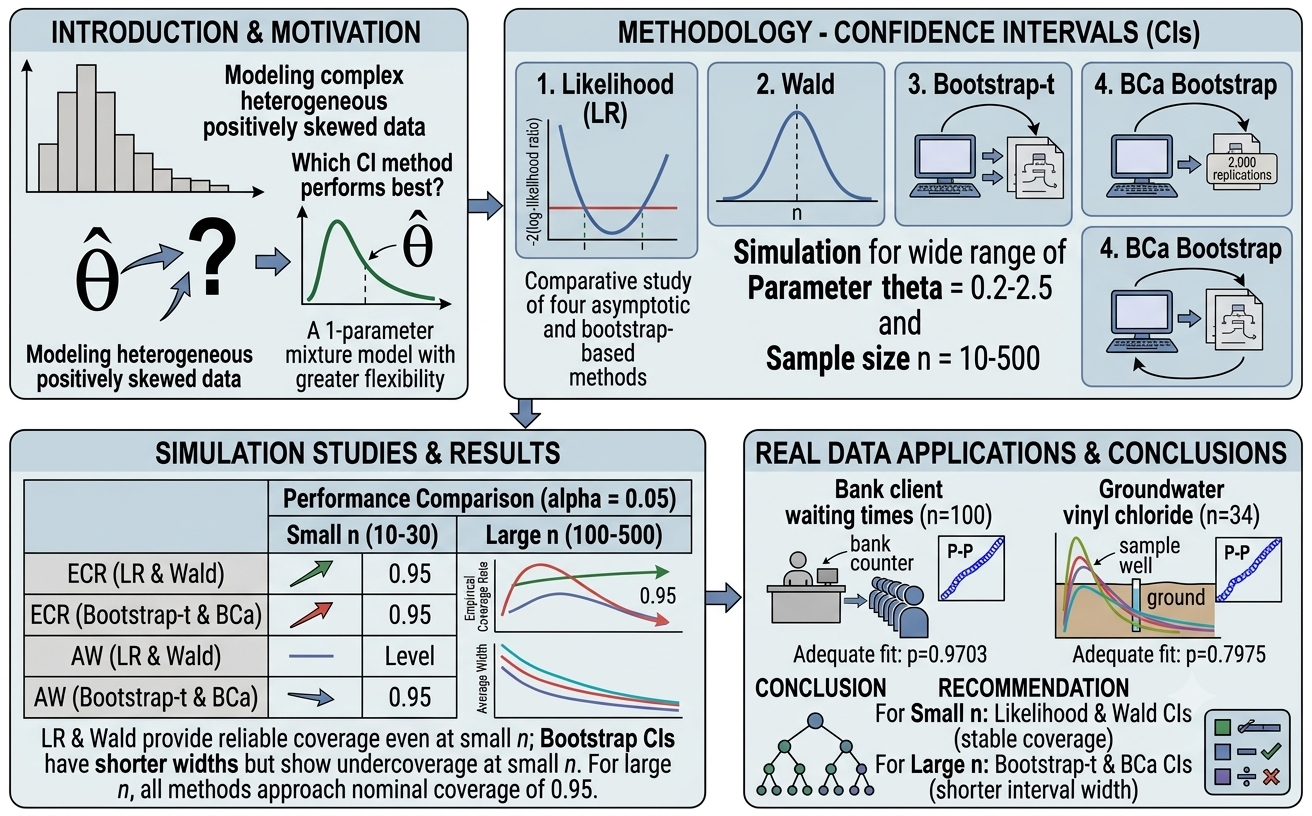
Statistical modeling of lifetime and reliability data has gained significant interest in the last few decades because of its potential use in various disciplines, including engineering, biomedical sciences, agriculture, and medicine. For portraying complex data behaviors, especially when the hazard rate demonstrates non-constant patterns, traditional distributions such as the exponential and gamma distributions are frequently insufficient. The X-Shanker distribution offers a simple mixture distribution that retains a single parameter while providing greater flexibility in modeling positively skewed and heterogeneous data than some conventional lifetime distributions. Despite the increased interest in the X-Shanker distribution, no thorough comparative evaluation of confidence interval (CI) estimation approaches for its parameter has been conducted. Consequently, this work aimed to recommend four CIs for the X-Shanker distribution parameter. Using simulation studies and applications to two actual datasets, the likelihood, Wald, bootstrap-t, and bias-corrected and accelerated (BCa) bootstrap CIs were assessed. Monte Carlo simulations were used to evaluate their performance, with parameter values ranging from 0.2 to 2.5, sample sizes from 10 to 500, 2,000 simulation replications, and 2,000 bootstrap resamples. The empirical coverage rate (ECR) and average width were used as evaluation criteria. Likelihood and Wald intervals typically maintained coverage rates close to the nominal level of 0.95 across various parameter settings, including small sample sizes. Conversely, the bootstrap-t and BCa bootstrap CIs showed significant undercoverage, with empirical coverage rates decreasing to approximately 0.87–0.92 in some scenarios, although typically yielding narrower intervals. For the ECRs of all four methods, the values increasingly became similar and approached 0.95. The proposed methods were applied to two real datasets on bank customer waiting times and vinyl chloride concentrations in groundwater. The maximum likelihood estimate for the waiting-time data was 0.1945, and the four interval methods produced broadly similar 95% confidence intervals, with the bootstrap-based intervals being slightly narrower. For the vinyl chloride data, the likelihood and Wald CIs were narrower than the bootstrap-t and BCa bootstrap CIs. The results of model comparison based on information criteria and graphical analysis confirmed that the X-Shanker distribution provided a satisfactory fit for the two datasets. These empirical findings were consistent with the simulation results. In conclusion, the likelihood and Wald CIs are recommended when reliable coverage is the primary concern, particularly for small samples, whereas the bootstrap-based CIs may be preferred for larger samples when shorter interval widths are desired.
References
Alzoubi, L., M. Gharaibeh, A. Alkhazaalh, and M. Benrabia (2022). Loai Distribution: Properties, Parameter Estimation, and Application to COVID-19 Real Data. Mathematics and Statistics in Engineering Applications, 71(4); 1231–1255.
Casella, G. and R. L. Berger (2002). Statistical Inference. Duxbury Thomson Learning, Pacific Grove.
Corder, G. W. and D. I. Foreman (2014). Nonparametric Statistics: A Step-by-Step Approach. John Wiley & Sons, Hoboken.
Davison, A. C. and D. V. Hinkley (1997). Bootstrap Methods and Their Application. Cambridge University Press, Cambridge.
Echebiri, U. V. and J. I. Mbegbu (2022). Juchez Probability Distribution: Properties and Applications. Asian Journal of Probability and Statistics, 20(2); 56–71.
Efron, B. and R. J. Tibshirani (1993). An Introduction to the Bootstrap. Chapman & Hall, New York.
Elechi, O., E. Okereke, I. Chukwudi, K. Chizoba, and O. Wale (2022). Iwueze’s Distribution and Its Application. Journal of Applied Mathematics and Physics, 10(12); 3783–3803.
Etaga, H. O., E. C. Celestine, C. K. Onyekwere, I. L. Omeje, M. P. Nwankwo, D. O. Oramulu, and O. J. Obulezi (2023a). A New Modification of Shanker Distribution with Applications to Increasing Failure Rate Data. Earthline Journal of Mathematical Sciences, 13(2); 509–526.
Etaga, H. O., M. P. Nwankwo, D. O. Oramulu, and O. J. Obulezi (2023b). An Improved X-Shanker Distribution with Applications to Rainfall and Vinyl Chloride Data. Scholars Journal of Engineering and Technology, 11(9); 212–224.
Gharaibeh, M. M. (2021). Gharaibeh Distribution and Its Applications. Journal of Statistics Applications and Probability, 10(2); 441–452.
Gharaibeh, M. M. and R. M. Al-Ayasrah (2024). Arz Distribution: A Novel One-Parameter Model with Bathtub-Shaped Hazard Rate and Application on COVID-19. Electronic Journal of Applied Statistical Analysis, 17(2); 206–224.
Ghitany, M. E., B. Atieh, and S. Nadarajah (2008). Lindley Distribution and Its Application. Mathematics and Computers in Simulation, 78(4); 493–506.
Henningsen, A. and O. Toomet (2011). MaxLik: A Package for Maximum Likelihood Estimation in R. Computational Statistics, 26(3); 443–458.
Iwok, I. and B. Nwikpe (2021). The Iwok-Nwikpe Distribution: Statistical Properties and Its Application. Asian Journal of Probability and Statistics, 15(1); 35–45.
Lehmann, E. L. and G. Casella (1998). Theory of Point Estimation. Springer, New York.
Lemonte, A. J. (2025). Bootstrap-Based Confidence Intervals for the Standard Two-Sided Power Distribution. Communications in Statistics - Simulation and Computation, 54(10); 4059–4075.
Nwikpe, B. J., D. E. Isaac, and E. Amos (2021). Nwikpe Probability Distribution: Statistical Properties and Goodness of Fit. Asian Journal of Probability and Statistics, 11(1); 52–61.
Oha, F. C., H. O. Etaga, P. O. Ibeakuzie, I. C. Anabike, and O. J. Obulezi (2024). Power X-Shanker Distribution: Properties, Estimation, and Applications. Engineering: Open Access, 2(1); 1–20.
Onyekwere, C. and O. Obulezi (2022). Chris-Jerry Distribution and Its Applications. Asian Journal of Probability and Statistics, 20(1); 16–30.
Panichkitkosolkul, W. (2025). Confidence Intervals for the Ram-Awadh Distribution Parameter: Applications in Engineering and COVID-19 Data. NIDA Development Journal, 65(1); 86–117.
Pawitan, Y. (2001). In All Likelihood: Statistical Modelling and Inference Using Likelihood. Clarendon Press, Oxford.
Saengrawee, N. and W. Panichkitkosolkul (2025). Parameter Estimation for Fav-Jerry Distribution: Likelihood and Bootstrap Confidence Intervals and Their Applications. Hacettepe Journal of Mathematics and Statistics, 54(6); 2483–2505.
Severini, T. A. (2000). Likelihood Methods in Statistics. Oxford University Press, Oxford.
Shanker, R. (2015a). Akash Distribution and Its Applications. International Journal of Probability and Statistics, 4(3); 65–75.
Shanker, R. (2015b). Shanker Distribution and Its Applications. International Journal of Statistics and Applications, 5(6); 338–348.
Shanker, R. (2016a). Amarendra Distribution and Its Applications. American Journal of Mathematics and Statistics, 6(1); 44–56.
Shanker, R. (2016b). Aradhana Distribution and Its Applications. International Journal of Statistics and Applications, 6(1); 23–34.
Shanker, R. (2016c). Devya Distribution and Its Applications. International Journal of Statistics and Applications, 6(4); 189–202.
Shanker, R. (2016d). Garima Distribution and Its Application to Model Behavioral Science Data. Biometrics & Biostatistics International Journal, 4(7); 275–281.
Shanker, R. (2016e). Sujatha Distribution and Its Applications. Statistics in Transition New Series, 17(3); 391–410.
Shanker, R. (2017a). Akshaya Distribution and Its Application. American Journal of Mathematics and Statistics, 7(2); 51–59.
Shanker, R. (2017b). Rama Distribution and Its Application. International Journal of Statistics and Applications, 7(1); 26–35.
Shanker, R. (2017c). Rani Distribution and Its Application. Biometrics & Biostatistics International Journal, 6(1); 256–265.
Shanker, R. (2017d). Suja Distribution and Its Application. International Journal of Probability and Statistics, 6(2); 11–19.
Shanker, R. (2023). Pratibha Distribution with Statistical Properties and Application. Biometrics & Biostatistics International Journal, 12(5); 136–142.
Shanker, R. and K. K. Shukla (2021). Adya Distribution with Properties and Application. Biometrics & Biostatistics International Journal, 10(3); 81–88.
Shraa, D. and A. Al-Omari (2019). Darna Distribution: Properties and Application. Electronic Journal of Applied Statistical Analysis, 12(2); 520–541.
Shukla, K. K. (2018). Prakaamy Distribution and Its Applications. Journal of Applied Quantitative Methods, 13(3); 30–38.
Srisuradetchai, P. and W. Panichkitkosolkul (2024). Confidence Intervals for the Parameter of the Juchez Distribution and Their Applications. Mathematics and Statistics, 12(3); 256–269.
Sungboonchoo, C. (2025). Improved Maximum Likelihood Estimator of the Extended Rama Distribution with Application to Lifetime Data. Science and Technology Indonesia, 10(1); 80–87.
Team, R. C. (2021). R: A Language and Environment for Statistical Computing. R Foundation for Statistical Computing, Vienna, Austria.
Thongjub, N. and W. Panichkitkosolkul (2026). Improved Inference for the X-Lindley Distribution: A Comparative Analysis of Confidence Intervals and Applications. Statistics, Optimization & Information Computing, 15(6); 4900–4921.
Tolba, A. H., C. K. Onyekwere, A. R. El-Saeed, N. Alsadat, H. Alohali, and O. J. Obulezi (2023). A New Distribution for Modeling Data with Increasing Hazard Rate: A Case of COVID-19 Pandemic and Vinyl Chloride Data. Sustainability, 15(17); 12782.
Tulyanitikul, B. and W. Panichkitkosolkul (2025). Confidence Intervals for the Zeghdoudi Distribution Parameter: Applications in Precipitation and COVID-19 Data Analysis. Journal of Current Science and Technology, 15(1); 87.
Authors

This work is licensed under a Creative Commons Attribution 4.0 International License.