
Synthesis of Nuclear Fuel Based on U–6Zr–xNb Alloy (x = 0, 1, 4, and 7 wt.%): Corrosion Product Analysis and γ-Phase Stability in Acidic and Alkaline Environment
Article Sidebar
-
U-6Zr-xNb, Corrosion Product, γ-U phase, Acidic, Alkaline
Abstract
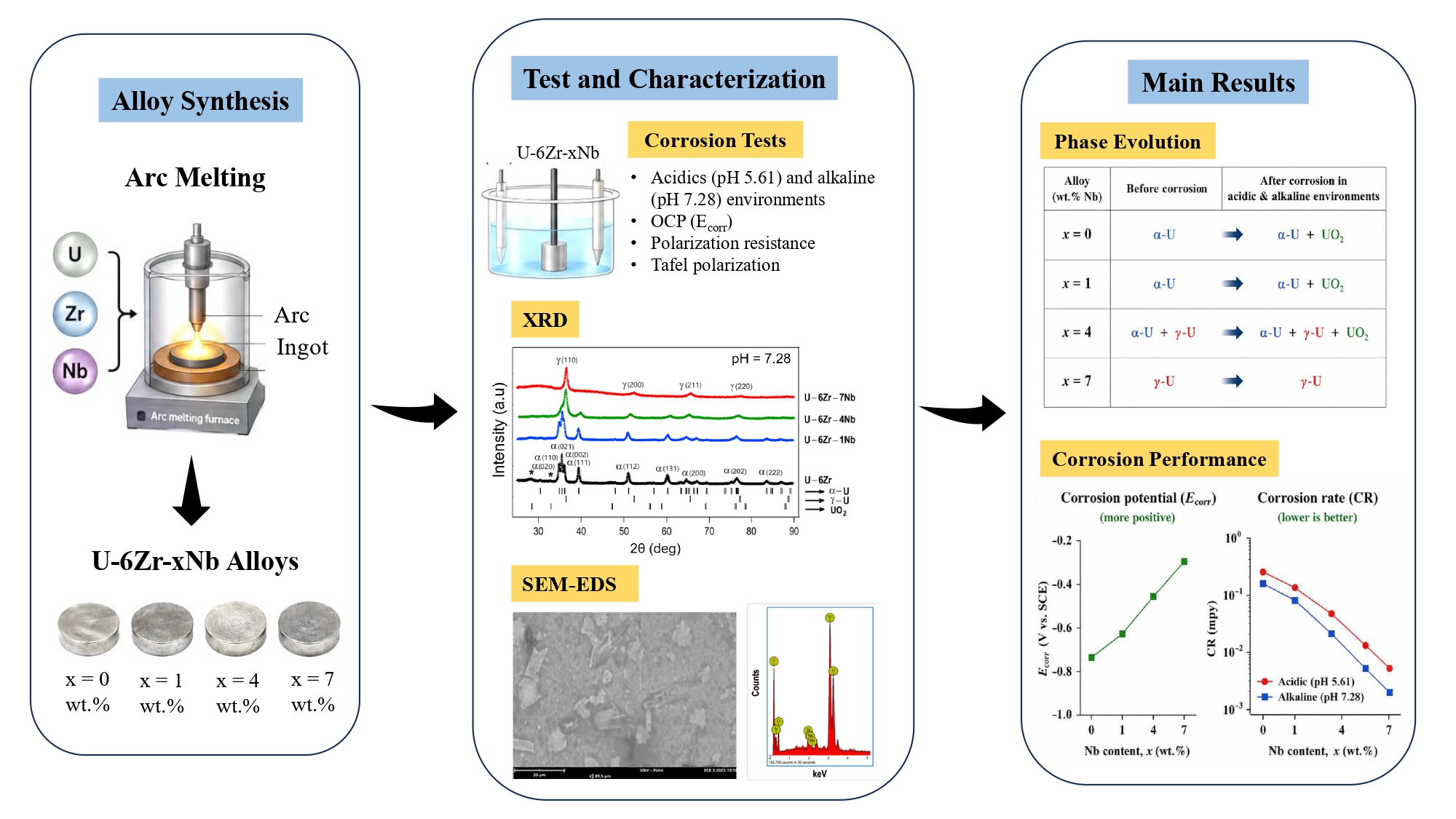
The U-6Zr alloys, considered as nuclear fuel, must endure mechanical, thermal, and corrosive loads. Corrosion resistance is crucial during reactor operation and storage, as environmental conditions can trigger material degradation. Niobium (Nb) addition is expected to suppress corrosion. The U-6Zr-xNb alloys (x = 0, 1, 4, and 7 wt.%) were fabricated using arc melting and tested in acidic and alkaline environments. XRD analyses before corrosion revealed that the x = 0 and 1 wt.% alloys consisted of a single α-U phase, while the x = 4 wt.% alloy showed both α-U and γ-U phases. At x = 7 wt.%, only the α-U phase was present. After corrosion, XRD showed the formation of α-U and UO₂ phases for x = 0 and 1 wt.%, α-U, γ-U, and UO₂ phases for x = 4 wt.%, and only the α-U phase for x = 7 wt.%. Electrochemical tests demonstrated that E_corr increased and the corrosion rate (CR) decreased with increasing Nb content. Thus, Nb effectively enhanced the corrosion resistance of the U-6Zr alloys. Among all compositions, the U-6Zr-7Nb alloy showed the lowest corrosion rate and highest corrosion resistance in both environments, suggesting its strong potential as a nuclear fuel candidate.
References
Bacon, S. R., M. Brierley, M. A. Baker, and J. F. Watts (2019). Oxidation of a Depleted Uranium-5 Wt Molybdenum U 5Mo Alloy in UHV by AES and XPS. Surface and Interface Analysis, 51; 849–856
Banos, A., N. J. Harker, and T. B. Scott (2018). A Review of Uranium Corrosion by Hydrogen and the Formation of Uranium Hydride. Corrosion Science, 136; 129–147
Banos, A. and T. Scott (2020). A Review of the Reaction Rates of Uranium Corrosion in Water. Journal of Hazardous Materials, 399; 122763
Banos, A., C. A. Stitt, and T. B. Scott (2016). The Effect of Sample Preparation on Uranium Hydriding. Corrosion Science, 113; 91–103
Carmack, W. J., D. L. Porter, Y. I. Chang, S. L. Hayes, M. K. Meyer, D. E. Burkes, C. B. Lee, T. Mizuno, F. Delage, and J. Somers (2009). Metallic Fuels for Advanced Reactors. Journal of Nuclear Materials, 392(2); 139–150
Dobrzynski, L., K. Blinowski, and M. Cooper (1994). Neutrons and Solid State Physics. Ellis Horwood Series in Neuroscience. Ellis Horwood
Duong, T. C., R. E. Hackenberg, A. Landa, P. Honarmandi, A. Talapatra, H. M. Volz, A. Llobet, et al. (2016). Revisiting Thermodynamics and Kinetic Diffusivities of Uranium Niobium with Bayesian Uncertainty Analysis. Calphad, 55; 219–230
Durazzo, M., J. A. B. Souza, E. F. Urano de Carvalho, and H. G. Riella (2017). Effect of Porosity on the Manufacturing of U3O8-Al Dispersion Fuel Plates. Progress in Nuclear Energy, 99; 49–58
El-Wazery, M. S., O. M. Mabrouk, S. M. Khafagy, and A. R. El-Sissy (2022). Mechanical and Microstructural Evaluation of AA6082-T61 Joints Produced by Ultrasonic Vibration Assisted Friction Stir Welding Process. International Journal of Engineering Transactions C: Aspects, 35(12); 1123–1132
Ferreira, A., F. R. Longen, R. A. M. Gotardo, F. F. Ivashita, R. Barco, A. Paesano Junior, and A. Luz (2018). Synthesis and Structural Characterization of U-Zr-Nb Alloys. Materials Research, 21(1); 1–5
Ghoshal, K., T. R. G. Kutty, S. Mishra, and A. Kumar (2013). Creep Studies on U–7%Zr, U–7%Nb and U Rich U–Nb–Zr Alloys. Journal of Nuclear Materials, 432(1); 20–22
Gomozov, L. I., V. B. Kishinevskii, O. S. Ivanov, A. V. Byalobzhenskii, and V. N. Lukinskaya (1974). Corrosion and Electrochemical Behavior of Certain Alloys of Uranium with Zirconium, Niobium, and Molybdenum in Aqueous Solutions. Soviet Atomic Energy, 37(5); 1182–1185
Guyadec, F. L., X. Génin, J. P. Bayle, O. Dugne, A. Duhart Barone, and C. Ablitzer (2010). Pyrophoric Behaviour of Uranium Hydride and Uranium Powders. Journal of Nuclear Materials, 396(2–3); 294–302
Idris, M. S. and R. A. M. Osman (2013). Structure Refinement Strategy of Li-Based Complex Oxides Using GSAS EXPGUI Software Package. Advanced Materials Research, 795; 479–482
Janney, D. E. and S. L. Hayes (2018). Experimentally Known Properties of U-10Zr Alloys: A Critical Review. Nuclear Technology, 203(2); 109–128
Kaity, S., J. Banerjee, S. Parida, P. Behere, and V. Bhasin (2020). Molar Heat Capacity of Uranium-Rich U-Zr-Nb and U-Zr-Mo Alloys. Journal of Nuclear Materials, 541; 152427
Kaity, S., J. Banerjee, S. C. Parida, and V. Bhasin (2018). Structural, Microstructural and Thermal Analysis of U-(6-x)Zr-xNb Alloys (x = 0, 2, 4, 6). Journal of Nuclear Materials, 504; 234–250
Kelly, D., J. A. Lillard, W. L. Manner, R. J. Hanrahan, and M. T. Paffett (2001). Surface Characterization of Oxidative Corrosion of U–Nb Alloys. Journal of Vacuum Science & Technology A, 19(4); 1959–1964
Kim, Y. S. and G. L. Hofman (2011). Interdiffusion in U3Si–Al, U3Si2–Al, and USi–Al Dispersion Fuels during Irradiation. Journal of Nuclear Materials, 410(1); 1–9
Landa, A., P. Söderlind, and A. Wu (2020). Phase Stability in U-6Nb Alloy Doped with Ti from the First Principles Theory. Applied Sciences, 10(10); 3417
Liu, Y., D. Yu, Y. Du, G. Sheng, Z. Long, J. Wang, and L. Zhang (2012). Atomic Mobilities, Diffusivities and Their Kinetic Implications for U–X (X = Ti, Nb and Mo) Bcc Alloys. Calphad, 37; 49–56
Martin, T. L., C. Coe, P. A. J. Bagot, P. Morrall, G. D. W. Smith, T. Scott, and M. P. Moody (2016). Atomic-Scale Studies of Uranium Oxidation and Corrosion by Water Vapour. Scientific Reports, 6; 1–10
Masrukan, M. H. Alhasa, M. Kartaman, and J. C. Sihotang (2024). Effect of Nb Addition on Corrosion Resistance of U-6Zr Alloys. Nuclear Technology, 210(3); 379–390
Masrukan, D. Handoko, D. Djuhana, R. Sigit, M. H. Al Hasa, W. A. Adi, and S. Mardiah (2025). Effect of Niobium Addition on Corrosion Behavior, Mechanical Properties, and Microstructures of U6Zr Alloys in an Aerated Environment. Makara Journal of Science, 29(4); 651–660
Mohammadian, E., M. Bakhshi-Jooybari, H. Gorji, and S. Nourouzi (2026). Macrostructural and Microstructural Analysis of Bonding of Copper Tubes to Carbon Fiber Composite Tubes by Electromagnetic Joining. International Journal of Engineering, Transactions B: Applications, 39(7); 1533–1541
Nelson, A. T., A. Migdisov, E. Sooby Wood, and C. J. Grote (2018). U3Si2 Behavior in H2O Environments: Part II, Pressurized Water with Controlled Redox Chemistry. Journal of Nuclear Materials, 500; 81–91
Olander, D. (2009). Nuclear Fuels–Present and Future. Journal of Nuclear Materials, 389(1); 1–22
Sermsrithong, C., P. Jaidaew, C. Promjantuk, and P. Buabthong (2022). Structural and Optical Properties of Bismuth-Doped ZnO Nanoparticles Synthesized by Co-Precipitation. International Journal of Engineering Transactions C: Aspects, 35(12); 2344–2349
Simnad, M. T. (1981). The UZrHx Alloy: Its Properties and Use in TRIGA Fuel. Nuclear Engineering and Design, 64(3); 403–422
Snead, L. L., D. T. Hoelzer, M. Rieth, and A. A. Nemith (2019). Refractory Alloys: Vanadium, Niobium, Molybdenum, Tungsten. In Structural Alloys for Nuclear Energy Applications. Elsevier, pages 585–640
Toby, B. H. (2001). EXPGUI, a Graphical User Interface for GSAS. Journal of Applied Crystallography, 34(2); 210–213
Valance, S., B. Baumeister, W. Petry, and J. Höglund (2020). Innovative and Safe Supply of Fuels for Reactors. EPJ Nuclear Sciences & Technologies, 6; 40
Vollath, D. (1986). Mechanical and Thermal Properties. In U Uranium: Supplement Volume C5 Uranium Dioxide, UO2, Physical Properties. Electrochemical Behavior. Springer, pages 1–205
Weirick, L. J. (1975). Effect of Heat Treatment Upon the Stress Corrosion Cracking of Mulberry (U-7.5 Nb-2.5 Zr)(1). Corrosion, 31(1); 5–14
Wu, Y., Q. Wu, S. Zhu, Z. Pu, Y. Zhang, Q. Wang, D. Lang, and Y. Zhang (2016). Effect of Niobium Element on the Electrochemical Corrosion Behavior of Depleted Uranium. Journal of Nuclear Materials, 478; 7–12
Xie, Y., X. Yuan, Z. Wu, G. Zeng, L. Jiang, X. Peng, and H. Li (2019). Adsorption Behavior and Mechanism of Mg/Fe Layered Double Hydroxide with Fe3O4-Carbon Spheres on the Removal of Pb(II) and Cu(II). Journal of Colloid and Interface Science, 536; 440–455
Zhou, S., R. Jacobs, W. Xie, E. Tea, C. Hin, and D. Morgan (2018). Combined Ab Initio and Empirical Model of the Thermal Conductivity of Uranium, Uranium-Zirconium, and Uranium-Molybdenum. Physical Review Materials, 2(8); 083401
Zhou, S., Y. Zhang, and D. Morgan (2021). An Ab-Initio Based Semi-Empirical Thermal Conductivity Model for Multiphase Uranium-Zirconium Alloys. Journal of Nuclear Materials, 553; 153044
Authors

This work is licensed under a Creative Commons Attribution 4.0 International License.