
A Generalized Uncertainty Principle Involving Fractional Fourier Transform
Article Sidebar
-
Fractional Fourier Transform, Heisenberg’s Uncertainty Principle, Logarithmic Uncertainty Principle
Abstract
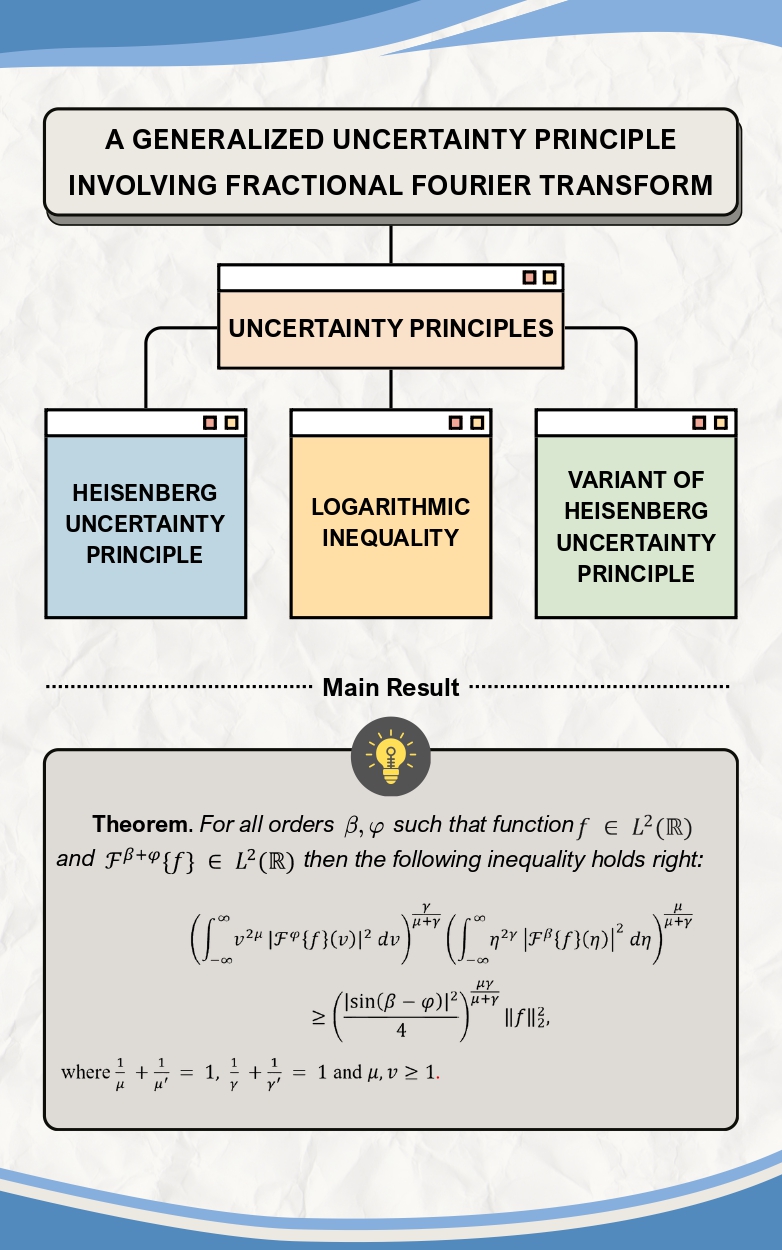
It is well known that the fractional Fourier transform (FrFT) is a non-trivial generalization of the classical Fourier transform. This transform has been extensively utilized in signal analysis and image processing. The uncertainty principle is one of the fundamental results related to the FrFT. In the present paper, we first propose the different method in proving a variant of Heisenberg uncertainty principles associated with the FrFT. This method combines the Heisenberg-type uncertainty principle pertaining to the FrFT and the additive property of the FrFT. We then provide an alternative proof of the logarithmic inequality for the FRFT and find that this result differs slightly that in the literature. Finally, we explicitly expand the variant of Heisenberg uncertainty principle to a more general case.
References
Aloui, Z. and K. Brahim (2023). Fractional Fourier Transform, Signal Processing and Uncertainty Principles. Circuits, Systems and Signal Processing, 42, 892–912.
Bahri, M. (2026). Fractional Fourier Transform: A Variant of Heisenberg Uncertainty Principle, Weighted Uncertainty Inequality and Application. An International Journal of Optimization and Control: Theories and Applications, 16, 1531–1540.
Bahri, M. and S. A. A. Karim (2023). Fractional Fourier Transform: Main Properties and Inequalities. Mathematics, 11(5), 1234.
Bracewell, R. (2000). The Fourier Transform and Its Applications. McGraw-Hill, Boston, MA, USA.
Chen, X., D. Pei, and M. Weixiong (2025). Lp-Type Heisenberg Pauli-Weyl Uncertainty Principles for Fractional Fourier Transform. Applied Mathematics and Computation, 491, 129236.
Debnath, L. and F. A. Shah (2015). Wavelet Transform and Their Basic Properties. Birkhäuser, Boston.
Gröchenig, K. (2001). Foundations of Time-Frequency Analysis. Birkhäuser, Boston, MA, USA.
Guanlei, X., W. Xiaotong, and X. Xiaogang (2009). The Logarithmic, Heisenberg’s and Short-Time Uncertainty Principles Associated with Fractional Fourier Transform. Signal Processing, 89, 339–343.
Kamalakkannan, R. and R. Roopkumar (2019). Multidimensional Fractional Fourier Transform and Generalized Fractional Convolution. Integral Transforms and Special Functions, 31(2), 152–165.
Kamalakkannan, R., R. Roopkumar, and A. Zayed (2021). On the Extension of the Coupled Fractional Fourier Transform and Its Properties. Integral Transforms and Special Functions, 33(1), 65–80.
Li, B.-Z. and T.-Z. Xu (2012). Parseval Relationship of Samples in the Fractional Fourier Transform Domain. Journal of Applied Mathematics, 2012(1), 428142.
Mahor, T. C., R. Mishra, and R. Jain (2021). Analytical Solutions of Linear Fractional Partial Differential Equations Using Fractional Fourier Transform. Journal of Computational and Applied Mathematics, 385, 113202.
Ozaktas, H. M., Z. Zalevsky, and M. A. Kutay (2001). The Fractional Fourier Transform with Applications in Optics and Signal Processing. Wiley, New York.
Shah, F. A., K. S. Nisar, W. Z. Lone, and A. Y. Tantary (2021). Uncertainty Principles for the Quadratic-Phase Fourier Transforms. Mathematical Methods in the Applied Sciences, 44(13), 10416–10431.
Sharma, K. K. and S. D. Josh (2006). On Scaling Properties of Fractional Fourier Transform and Its Relation with Other Transform. Optics Communications, 257, 27–38.
Shi, J., X. Liu, and N. Zhang (2012). On Uncertainty Principle for Signal Concentrations with Fractional Fourier Transform. Signal Processing, 92, 2830–2836.
Sulasteri, S., M. Bahri, N. Bachtiar, J. Kusuma, and A. Ribal (2023). Solving Generalized Heat and Generalized Laplace Equations Using Fractional Fourier Transform. Optics Communications, 7(7), 557.
Tao, R., Y. L. Li, and Y. Wang (2010). Short-Time Fractional Fourier Transform and Its Applications. IEEE Transactions on Signal Processing, 58(5), 2568–2580.
Zayed, A. (2018). Two-Dimensional Fractional Fourier Transform and Some of Its Properties. Integral Transforms and Special Functions, 29(7), 553–570.
Authors

This work is licensed under a Creative Commons Attribution 4.0 International License.