
Spectrophotometry vs Digital Image Colorimetry: Analytical Challenges, Standardization, and Emerging Intelligent Frameworks
Article Sidebar
-
Digital Image Colorimetry, Spectrophotometry, Smartphone-Based Sensing, Color Space Analysis, Green Analytical Chemistry, Analytical Reliability
Abstract
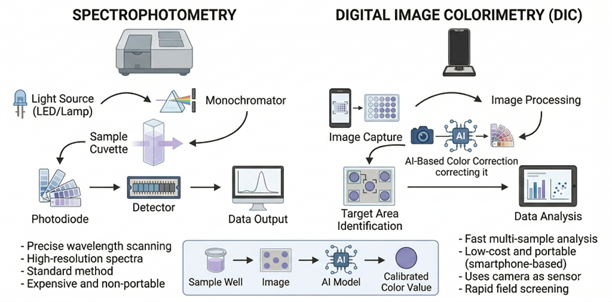
Colorimetric analysis provides a rapid and cost-effective approach for monitoring chemical reactions and determining analyte concentrations. This review examines the strengths and limitations of conventional spectrophotometric methods, known for high precision but high cost and low portability, against digital image colorimetry (DIC). DIC, utilizing smartphones and other portable imaging devices, offers advantages in portability, low operational cost, and alignment with Green Analytical Chemistry principles. However, its analytical performance is often influenced by illumination variability, differences between imaging devices, color-space selection, and calibration strategies. This paper reviews recent developments in DIC, including hardware platforms, color-space transformations, and advanced data processing approaches used to improve analytical performance. Furthermore, to evaluate analytical reliability, this review introduces a novel fuzzy logic-based qualitative reasoning framework. Using a Mamdani-type inference system, the model evaluates the complex interactions between four key variables: lighting stability, device consistency, color-space robustness, and calibration strength. The framework demonstrates that DIC can achieve a "Good" analytical reliability score when lighting is moderately controlled, color-space selection is robust, and calibration strategies are sufficiently strong. However, uncontrolled device variability remains a limiting factor preventing systems from reaching an "Excellent" reliability category, highlighting the ongoing need for methodological standardization in digital colorimetric technologies.
References
Akl, M. A., C. P. C. Sim, M. E.Nunn, L. L. Zeng, T. A. Hamza, and A. G. Wee (2022). Validation of Two Clinical Color Measuring Instruments for Use in Dental Research. Journal of Dentistry, 125; 104223
Antela, K., R. Sáez-Hernández, M. L. Cervera, A. Morales-Rubio, and M. J. Luque (2023). Development of an Automated Colorimeter Controlled by Raspberry Pi 4. Analytical Methods, 15; 512–518
Azhar, M. N., A. Bustam, M. I. Zakaria, S. A. Mohd Said, and K. Poh (2023). Improving the Reliability of Smartphone-Based Urine Colorimetry Using a Colour Card Calibration Method. Digital Health, 9; 20552076231154684
Baker, D. V., J. Bernal-Escalante, C. Traaseth, Y.Wang, M. V. Tran, S. Keenan, and W. R. Algar (2025). Smartphones as a Platform for Molecular Analysis: Concepts, Methods, Devices and Future Potential. Lab on a Chip, 25; 884–955
Bharti, J., R. Jain, R. R. Jha, A. Bajaj, and S. Sharma (2022). A Green Analytical Approach Based on Smartphone Digital Image Colorimetry for Aspirin and Salicylic Acid Analysis. Sustainable Chemistry for the Environment, 2; 100032
Bhatt, S., S. Kumar, M. K. Gupta, S. K. Datta, and S. K. Dubey (2024). Colorimetry-Based and Smartphone-Assisted Machine-Learning Model for Quantification of Urinary Albumin. Measurement Science and Technology, 35(1); 015030
Botelho, B. G., K. C. F. Dantas, and M. M. Sena (2022). Determination of Allura Red Dye in Hard Candies by Using Digital Images ObtainedWith a Mobile Phone and N-Way PLS. Food Chemistry, 374; 131748
Costa, R. C., J. C. Leite, G. C. Brandão, S. L. C. Ferreira, and W. N. L. Santos (2023). AMethod Based on Digital Image Colorimetry for Determination of Total Phenolic Content in Fruits. Food Analytical Methods, 16; 1261–1270
Destanoğlu, O., M. Ş. Cansever, E. İşat, T. Zübarioğlu, A. Ç. Aktuğlu Zeybek, and E. Kıykım (2023). Analysis of Biotinidase Activity in Serum by Digital Imaging Colorimetry Detection. ACS Omega, 8(42); 39796–39806
Dinmeung, N., C. Sirisathitkul, and S. Sirisathitkul (2023). Forensic Applications of Smartphone Colorimetry for Bloodstain Analysis. Forensic Science International, 345; 111456
Doğan, V., T. Işık, V. Kılıç, and N. Horzum (2022). A Field-DeployableWater Quality MonitoringWith Machine Learning-Based Smartphone Colorimetry. Analytical Methods, 14(35); 3458–3466
Eksperiandova, L. P., S. V. Khimchenko, N. A. Stepanenko, and I. B. Shcherbakov (2016). Simple Instrumental and Visual Tests forNonlaboratory Environmental Control. Journal of Analytical Methods in Chemistry, 2016; 1270629
Elagamy, S. H., L. Adly, and M. A. Abdel Hamid (2023). Smartphone Based Colorimetric Approach for Quantitative Determination of Uric Acid Using ImageJ. Scientific Reports, 13; 21888
Fan, X., Y. Li, Z. Guo, Y. Xie, and Z. Zhang (2021a). Recent Advances in Smartphone-Based Colorimetric Sensing. Talanta, 230; 122296
Fan, Y., J. Li, Y. Guo, L. Xie, and G. Zhang (2021b). Digital Image Colorimetry on Smartphone for Chemical Analysis: A Review. Measurement, 171; 108829
Fay, C. D. and L. Wu (2024). Critical Importance of RGB Color Space Specificity for Colorimetric Bio/Chemical Sensing: A Comprehensive Study. Talanta, 266; 124957
Firdaus, M. L., H. Apriyoanda, I. Isnan, S.Wyantuti, and D. R. Eddy (2023a). Quantitative Analysis of Cr(III) and Cr(VI) Using Gold NanoparticlesWith UV-Vis Spectrometry and Smartphone Colorimetric-Sensing. Science and Technology Indonesia, 8(3); 722–730
Firdaus, M. L., R. M. Okumura, E. Nursaadah, D. Handayani, A. Mayub, L. Rahmidar, M. D. Permana, A. Luthfiah, S.Wyantuti, D. R. Eddy, and Y.W. Hartati (2023b). Colorimetric Sensing of Ascorbic Acid Using Cu-Phen MOFs and Subsequent Digital Image AnalysisWith Smartphone. Science and Technology Indonesia, 8(4); 660–665
Ganguly, S. and J. Sengupta (2025). Advances in Paper-Based Ammonia Sensors in Environment: Sustainable Materials, Nanotechnology Integration, and Smart Analytical Platforms. Earth Environment and Sustainability, 1(1); 130–148
García-Miralles, M., J. López-García, H. Martínez-Pérez-Cejuela, and M. de la Guardia (2024). Neural Network-Based Digital Camera Spectrophotometer: Application to Chromogenic Technologies Characterization. ACS Applied Optical Materials, 2(7); 1234–1245
Gölcez, T., V. Kılıç, and M. Şen (2021). A Portable Smartphone-Based Platform With an Offline Image-Processing Tool for the Rapid Paper-Based Colorimetric Detection of Glucose in Artificial Saliva. Analytical Sciences, 37(4); 561–567
Gomes, J. S., R. Sousa, and J. F. S. Petruci (2022). Paper-Based Colorimetric Sensor Array for the Rapid and On-Site Discrimination of Green Tea Samples Based on the Flavonoid Composition. Analytical Methods, 14(25); 2471–2478
Hou, P., R. Deng, J. Guo, W. Chen, X. Li, and H. Z. Yu (2021). AWiFi Scanner in Conjunction With Disposable Multiplex Paper Assay for the Quantitation of Disease Markers in Blood Plasma. Analytical and Bioanalytical Chemistry, 413(18); 4625–4634
James, H. A. and K. C. Honeychurch (2024). Digital Image Colorimetry Smartphone Determination of Acetaminophen. Journal of Chemical Education, 101(1); 187–196
Ji, J., S. Fang, Z. Shi, Q. Xia, and Y. Li (2020). An Efficient Nonlinear Polynomial Color Characterization Method Based on Interrelations of Color Spaces. Color Research and Application, 45(6); 1023–1039
Joh, M., S. Kumaran, Y. Shin, H. Cha, E. Oh, K. H. Lee, and H. J. Choi (2025). An EnsembleModel of Machine Learning Regression Techniques and Color Spaces IntegratedWith a Color Sensor: Application to Color-Changing Biochemical Assays. RSC Advances, 15(3); 1754–1765
Kawamura, K., K. Miyazawa, and L. Kent (2021). The Past, Present and Future in Tube- and Paper-Based Colorimetric Gas Detectors. AppliedChem, 1(1); 14–40
Khan, A., H. Khan, N. He, Z. Li, H. K. Alyahya, and Y. A. Bin Jardan (2025). Colorimetric Aptasensor CoupledWith a Deep-Learning-Powered Smartphone App for Programmed Death Ligand-1 Expressing Extracellular Vesicles. Frontiers in Immunology, 15; 1479403
Kim, J., K. Kang, M. Shin, S. Kim, J. Yoo, M.-K. Kim,W. B. Lee, and D.-H. Lee (2026). Machine Learning-Enhanced Colorimetric Sensor Array for Rapid Detection of Nerve Agents. Journal of Hazardous Materials, 501; 140703
Kiwfo, K., K. Grudpan, A. Held, and W. Frenzel (2024). Smartphone-Based Color Evaluation of Passive Samplers for Gases: A Review. Atmosphere, 15(4); 451
Ko, A. and C. Liao (2023). Paper-Based Colorimetric Sensors for Point-of-Care Testing. AnalyticalMethods, 15(35); 4377–4404
Kwiek, P. and M. Jakubowska (2024). Color Standardization of Chemical Solution Images Using Template-Based Histogram Matching in Deep Learning Regression. Algorithms, 17(8); 335
Li, X., Y. Zhang, Z.Wang, M. Chen, and Q. Liu (2025). Microfluidic Paper-Based Analytical Device for Colorimetric Detection of Fluoride IonWith Smartphone Readout. Microchemical Journal, 202; 110231
Li, Y. and L. Feng (2020). Progress in Paper-Based Colorimetric Sensor Array. Chinese Journal of Analytical Chemistry, 48(11); 1448–1457
Li, Z., Z. Li, D. Zhao, and H. Li (2022). Smartphone-Based Visualized Microarray Detection for Multiplexed Harmful Substances in Liquid Samples. Biosensors and Bioelectronics, 187; 113309
Liang, Z., Y. Qin, X. Zhong, X. Ma, L. Deng, Z. Zou, L. Feng, Z. Pan, S. Pan, M. Li, Z. Su, and J.Wu (2025). A Smartphone-Integrated Paper-Based Colorimetric Sensor Array: Real-Time Detection and Classification of Flavonoids. Talanta, 293; 128030
Liu, J., X. Chen, Q. Diao, Z. Tang, and X. Niu (2025). Machine-Learning-Assisted Nanozyme-Based Sensor Arrays: Construction, Empowerment, and Applications. Biosensors, 15(6); 344
Liu, X., D.Huo, J. Li, Y. Ma, H. Liu, H. Luo, S. Zhang, X. Luo, and C.Hou (2023). Pattern-Recognizing-Assisted Detection of MildewedWheat by Dyes/Dyes-Cu-MOF Paper-Based Colorimetric Sensor Array. Food Chemistry, 415; 135525
Lyu, X., V. Hamedpour, Y. Sasaki, Z. Zhang, and T. Minami (2021). 96-Well Microtiter Plate Made of Paper: A Printed Chemosensor Array for Quantitative Detection of Saccharides. Analytical Chemistry, 93(2); 1179–1184
Mahdi, N. I. (2023). Determination of Azo Dyes Using Smartphone Digital Image. Al-Mustansiriyah Journal of Science, 34(3); 43–49
Markus, V., O. Dalmizrak, O. H. Edebal, M. Al-Nidawi, and J. Caleb (2023). Smartphone Digital Image Colorimetry for Quantification of Serum Proteins. Analytical Methods, 15(38); 5018–5026
Martínez-Pérez-Cejuela, H., R. B. R. Mesquita, E. F. Simó-Alfonso, J. M. Herrero-Martínez, and A. O. S. S. Rangel (2023). Combining Microfluidic Paper-Based Platform and Metal-Organic Frameworks in a Single Device for Phenolic Content Assessment in Fruits. Microchimica Acta, 190(4); 126
Mazur, F., Z. Han, A. D. Tjandra, and R. Chandrawati (2024). Digitalization of Colorimetric Sensor Technologies for Food Safety. Advanced Materials, 36; 2404274
Mendel, J. M. (1995). Fuzzy Logic Systems for Engineering: A Tutorial. Proceedings of the IEEE, 83(3); 345–377
Meng, R., Z. Yu, Q. Fu, Y. Fan, L. Fu, Z. Ding, S. Yang, Z. Cao, and L. Jia (2024). Smartphone-Based Colorimetric Detection Platform Using Color Correction Algorithms to Reduce External Interference. Spectrochimica Acta Part A: Molecular and Biomolecular Spectroscopy, 316; 124350
Mermer, K., J. Paluch, and J. Kozak (2022). Smartphone-Based Digital Image Colorimetry for the Determination of Vancomycin in Drugs. Monatshefte für Chemie - Chemical Monthly, 153(9); 801–809
Nath, K., D. Sarkar, and S. DasGupta (2025). Paper-Based Microfluidic Device for Serum Zinc Assay by Colorimetry. The Analyst, 150(7); 1347–1360
Nguyen, N. A., A. Hendricks, E. Montoya, A. Mayers, D. Rajmohan, A. Morrin, M. McCaul, N. Dunne, N. O’Connor, A. Spanias, G. Raupp, and E. Forzani (2025). New Imaging Method of Mobile Phone-Based Colorimetric Sensor for Iron Quantification. Sensors, 25(15); 4693
Nuanjan, J., Y. Sirisathitkul,W. Noonsuk, and C. Sirisathitkul (2024). Digital Image Colorimetry of Archaeological Earthenware Under Different Lighting Sources. International Journal of Conservation Science, 15(4); 1695–1702
Peixoto, P. S., P. H. Carvalho, A. Machado, L. Barreiros, A. A. Bordalo, H. P. Oliveira, and M. A. Segundo (2022). Development of a Screening Method for Sulfamethoxazole in EnvironmentalWater by Digital ColorimetryUsing aMobile Device. Chemosensors, 10(1); 25
Phuangsaijai, N., J. Jakmunee, and S. Kittiwachana (2021). Investigation Into the Predictive Performance of Colorimetric Sensor Strips Using RGB, CMYK, HSV, and CIELAB CoupledWith Various Data PreprocessingMethods: A Case Study on Analysis ofWater Quality Parameters. Journal of Analytical Science and Technology, 12; 19
Pires, F. d. C., Y. d. S. Mutz, T. C. L. d. Carvalho, N. D. Lorenzo, R. G. F. A. Pereira, R. A. d. Rocha, and C. A. Nunes (2024). Feasibility of Using Colorimetric Devices forWhole and Ground Coffee Roasting Degrees Prediction. Journal of the Science of Food and Agriculture, 104(9); 5435–5441
Pongkitdachoti, U. and F. Unob (2022). Silver-Doped Hydroxyapatite for Formaldehyde Determination by Digital-Image Colorimetry. Analytical Methods, 14(9); 926–934
Ponhong, K., T. Nilnit, C. Y. Lee,W. Kusakunniran, P. Saetear, and S.-A. Supharoek (2025). A Facile Smartphone-Based Digital Image Colorimetric Sensor for the Determination of Tetracyclines inWater Using Natural Phenolic Compounds Induced to Grow Gold Nanoparticles. RSC Advances, 15; 8411–8419
Resende, L. M. B., E. J. Magalhães, and C. A. Nunes (2023). Optimization and Validation of a Smartphone-Based Method for the Determination of Total Sterols in Selected Vegetable Oils by Digital Image Colorimetry. Journal of Food Composition and Analysis, 117; 105111
Ross, T. J. (2010). Fuzzy Logic With Engineering Applications. JohnWiley & Sons, 3 edition
Sabarudin, A., S. Fiddaroini, A. L. Fahmi, A. M. Roja’i, I. E. Salsabila, Aulanni’am, A. Srihardyastutie, H. Susianti, and N. Samsu (2025). Nanoparticle-Enhanced 3DConnector Microfluidic Paper-Based Analytical Device (3D-μPADs) for Sensitive and Cost-Effective Detection of Albumin–Creatinine Ratio in Urine Sample. Science and Technology Indonesia, 10(2); 504–518
Sáez-Hernández, R., J. Cruz, M. Alcalà, Á. Morales-Rubio, and M. L. Cervera (2025a). An Artificial Intelligence-Based Semiquantitative Method Based on Visible Spectroscopy and Imaging to Analyse Inorganic Red Pigments in Wall Paintings. Journal of Cultural Heritage, 75; 139–146
Sáez-Hernández, R., A. Ruiz, A. R. Mauri-Aucejo, V. Yusa, and M. L. Cervera (2025b). Development of Smartphone-Based Digital Image Colorimetry for Advanced Sensing. ChemistrySelect, 10(25); 1507
Sáez-Hernández, R., P. Ruiz, A. R. Mauri-Aucejo, V. Yusa, and M. L. Cervera (2022). Determination of Acrylamide in Toasts Using Digital Image Colorimetry by Smartphone. Food Control, 141; 109163
Soares, S., G. M. Fernandes, and F. R. P. Rocha (2023). Smartphone-Based Digital Images in Analytical Chemistry: Why, When, and How to Use. TrAC Trends in Analytical Chemistry, 168; 117284
Soda, Y., K. J. Robinson, T. J. Cherubini, and E. Bakker (2020). Colorimetric Absorbance Mapping and Quantitation on Paper-Based Analytical Devices. Lab on a Chip, 20(8); 1441–1448
Soldat, D. J., P. Barak, and B. J. Lepore (2009). Microscale Colorimetric Analysis Using a Desktop Scanner and Automated Digital Image Analysis. Journal of Chemical Education, 86(5); 617
Thongkon, N., P. Maisom, O. Taewcharoen,W. Kamsomjit, S. Nilsuwan, N. Saejana, and S. Somrak (2024). Molecularly Imprinted Polymer on Cotton Materials as Substrates for Smartphone-Based Image and Distance-Based Analysis of Cu(II) inWater Samples. Analytical Methods, 16(45); 7723–7735
Tiuftiakov, N. Y., A. V. Kalinichev, N. V. Pokhvishcheva, and M. A. Peshkova (2021). Digital Color Analysis for Colorimetric Signal Processing: Towards an Analytically Justified Choice of Acquisition Technique and Color Space. Sensors and Actuators B: Chemical, 344; 130274
Tong, L. and J. D. Hutcheson (2021). A Surface-Based Calibration Approach to Enable Dynamic and Accurate Quantification of Colorimetric Assay Systems. Analytical Methods, 13(37); 4290–4297
Velasco, L. G., D. S. Rocha, R. P. S. de Campos, andW. K. T. Coltro (2025). Integration of Paper-Based Analytical DevicesWith Digital Microfluidics for Colorimetric Detection of Creatinine. The Analyst, 150(1); 60–68
Wang, B., Y. Li, M. Zhou, Y. Han, M. Zhang, Z. Gao, Z. Liu, P. Chen,W. Du, X. Zhang, X. Feng, and B. F. Liu (2023). Smartphone-Based Platforms Implementing Microfluidic DetectionWith Image-Based Artificial Intelligence. Nature Communications, 14(1); 1360
Wongthanyakram, J., A. Harfield, and P. Masawat (2023). A Smart Device-Based Digital Image Colorimetry for Immediate and Simultaneous Determination of Curcumin in Turmeric. Computers and Electronics in Agriculture, 205; 107629
Woolf, M. S., L. M. Dignan, A. T. Scott, and J. P. Lander (2021). Digital Postprocessing and Image Segmentation for Objective Analysis of Colorimetric Reactions. Nature Protocols, 16(1); 218–238
Wu, K.-H.,W.-C.Huang, J.-C.Wang, and S.-H.Wang (2024). Paper-Based Colorimetric Sensor Using Photoshop and a Smartphone App for the Quantitative Detection of Carbofuran. Analytical Methods, 16(7); 1043–1049
Yang, L., C. Huangfu, Y.Wang, Y. Qin, A. Qin, and L. Feng (2023). Visual Detection of Mercaptan Gases Using Silver Nanoparticles-Based Colorimetric Sensor Array. ACS Applied Nano Materials, 6(23); 22383–22393
Yang, X., Z. Bi, J. Li, L.Wang, H. Huang, and Y. Li (2025). Paper-Based Colorimetric Sensor Array Integrated With Smartphone APP for the Identification of Tea Polyphenol and Longjing Tea. Biosensors and Bioelectronics, 278; 117391
Yang, Z., G. Cai, J. Zhao, and S. Feng (2022). An Optical POCT Device for Colorimetric Detection of Urine Test Strips Based on Raspberry Pi Imaging. Photonics, 9(10); 784
Yeerum, C., P. Issarangkura Na Ayutthaya, K. Kesonkan, K. Kiwfo, P. Boochathum, K. Grudpan, and M. Vongboot (2022). Modified Natural Rubber as a Simple Chemical Sensor With Smartphone Detection for Formaldehyde Content in a Seafood Sample. Molecules, 27(7); 2159
Zadeh, L. A. (1965). Fuzzy Sets. Information and Control, 8(3); 338–353
Zeng, R., C. M. Mannaerts, and Z. Shang (2021). A Low-Cost Digital Colorimetry Setup to Investigate the Relationship BetweenWater Color and Its Chemical Composition. Sensors, 21(20); 6699
Zhang, L., Y. Chen, X.Wang, J. Li, and H. Liu (2024). A Digital Image Colorimetry System Based on Smart Devices for Water Quality Monitoring. Scientific Reports, 14(1); 52931
Zhbanova, V. L. (2020). Research Into Methods for Determining Colour Differences in the CIELAB Uniform Colour Space. Light & Engineering, 28(3); 53–59
Authors

This work is licensed under a Creative Commons Attribution 4.0 International License.