
Development of Cassava Starch-Based Bioplastic Films Reinforced with Jerbung Shrimp Waste Powder (Fenneropenaeus merguiensis de Man)
Article Sidebar
-
Cassava Starch, Shrimp Waste, Bio-Based Filler, Glycerol, Water Vapor Transmission Rate, Biodegradable Filmple
Abstract
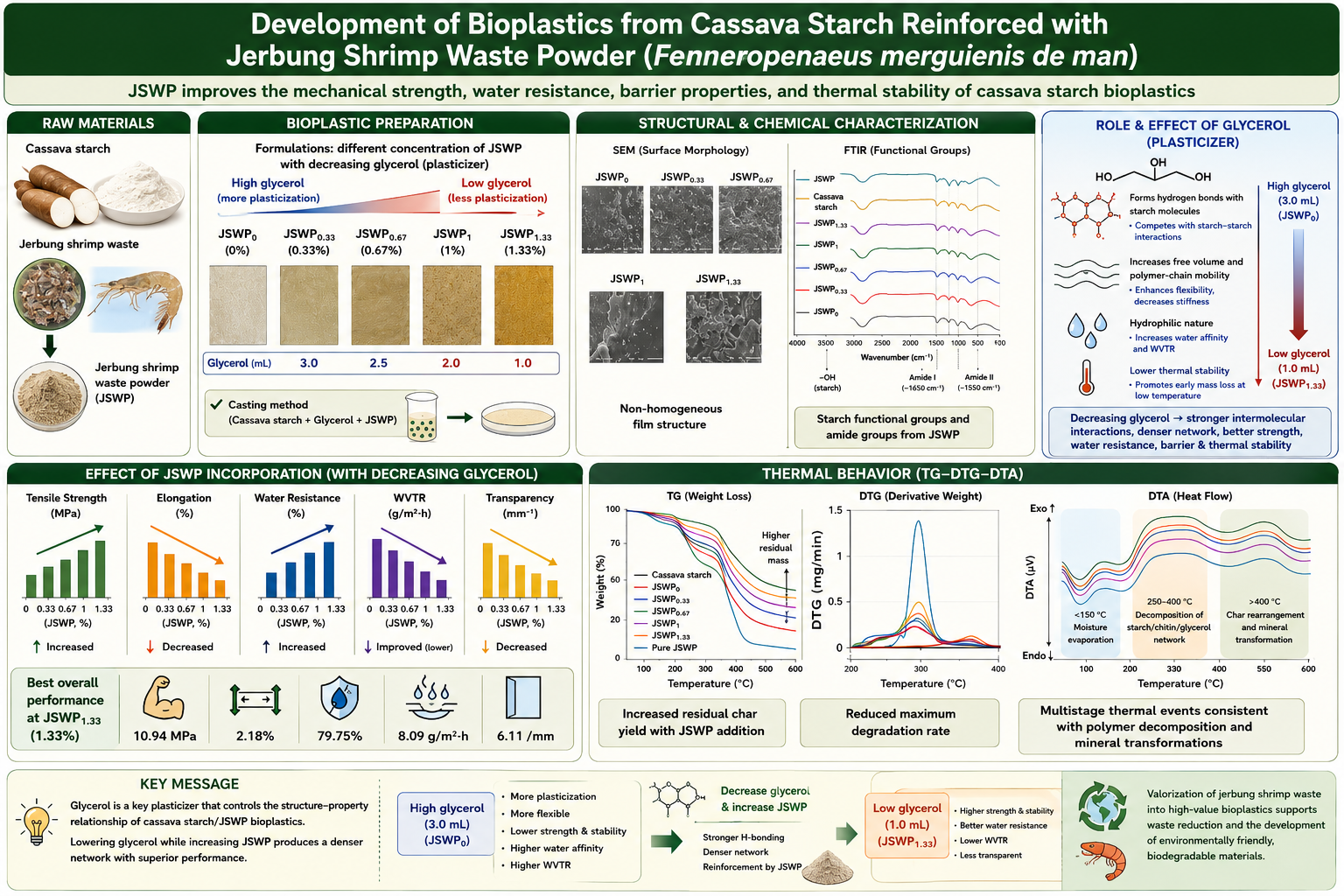
Plastic waste is a major environmental concern because of its long-term persistence and slow degradation under environmental conditions. Bioplastics derived from renewable resources offer a potential alternative to conventional petroleum-based plastics. This study evaluated cassava starch-based bioplastic films prepared using five paired formulations in which increasing Jerbung shrimp waste powder (JSWP) content was accompanied by a proportional reduction in glycerol content. A completely randomized design was used to evaluate formulations containing 0, 0.33, 0.67, 1.00, and 1.33% JSWP, paired with 2.00, 1.67, 1.33, 1.00, and 0.67% glycerol, respectively, based on the total mass of the film-forming formulation. Film morphology, functional groups, and crystalline structure were characterized using scanning electron microscopy (SEM), Fourier-transform infrared spectroscopy (FTIR), and X-ray diffraction (XRD), respectively. SEM revealed relatively rough and heterogeneous film surfaces, while FTIR spectra showed bands associated with starch and amide-containing components derived from JSWP. XRD analysis indicated the disappearance of native cassava starch crystallinity after film formation and the appearance of diffraction peaks associated with JSWP components, confirming successful incorporation of the filler into the bioplastic matrix. Thermogravimetric analysis showed that formulations containing more JSWP and less glycerol exhibited lower maximum mass-loss rates and greater residual mass at 600°C, with JSWP1.33 producing the highest residual mass among the composite films. Across the paired formulations, tensile strength and water resistance increased, whereas elongation at break and transparency decreased numerically. WVTR also showed a decreasing numerical trend, although differences in WVTR and elongation were not statistically significant. Among the evaluated formulations, JSWP1.33 exhibited the highest mean tensile strength, water resistance, thickness, and residual mass, together with the lowest mean elongation, transparency, and WVTR. These findings demonstrate the potential of paired JSWP–glycerol formulation as a strategy for increasing the strength and water resistance of cassava starch-based films (CSBF), although the independent contributions of JSWP and glycerol require further investigation.
References
Anh Duy, N. B., N. Thanh Huy, P. B. Dong, P. N. Hong Nhu, P. Quoc Phu, and N. Chi Thanh (2026). Sustainability Crown Waste for the Development of pH-Sensitive Anthocyanins. RSC Sustainability, 4; 851–864
ASTM, A. (1997). Standard Test Method for Transparency of Plastic Sheeting. Annual Book of American Standard Testing Methods; 389–391
Atiwesh, G., A. Mikhael, C. C. Parrish, J. Banoub, and T.-A. T. Le (2021). Environmental Impact of Bioplastic Use: A Review. Heliyon, 7(9)
Bangar, S. P., S. S. Purewal, M. Trif, S. Maqsood, M. Kumar, V. Manjunatha, and A. V. Rusu (2021). Functionality and Applicability of Starch-Based Films: An Eco-Friendly Approach. Foods, 10(9); 2181
Béres, K. A., P. Németh, and L. Kótai (2025). Review on Chemistry of Water-Containing Calcium Carbonates and Their Transformations into Amorphous and Crystalline Carbonate Modifications. Inorganics, 13(10); 321
Bian, F., S. Qian, C. Li, Z. Zhong, and X. Zhang (2026). Bamboo Cellulose Fiber in Plastic Substitution—Policy, Performance, and Industrial Perspectives. Industrial Crops and Products, 239; 122539
Chamas, A., H. Moon, J. Zheng, Y. Qiu, T. Tabassum, J. H. Jang, M. Abu-Omar, S. L. Scott, and S. Suh (2020). Degradation Rates of Plastics in the Environment. ACS Sustainable Chemistry & Engineering, 8(9); 3494–3511
Chamorro, A. F., M. Palencia, and T. A. Lerma (2025). Physicochemical Characterization and Properties of Cassava Starch: A Review. Polymers, 17(12); 1663
El Feky, A. R., M. Ismaiel, M. Yılmaz, F. M. Madkour, A. El Nemr, and H. A. Ibrahim (2024). Biodegradable Plastic Formulated from Chitosan of Aristeus Antennatus Shells with Castor Oil As a Plasticizer Agent and Starch As a Filling Substrate. Scientific Reports, 14(1); 11161
Gonçalves, I., J. Lopes, A. Barra, D. Hernández, C. Nunes, K. Kapusniak, J. Kapusniak, D. V. Evtyugin, J. A. Lopes da Silva, P. Ferreira, and M. A. Coimbra (2020). Tailoring the Surface Properties and Flexibility of Starch-Based Films Using Oil and Waxes Recovered from Potato Chips Byproducts. International Journal of Biological Macromolecules, 163; 251–259
Gudeta, B. (2026). Evaluation of Banana Cellulose Filler Impacts on Bioplastic Films Formulated from Potato Peel Starch. Next Materials, 11; 101611
Gujral, H., A. Sinhmar, M. Nehra, V. Nain, R. Thory, A. K. Pathera, and P. Chavan (2021). Synthesis, Characterization, and Utilization of Potato Starch Nanoparticles as a Filler in Nanocomposite Films. International Journal of Biological Macromolecules, 186; 155–162
Hendrawati, A. R. Liandi, H. Ahyar, I. Maladi, A. Azhari, and M. Cornelia (2023). The Influence of the Filler Addition of Rice Husk Cellulose, Polyvinyl Alcohol, and Zinc Oxide on the Characteristics of Environmentally Friendly Cassava Biodegradable Plastic. Case Studies in Chemical and Environmental Engineering, 8; 100520
Jafarzadeh, S., Z. Qazanfarzadeh, N. Oladzadabbasabadi, M. Naebe, and C. J. Barrow (2026). Transforming Nutshell Waste into Next-Generation Bioplastics for a Sustainable and Circular Economy. Biomass and Bioenergy, 210; 109061
Jantasrirad, S., J. Mayakun, A. Numnuam, and K. Kaewtatip (2021). Effect of Filler and Sonication Time on the Performance of Brown Alga (Sargassum plagiophyllum) Filled Cassava Starch Biocomposites. Algal Research, 56; 102321
Japanese Standards Association (2019). JIS K 7127:2019: Plastics—Determination of Tensile Properties of Plastic Films and Sheets
Kusumawati, R., A. Hanif, D. Abdullah, R. C. Nissa, B. Firdiana, R. Handayani, I. Munifah, F. R. Dewi, J. Basmal, and S. Wibowo (2025). Physical Properties of Biodegradable Chitosan-Cassava Starch Based Bioplastic Film. Science and Technology Indonesia, 10(1); 191–200
Laksanawati, A. T., M. H. Khirzin, L. Hafifah, H. S. Kusuma, H. Darmokoesoemo, and A. N. Amenaghawon (2026). Biodegradable Film from Taro Starch and Gelatin with Duck Eggshell Nano Calcium Filler (TS-G/DES Nano Calcium): Study of Chemical, Physical, and Mechanical Properties. Next Materials, 11; 101744
Lim, W. S., S. Y. Ock, G. D. Park, I. W. Lee, M. H. Lee, and H. J. Park (2020). Heat-Sealing Property of Cassava Starch Film Plasticized with Glycerol and Sorbitol. Food Packaging and Shelf Life, 26; 100556
Liu, D., P. Zhao, J. Chen, Y. Yan, and Z. Wu (2022). Recent Advances and Applications in Starch for Intelligent Active Food Packaging: A Review. Foods, 11(18); 2879
Ma, F., C. Jiang, W. Xie, and D. Wu (2023). Effect of Chitin Nanocrystals on Stereocomplexation of Poly (L-lactide)/Poly (D-lactide) Blends. International Journal of Biological Macromolecules, 239; 124372
Nazarudin, Ulyarti, I. A. Pratama, and S. D. Yuwono (2023). Improving the Characteristics of Edible Film Using Modified Cassava Starch Over Ethanol Precipitation. Science and Technology Indonesia, 8(1); 32–37
Pathak, G., M. Nichter, A. Hardon, and E. Moyer (2024). The Open Burning of Plastic Wastes is an Urgent Global Health Issue. Annals of Global Health, 90(1); 1–5
Piglowska, M., B. Kurc, L. Rymaniak, P. Lijewski, and P. Fuc (2020). Kinetics and Thermodynamics of Thermal Degradation of Different Starches and Estimation the OH Group and H2O Content on the Surface by TG/DTG-DTA. Polymers, 12(2); 357
Piñeros-Hernandez, D., C. Medina-Jaramillo, A. López-Córdoba, and S. Goyanes (2017). Edible Cassava Starch Films Carrying Rosemary Antioxidant Extracts for Potential Use as Active Food Packaging. Food Hydrocolloids, 63; 488–495
Saputra, D. D. and M. Mursyid (2023). The Effect of Acetic Acid Concentration on the Physicochemical Properties of Shrimp Shell Powder (Fenneropenaeus merguiensis de Man). Bio-Geo Material and Energy (BiGME), 3(1); 36–44
Satria, W., N. Nazarudin, and M. Mursalin (2024). The Effect of NaOH Concentration on the Physical and Chemical Properties of Jerbung Shrimp (Fenneropenaeus merguiensis de Man) Waste Powder. Jurnal Bio-Geo Material dan Energi, 4(1); 9–17
Shanmathy, M., M. Mohanta, and A. Thirugnanam (2021). Development of Biodegradable Bioplastic Films from Taro Starch Reinforced with Bentonite. Carbohydrate Polymer Technologies and Applications, 2; 100173
Tankaew, S., B. Phonsing, A. Sukolrat, and S. Torpee (2026). Utilization of Coconut Meal Waste as a Filler in a Starch-Based Bioplastic and Its Application. Industrial Crops and Products, 245; 123278
Ulyarti, A. Ramadhani, Mursyid, and Nazarudin (2025). Effect of the Ratio of Shrimp Waste Powder (Fenneropenaeus merguiensis de Man) to Glycerol on the Characteristics of Yam Starch-Derived Bioplastics. Jurnal Penelitian Pendidikan IPA, 11(10); 1–7
Ulyarti, U., L. Lisani, S. Surhaini, P. Lumbanraja, B. Satrio, S. Supriyadi, and N. Nazarudin (2022a). The Application of Gelatinisation Techniques in Modification of Cassava and Yam Starches Using Precipitation Method. Journal of Food Science and Technology, 59(3); 1230–1238
Ulyarti, U., M. Mursyid, I. Ismanto, I. Rahmayani, R. Suseno, and Nazarudin (2022b). Modification of Cassava Starch (Manihot utilissima) Using Precipitation Method with Addition of NaCl. Biological Sciences Research, 16; 132–137
Velis, C. A. and E. Cook (2021). Mismanagement of Plastic Waste through Open Burning with Emphasis on the Global South: A Systematic Review of Risks to Occupational and Public Health. Environmental Science & Technology, 55(11); 7186–7207
Widiyawati, S., Nazarudin, and Ulyarti (2024). Study on Ratio of Jerbung Shrimp Waste Powder (Fenneropenaeus merguiensis de Man) and Purple Yam Starch in the Production of Bioplastics. Bio-Geo Material and Energy (BiGME), 4(2); 64–71
Windra, A., Ulyarti, and D. W. Sari (2022). Correlation Study Between Modification Types and Characteristics of Cassava Starch (Manihot utilissima) Using Pearson Correlation. Bio-Geo Material and Energy (BiGME), 2(2); 67–85
Yang, Y., J. Fu, Q. Duan, H. Xie, X. Dong, and L. Yu (2024). Strategies and Methodologies for Improving Toughness of Starch Films. Foods, 13(24); 4036
Yin, P., J. Liu, W. Zhou, and P. Li (2020). Preparation and Properties of Corn Starch/Chitin Composite Films. Polymers, 12(7); 1606
Zhang, J., W. R. Xu, and Y. C. Zhang (2022). Facile Production of Chitin from Shrimp Shells Using a Deep Eutectic Solvent and Acetic Acid. RSC Advances, 12(35); 22631–22638
Zhu, F. (2025). Starch-Based Films and Coatings for Food Packaging: Interactions with Phenolic Compounds. Food Research International, 204; 115758
Authors

This work is licensed under a Creative Commons Attribution 4.0 International License.