
Synergistic Integration of Multi-Sensor Satellite Data and Gradient Boosting Machine Learning for High-Resolution PM₂.₅ Estimation during Tropical Peatland Fires
Article Sidebar
-
Machine Learning, PM2.5 Estimation, Histogram-Based Gradient Boosting, Tropical Peatland Fires, Multi-Sensor Satellite, Air Quality Dynamics
Abstract
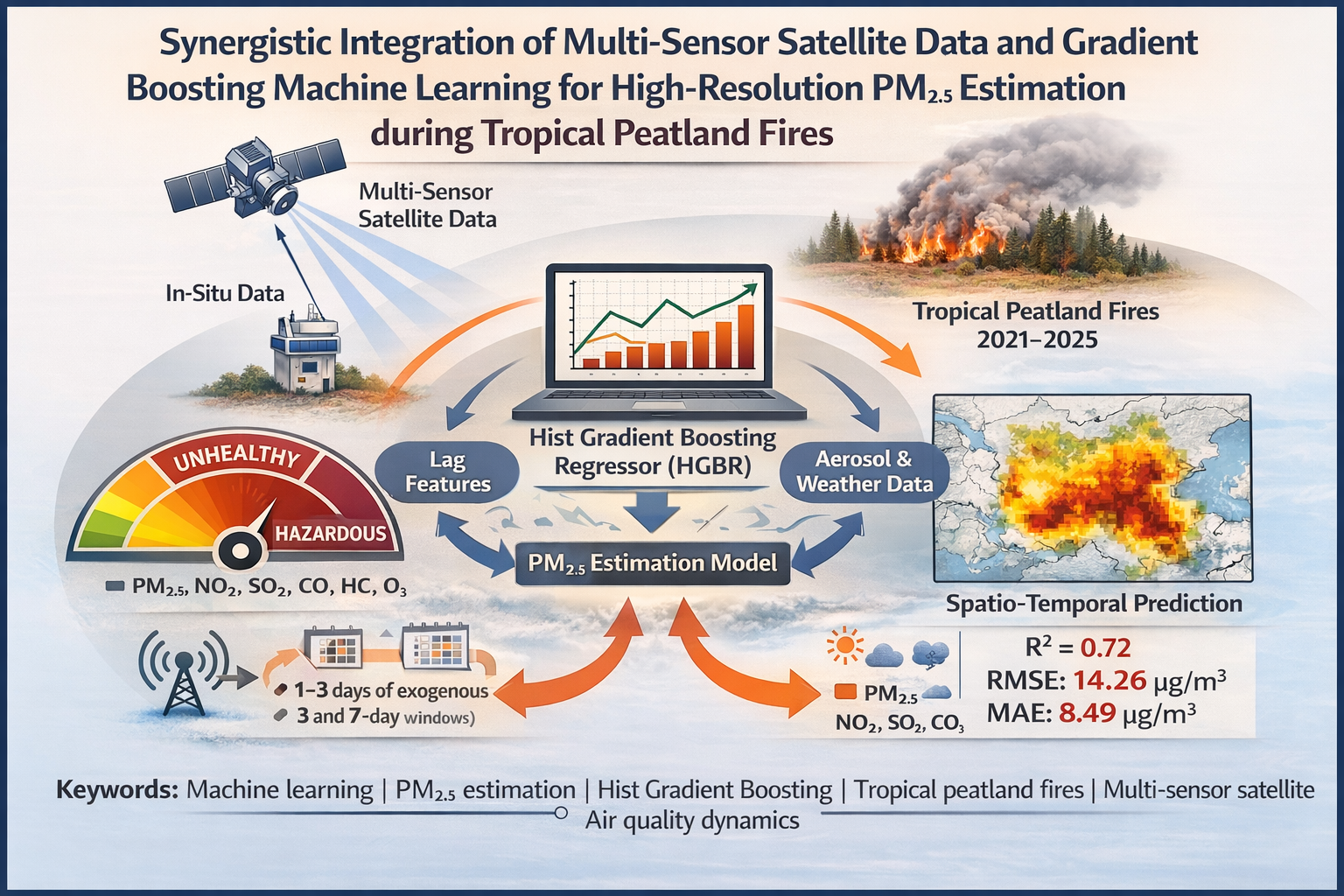
Tropical peatland and forest fires are critical contributors to regional haze and public health crises, yet ground-based monitoring in these regions remains sparse. This study develops a robust framework for estimating surface PM₂.₅ concentrations during extreme fire events (2021–2025) by integrating multi-sensor satellite observations with in-situ data through a Hist Gradient Boosting Regressor (HGBR) approach. To enhance predictive accuracy, we implemented advanced feature engineering, including 1–3 days of exogenous lags, rolling statistics (3 and 7-day windows), and aerosol–meteorological interaction variables. Our analysis of multiple pollutants (PM₂.₅, NO₂, SO₂, CO, HC, and O₃) reveals that during active fire periods, the Air Quality Index (AQI) frequently escalated to "Unhealthy" and "Hazardous" levels. The proposed HGBR model demonstrated high fidelity in representing spatiotemporal variability, achieving a coefficient of determination (R² = 0.72), with an RMSE of 14.26 μg/m³ and MAE of 8.49 μg/m³ (n = 339). These results validate the efficacy of machine learning-driven satellite monitoring in bypassing the limitations of fragmented ground station networks. This framework offers a scalable solution for operational air quality forecasting and early warning systems in fire-prone equatorial regions.
References
Arshad, N., N. Mazhar, and A. Ahmad (2025). Assessment of Air Quality Variations in Punjab, Pakistan, Using Sentinel-5P During COVID-19 Lockdowns. Environmental Monitoring and Assessment, 197(12); 1328.
Atkinson, A. C., M. Riani, and F. Torti (2016). Robust Methods for Heteroskedastic Regression. Computational Statistics & Data Analysis, 104; 209–222.
Aziis, D. M., A. Wirasatriya, and H. Setiyono (2025). Pengaruh El Nino Kuat 2023 Terhadap Variabilitas Suhu Permukaan Laut dan Curah Hujan di Laut Sawu. Indonesian Journal of Oceanography, 7(1); 32–41. (in Indonesian)
Balsamo, G., A. Agusti-Panareda, C. Albergel, G. Arduini, A. Beljaars, J. Bidlot, E. Blyth, N. Bousserez, S. Boussetta, A. Brown, R. Buizza, C. Buontempo, F. Chevallier, M. Choulga, H. Cloke, M. F. Cronin, M. Dahoui, P. De Rosnay, P. A. Dirmeyer, and X. Zeng (2018). Satellite and In Situ Observations for Advancing Global Earth Surface Modelling: A Review. Remote Sensing, 10(12); 2038.
Bennouna, Y. S., V. E. Cachorro, D. Mateos, M. A. Burgos, C. Toledano, B. Torres, and A. M. De Frutos (2016). Long-Term Comparative Study of Columnar and Surface Mass Concentration Aerosol Properties in a Background Environment. Atmospheric Environment, 140; 261–272.
Berg, P., H. Feldmann, and H.-J. Panitz (2012). Bias Correction of High Resolution Regional Climate Model Data. Journal of Hydrology, 448–449; 80–92.
Binte Habib, A., M. G. R. Alam, and M. Z. Uddin (2025). AUNET (Attention-Based Unified Network): Leveraging Attention-Based N-BEATS for Enhanced Univariate Time Series Forecasting. IEEE Access, 13; 95184–95217.
Breiman, L. (2001). Random Forests. Machine Learning, 45(1); 5–32.
Burnett, R., H. Chen, M. Szyszkowicz, N. Fann, B. Hubbell, C. A. Pope, J. S. Apte, M. Brauer, A. Cohen, S. Weichenthal, J. Coggins, Q. Di, B. Brunekreef, J. Frostad, S. S. Lim, H. Kan, K. D. Walker, G. D. Thurston, R. B. Hayes, and J. V. Spadaro (2018). Global Estimates of Mortality Associated with Long-Term Exposure to Outdoor Fine Particulate Matter. Proceedings of the National Academy of Sciences, 115(38); 9592–9597.
Chen, J., Y. Liu, M. Zhang, and Y. Peng (2016). New Understanding and Quantification of the Regime Dependence of Aerosol–Cloud Interaction for Studying Aerosol Indirect Effects. Geophysical Research Letters, 43(4); 1780–1787.
Coelho, C. A. S., C. A. T. Ferro, D. B. Stephenson, and D. J. Steinskog (2008). Methods for Exploring Spatial and Temporal Variability of Extreme Events in Climate Data. Journal of Climate, 21(10); 2072–2092.
Crippa, P., S. Castruccio, S. Archer-Nicholls, G. B. Lebron, M. Kuwata, A. Thota, S. Sumin, E. Butt, C. Wiedinmyer, and D. V. Spracklen (2016). Population Exposure to Hazardous Air Quality Due to the 2015 Fires in Equatorial Asia. Scientific Reports, 6(1); 37074.
Doreswamy, K. S. H., Y. Km, and I. Gad (2020). Forecasting Air Pollution Particulate Matter (PM₂.₅) Using Machine Learning Regression Models. Procedia Computer Science, 171; 2057–2066.
Ghafarian, F., R. Wieland, D. Lüttschwager, and C. Nendel (2022). Application of Extreme Gradient Boosting and Shapley Additive Explanations to Predict Temperature Regimes Inside Forests from Standard Open-Field Meteorological Data. Environmental Modelling & Software, 156; 105466.
Guo, M., H. Zhang, and P. Xia (2020). A Method for Predicting Short-Time Changes in Fine Particulate Matter (PM₂.₅) Mass Concentration Based on the Global Navigation Satellite System Zenith Tropospheric Delay. Meteorological Applications, 27(1); e1866.
Guryanov, A. (2019). Histogram-Based Algorithm for Building Gradient Boosting Ensembles of Piecewise Linear Decision Trees. In W. M. P. Van Der Aalst, V. Batagelj, D. I. Ignatov, M. Khachay, V. Kuskova, A. Kutuzov, S. O. Kuznetsov, I. A. Lomazova, N. Loukachevitch, A. Napoli, P. M. Pardalos, M. Pelillo, A. V. Savchenko, and E. Tutubalina, editors, Analysis of Images, Social Networks and Texts, volume 11832. Springer International Publishing, pages 39–50.
Gustafson, W. I. and S. Yu (2012). Generalized Approach for Using Unbiased Symmetric Metrics with Negative Values: Normalized Mean Bias Factor and Normalized Mean Absolute Error Factor. Atmospheric Science Letters, 13(4); 262–267.
Handschuh, J., T. Erbertseder, and F. Baier (2024). On the Added Value of Satellite AOD for the Investigation of Ground-Level PM₂.₅ Variability. Atmospheric Environment, 331; 120601.
Huang, X. and G. Rein (2014). Smouldering Combustion of Peat in Wildfires: Inverse Modelling of the Drying and the Thermal and Oxidative Decomposition Kinetics. Combustion and Flame, 161(6); 1633–1644.
Johnston, F. H., S. B. Henderson, Y. Chen, J. T. Randerson, M. Marlier, R. S. DeFries, P. Kinney, D. M. J. S. Bowman, and M. Brauer (2012). Estimated Global Mortality Attributable to Smoke from Landscape Fires. Environmental Health Perspectives, 120(5); 695–701.
Karim, M., S. Tomar, S. K. Shah, and T. P. Singh (2025). Analyzing and Predicting PM₁₀ Using Remote Sensing and Machine Learning: A Case Study of Delhi, India. Discover Applied Sciences, 7(11); 1291.
Kong, L., J. Xin, W. Zhang, and Y. Wang (2016). The Empirical Correlations Between PM₂.₅, PM₁₀ and AOD in the Beijing Metropolitan Region and the PM₂.₅, PM₁₀ Distributions Retrieved by MODIS. Environmental Pollution, 216; 350–360.
Ma, P., F. Tao, L. Gao, S. Leng, K. Yang, and T. Zhou (2022). Retrieval of Fine-Grained PM₂.₅ Spatiotemporal Resolution Based on Multiple Machine Learning Models. Remote Sensing, 14(3); 599.
Marlier, M. E., R. S. DeFries, P. S. Kim, D. L. A. Gaveau, S. N. Koplitz, D. J. Jacob, L. J. Mickley, B. A. Margono, and S. S. Myers (2015). Regional Air Quality Impacts of Future Fire Emissions in Sumatra and Kalimantan. Environmental Research Letters, 10(5); 054010.
Miah, M. T., R. Raiyan, R. A. Mishu, M. R. Hasan, R. Islam, P. K. Jodder, and K. R. Rahaman (2025). Decoding Climatic Variability and Ecosystem Impact: Integrating Satellite-Derived Data and Geospatial Techniques for Holistic Air Quality Assessment in Nova Scotia. Theoretical and Applied Climatology, 156(10); 523.
Murray, C. J. L., A. Y. Aravkin, P. Zheng, C. Abbafati, K. M. Abbas, M. Abbasi-Kangevari, F. Abd-Allah, A. Abdelalim, M. Abdollahi, I. Abdollahpour, K. H. Abegaz, H. Abolhassani, V. Aboyans, L. G. Abreu, M. R. M. Abrigo, A. Abualhasan, L. J. Abu-Raddad, A. I. Abushouk, M. Adabi, and S. S. Lim (2020). Global Burden of 87 Risk Factors in 204 Countries and Territories, 1990–2019: A Systematic Analysis for the Global Burden of Disease Study 2019. The Lancet, 396(10258); 1223–1249.
Pope, C. A. and D. W. Dockery (2006). Health Effects of Fine Particulate Air Pollution: Lines That Connect. Journal of the Air & Waste Management Association, 56(6); 709–742.
Ravish, P., S. Chaudhry, and A. Sharma (2025). Impact of Different Crop Residue Burning Activities on Seasonal Variation in Ambient Air Quality. Discover Atmosphere, 3(1); 22.
Reid, J. S., E. J. Hyer, R. S. Johnson, B. N. Holben, R. J. Yokelson, J. Zhang, J. R. Campbell, S. A. Christopher, L. Di Girolamo, L. Giglio, R. E. Holz, C. Kearney, J. Miettinen, E. A. Reid, F. J. Turk, J. Wang, P. Xian, G. Zhao, R. Balasubramanian, and S. C. Liew (2013). Observing and Understanding the Southeast Asian Aerosol System by Remote Sensing: An Initial Review and Analysis for the Seven Southeast Asian Studies (7SEAS) Program. Atmospheric Research, 122; 403–468.
Shofiana, D. A., M. Caniadi, R. Sholehurrohman, and Aristoteles (2025). Decision Tree Algorithms in Water Quality Classification: A Comparative Study of Random Forest, XGBoost, and C5.0. Science and Technology Indonesia, 10(4); 999–1011.
Stavros, E. N., D. McKenzie, and N. Larkin (2014). The Climate-Wildfire-Air Quality System: Interactions and Feedbacks Across Spatial and Temporal Scales. WIREs Climate Change, 5(6); 719–733.
Subhi Malallah, H. and M. Bahjat Abdulrazzaq (2023). Web-Based Agricultural Management Products for Marketing System: Survey. Academic Journal of Nawroz University, 12(2); 49–62.
Uyanık, G. K. and N. Güler (2013). A Study on Multiple Linear Regression Analysis. Procedia - Social and Behavioral Sciences, 106; 234–240.
Van Der Werf, G. R., J. T. Randerson, L. Giglio, T. T. Van Leeuwen, Y. Chen, B. M. Rogers, M. Mu, M. J. E. Van Marle, D. C. Morton, G. J. Collatz, R. J. Yokelson, and P. S. Kasibhatla (2017). Global Fire Emissions Estimates During 1997–2016. Earth System Science Data, 9(2); 697–720.
Velastegui-Montoya, A., N. Montalván-Burbano, P. Carrión-Mero, H. Rivera-Torres, L. Sadeck, and M. Adami (2023). Google Earth Engine: A Global Analysis and Future Trends. Remote Sensing, 15(14); 3675.
Vetrita, Y., I. Albar, I. Santoso, I. Prasasti, T. Kartika, A. B. Usman, A. Tosiani, D. Haryanto, Endrawati, E. Famurianty, K. Ulfa, and J. Purwanto (2025a). Monthly Mapping of Indonesia’s Burned Areas: Implementation, History, Techniques, and Future Directions. International Journal of Remote Sensing, 46(2); 636–660.
Vetrita, Y., K. Diwyacitta, K. M. Sukarno, I. Albar, A. B. Usman, R. P. Ritonga, I. Santoso, A. I. Lestari, T. Kartika, D. A. Novresiandi, I. Prasasti, K. Ulfa, N. Novita, S. E. Siwi, S. Augusto, E. T. Prakoso, K. I. N. Rahmi, U. C. Nugroho, J. Widodo, and M. A. Cochrane (2025b). Evaluating the Capabilities of High-Resolution PlanetScope and Sentinel-2 Images for Mapping Burned Area and Vegetation Regrowth in Indonesia’s Savannas. International Journal of Remote Sensing, 46(18); 6803–6825.
Xu, X., T. Tong, W. Zhang, and L. Meng (2020). Fine-Grained Prediction of PM₂.₅ Concentration Based on Multisource Data and Deep Learning. Atmospheric Pollution Research, 11(10); 1728–1737.
Yin, L., C. Jiang, X. Wen, C. Du, W. Zhong, Z. Feng, Y. Long, and Y. Ma (2019). Microplastic Pollution in Surface Water of Urban Lakes in Changsha, China. International Journal of Environmental Research and Public Health, 16(9); 1650.
Yulianti, Y., R. Rupita, S. E. Rahmaniah, S. Syarmiati, and S. Sudirman (2024). Impact of Forest and Land Fires on Environmental Pollution and Public Health in Sungai Raya Sub-District, Kubu Raya District. International Journal of Multidisciplinary Approach Research and Science, 2(02); 787–800.
Zaib, S., J. Lu, and M. Bilal (2022). Spatio-Temporal Characteristics of Air Quality Index (AQI) over Northwest China. Atmosphere, 13(3); 375.
Zhao, Q., L. Yu, X. Li, D. Peng, Y. Zhang, and P. Gong (2021). Progress and Trends in the Application of Google Earth and Google Earth Engine. Remote Sensing, 13(18); 3778.
Authors

This work is licensed under a Creative Commons Attribution 4.0 International License.