
Space Weather-Induced Charging in The Garuda-1 Satellite Power Failure
Article Sidebar
-
Garuda-1 Anomaly, Energetic Electrons, Space Weather, Geomagnetic Activity, MLT, Satellite Charging
Abstract
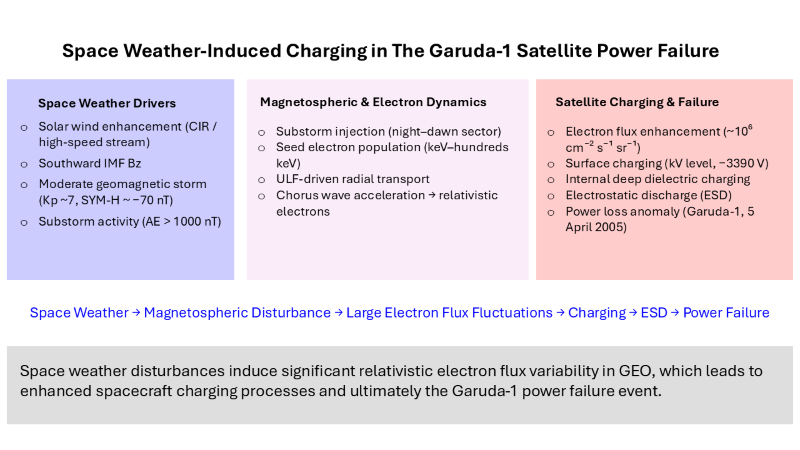
This study investigates the relationship between the geostationary space environment and the Garuda-1 satellite power anomaly that occurred on April 5, 2005. To assess potential anomaly mechanisms, GOES-12 electron and proton flux data, geomagnetic indices, solar wind parameters, and SPENVIS-based charging simulations were examined. While proton fluxes and solar X-ray activity remained relatively low during the event period, relativistic electron fluxes increased significantly under disturbed geomagnetic conditions, as indicated by enhanced AE activity, increased solar wind speed, and prolonged southward IMF Bz. Under these conditions, SPENVIS simulations indicate increased spacecraft surface and internal charging susceptibility. The findings suggest that storm-time energetic electron enhancement and associated charging processes in the geostationary environment may have been associated with the reported Garuda-1 anomaly. This work emphasizes the importance of magnetic local time dependence and geomagnetic activity in influencing spacecraft charging risk for geostationary satellites.
References
Ahmad, N., L. M. M. Kilowasid, H. Fakhrurroja, Neflia, A. Rachman, A. Husin, and H. Fathoni (2025). How Geomagnetic Storms Affect the Loss of Starlink Satellites in February 2022? Earth, Planets and Space, 77; 2
Ahmad, N., H. Usui, and Y. Miyake (2018). Particle in Cell Simulation to Study the Charging and Evolution of Wake Structure of LEO Spacecraft. Journal of Advanced Simulation in Science and Engineering, 6(1); 21–31
Ahmad, N., H. Usui, Y. Miyake, S. Supriadi, H. Fakhrurroja, H. S. Alam, and H. Bangkit (2026b). Case Studies of Ion Focusing in the Downstream Region of a Modeled Low Earth Orbit Spacecraft. Earth and Planetary Physics, 10(1); 136–143
Baker, D. N. (2000). The Occurrence of Operational Anomalies in Spacecraft and Their Relationship to Space Weather. IEEE Transactions on Plasma Science, 28(6); 2007–2016
Baker, D. N. (2001). Satellite Anomalies Due to Space Storms. In I. A. Daglis, editor, Space Storms and Space Weather Hazards, volume 38 of NATO Science Series. Springer, pages 285–311
Baker, D. N., J. H. Allen, S. G. Kanekal, and G. D. Reeves (1998). Disturbed Space Environment May Have Been Related to Pager Satellite Failure. Eos, Transactions American Geophysical Union, 79(40); 477–483
Baker, D. N., P. J. Erickson, J. F. Fennell, J. C. Foster, A. N. Jaynes, and P. T. Verronen (2018). Space Weather Effects in the Earth’s Radiation Belts. Space Science Reviews, 214; 17
Belov, A., L. Dorman, N. Iucci, O. Kryakunova, and N. Ptitsyna (2004). The Relation of High- and Low-Orbit Satellite Anomalies to Different Geophysical Parameters. In I. A. Daglis, editor, Effects of Space Weather on Technology Infrastructure, volume 176 of NATO Science Series II: Mathematics, Physics and Chemistry. Springer, Dordrecht, pages 147–163
Benz, A. O. (2008). Flare Observations. Living Reviews in Solar Physics, 5; 1
Bland, E., T. Bozóki, and N. Partamies (2022). Spatial Extent of the Energetic Electron Precipitation Region During Substorms. Frontiers in Astronomy and Space Sciences, 9; 978371
Bornmann, P. L., D. Speich, J. Hirman, L. Matheson, R. Grubb, H. A. Garcia, and R. Viereck (1996). GOES X-Ray Sensor and Its Use in Predicting Solar-Terrestrial Disturbances. In Proceedings of SPIE: GOES-8 and Beyond, volume 2812. pages 291–298
Borovsky, J. E. and J. A. Valdivia (2018). The Earth’s Magnetosphere: A Systems Science Overview and Assessment. Surveys in Geophysics, 39; 817–859
Chen, G.-X., W.-Y. Xu, Z.-G. Wei, B. H. Ahn, and Y. Kamide (2003). Auroral Electrojet Oval. Earth, Planets and Space, 55; 255–261
Choi, H. S., J. Lee, K. S. Cho, Y. S. Kwak, I. H. Cho, Y. D. Park, Y. Kim, D. Baker, G. Reeves, and L. DK (2011). Analysis of GEO Spacecraft Anomalies: Space Weather Relationship. Space Weather, 9
Clark, T. A. and C. D. Anger (1967). Morphology of Electron Precipitation During Auroral Substorms. Planetary and Space Science, 15(8); 1287–1301
Dorman, L. I., A. V. Belov, E. A. Eroshenko, L. I. Gromova, N. Iucci, A. E. Levitin, and G. Villoresi (2005). Different Space Weather Effects in Anomalies of the High and Low Orbital Satellites. Advances in Space Research, 36; 2530–2536
Fennell, J. F., H. C. Koons, J. L. Roeder, and J. B. Blake (2001). Spacecraft Charging: Observations and Relationship to Satellite Anomalies. Technical report
Fletcher, L., B. R. Dennis, H. S. Hudson, S. Krucker, K. Phillips, A. Veronig, L. Bone, A. Caspi, Q. Chen, P. Gallagher, P. Grigis, H. Ji, W. Liu, R. Milligan, and M. Temmer (2011). An Observational Overview of Solar Flares. Space Science Reviews, 159; 19
Garrett, H. B. and A. C. Whittlesey (2012). Guide to Mitigating Spacecraft Charging Effects. Jet Propulsion Laboratory, California Institute of Technology and John Wiley & Sons
Gubby, R. and J. Evans (2002). Space Environment Effects and Satellite Design. Journal of Atmospheric and Solar-Terrestrial Physics, 64(16); 1723–1733
Hands, A. D. P., K. A. Ryden, N. P. Meredith, S. A. Glauert, and R. B. Horne (2018). Radiation Effects on Satellites During Extreme Space Weather Events. Journal of Atmospheric and Solar-Terrestrial Physics, 169; 1216–1226
Hanslmeier, A. (2010). The Sun and Space Weather. In Heliophysical Processes. Springer, pages 233–249
Heynderickx, D., B. Quaghebeur, J. Wera, E. J. Daly, and H. D. R. Evans (2004). New Radiation Environment and Effects Models in the European Space Agency’s Space Environment Information System (SPENVIS). Space Weather, 2(10); S10S03
Horne, R. B., R. M. Thorne, Y. Y. Shprits, N. P. Meredith, S. A. Glauert, A. J. Smith, et al. (2005). Wave Acceleration of Electrons in the Van Allen Radiation Belts. Nature, 437; 227–230
Hua, M., J. Bortnik, H. E. Spence, and G. D. Reeves (2023). Testing the Key Processes That Accelerate Outer Radiation Belt Relativistic Electrons During Geomagnetic Storms. Frontiers in Astronomy and Space Sciences, 10; 1–12
Iucci, N., A. E. Levitin, A. V. Belov, E. A. Eroshenko, N. G. Ptitsyna, G. Villoresi, et al. (2005). Space Weather Condition and Spacecraft Anomalies in Different Orbits. Space Weather, 3; S01001
Kilowasid, L. M. M., Triyanta, W. Sugitomo, A. Yoshikawa, and T. Uozumi (2014). Pc5 Magnetic Pulsations During the Outer Electron Radiation Belt. International Journal of Technology, 5(3); 269–276
Kim, H.-J., L. Lyons, V. Pinto, C.-P. Wang, and K.-C. Kim (2015). Revisit of Relationship between Geosynchronous Relativistic Electron Enhancements and Magnetic Storms. Geophysical Research Letters, 42(15); 6155–6161
Kirov, B., K. Georgieva, and S. Asenovski (2024). Satellite Anomalies and Their Causes. Sun and Geosphere, 16(1); 10–18
Lai, T. S. (2011). Fundamentals of Spacecraft Charging: Spacecraft Interactions with Space Plasmas. Princeton University Press
Lara, C., V. A. Pinto, J. Silva, B. Zenteno-Quinteros, and P. S. Moya (2025). On the Relationship Between ULF Wave Power and Changes of Relativistic Electron Fluxes in the Outer Radiation Belt. Universe, 11(5); 151
Larsen, B. A. and J. T. Niehof (2013). Electron Acceleration in the Heart of the Van Allen Radiation Belts. Science, 341(6149); 991–994
Li, X., D. N. Baker, M. Temerin, G. Reeves, and R. Friedel (2005). Energetic Electrons, 50 keV to 6 MeV, at Geosynchronous Orbit: Their Responses to Solar Wind. Space Weather, 3; S04001
Mann, I. R., T. P. O’Brien, and D. K. Milling (2004). Correlations Between ULF Wave Power, Solar Wind Speed, and Relativistic Electron Flux in the Magnetosphere: Solar Cycle Dependence. Journal of Atmospheric and Solar-Terrestrial Physics, 66(2); 187–198
Millan, R. M. and R. M. Thorne (2007). Review of Radiation Belt Relativistic Electron Losses. Journal of Atmospheric and Solar-Terrestrial Physics, 69(3); 362–377
Normand, E. (1994). A Comparison of Two Different Types of Geosynchronous Satellite Measurements During the 1989 Solar Proton Events. Advances in Space Research, 14(10); 695–699
O’Brien, T. P. (2009). SEAES-GEO: A Spacecraft Environmental Anomalies Expert System for Geosynchronous Orbit. Space Weather, 7(9); S09003
Pilipenko, V., N. Yagova, N. Romanova, and J. Allen (2006). Statistical Relationships Between Satellite Anomalies at Geostationary Orbit and High-Energy Particles. Advances in Space Research, 37(6); 1192–1205
Pratiwi, N., D. Herdiwijaya, N. Ahmad, T. Hidayat, M. I. Ikhsan, D. F. Dina, et al. (2025). The Effects of May 2024 Solar and Geomagnetic Storms on an Indonesian GEO Satellite’s Orbital Parameters. Advances in Space Research, 76(12); 7261–7271
Rachman, A. and D. Herdiwijaya (2014). Identifying Solar Wind Structures Related to Garuda 1 Satellite Anomaly by Analyzing Solar Wind and IMF Parameters. In AIP Conference Proceedings, volume 1589. pages 22–25
Reeves, G., R. Friedel, R. Belian, M. M. Meier, M. G. Henderson, T. Onsager, et al. (1998). The Relativistic Electron Response at Geosynchronous Orbit During the January 1997 Magnetic Storm. Journal of Geophysical Research, 103(A8); 17559–17570
Reeves, G. D., K. L. McAdams, R. H. W. Friedel, and T. P. O’Brien (2003). Acceleration and Loss of Relativistic Electrons During Geomagnetic Storms. Geophysical Research Letters, 30(10); 1529
Rodger, C. J., A. T. Hendry, M. A. Clilverd, C. Forsyth, and S. K. Morley (2021). Examination of Radiation Belt Dynamics During Substorm Clusters: Activity Drivers and Dependencies of Trapped Flux Enhancements. Journal of Geophysical Research: Space Physics, 127(1); e2021JA030003
Saiz, E., C. Cid, and A. Guerrero (2018). Environmental Conditions During the Reported Charging Anomalies of the Two Geosynchronous Satellites: Telstar 401 and Galaxy 15. Space Weather, 16(11); 1784–1796
Surkov, V. V. and K. S. Mozgov (2021). Electrification of Dielectric Satellites Under the Influence of Electron Flows of the Earth’s Radiation Belts. Geomagnetism and Aeronomy, 61(4); 551–558
Thomsen, M. F., M. G. Henderson, and V. K. Jordanova (2013). Statistical Properties of Surface Charging Environment at Geosynchronous Orbit. Space Weather, 11(5); 237–244
Thorne, R. M. (2010). Radiation Belt Dynamics: The Importance of Wave-Particle Interactions. Geophysical Research Letters, 37(22); L22107
Tranquille, C. (1994). Solar Proton Events and Their Effect on Space Systems. Radiation Physics and Chemistry, 43(1–2); 135–151
Wang, T., L. Dai, C. P. Escoubet, W. Gonzalez, Y. Ren, M. Zhu, et al. (2026). Substorm Expansion Embedded in a Global Cycle of Field-Aligned Currents and Auroral Electrojets. Nature Communications, 17; 2970
Waterfall, C. O. G., S. Dalla, O. Raukunen, D. Heynderickx, P. Jiggens, and R. Vainio (2023). High Energy Solar Particle Events and Their Relationship to Associated Flare, CME and GLE Parameters. Space Weather, 21(3); e2022SW003334
Authors

This work is licensed under a Creative Commons Attribution 4.0 International License.