
Semi-Analytical and Numerical Solutions of the KdV-BBM Equation Using Differential Transformation Method and iRK-5 Based Method of Lines
Article Sidebar
-
KdV-BBM, iRK-5, Cauchy boundary, DTM, MOL
Abstract
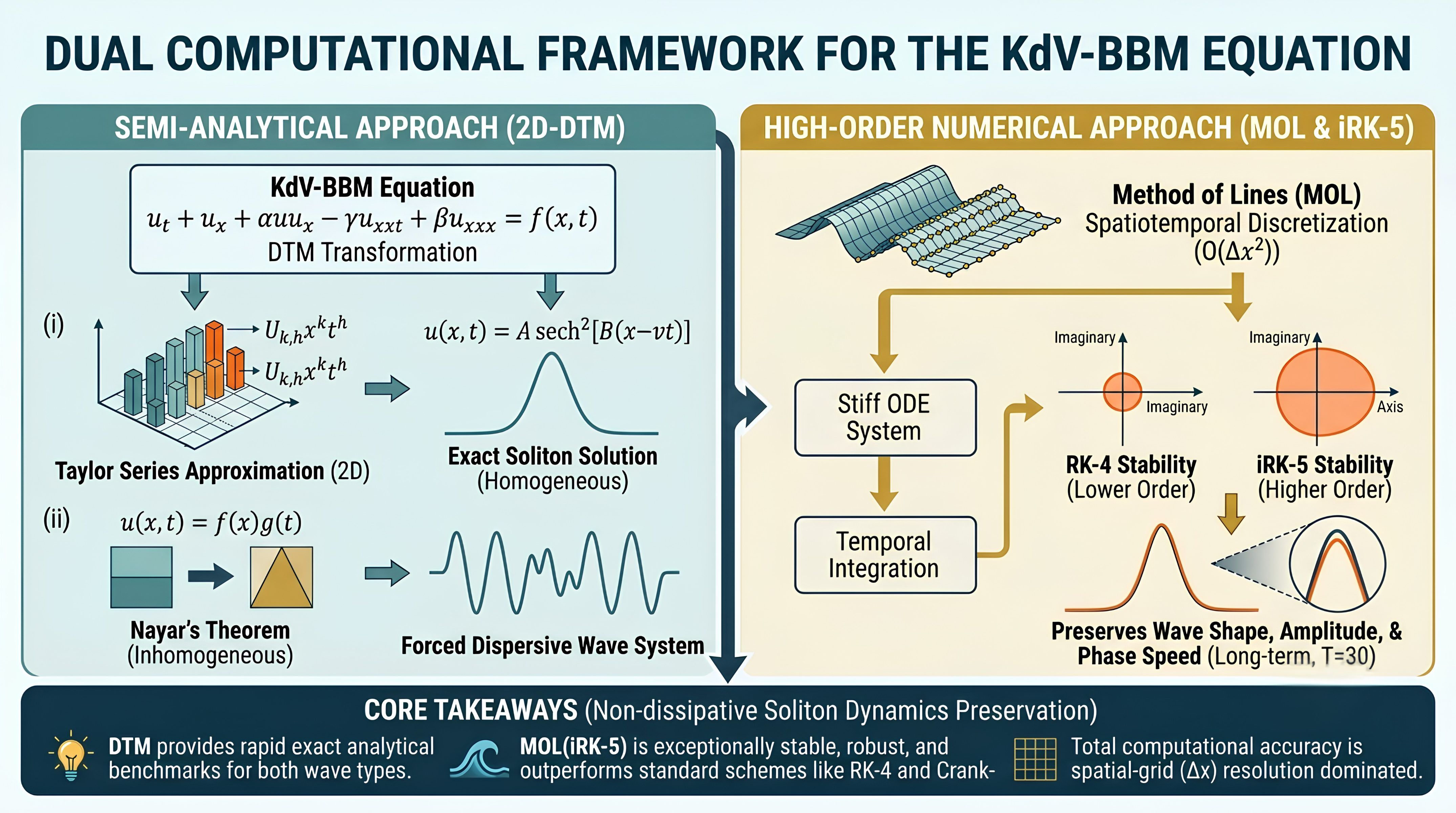
The Korteweg-de Vries-Benjamin-Bona-Mahony (KdV-BBM) equation is a fundamental mathematical model describing nonlinear long-wave propagation in dispersive media. This study presents a comprehensive computational investigation employing two distinct and complementary approaches: a tailored semi-analytical Differential Transformation Method (DTM) and a numerical Method of Lines (MOL) coupled with an improved fifth-order Runge-Kutta (iRK-5) scheme to solve both homogeneous and inhomogeneous KdV-BBM equations. The scientific novelty of this work lies in optimizing these two independent frameworks to achieve high accuracy without requiring restrictive linearization or excessively small time steps. Semi-analytically, DTM is optimized using prescribed Cauchy boundary conditions for the homogeneous model to supply essential derivative data that guarantees coefficient uniqueness and accelerates series convergence, while Nayar’s Theorem is incorporated to efficiently circumvent complex recurrence relations in the inhomogeneous case via variable separability. Numerically, the continuous PDE is discretized spatially via centered differences and integrated in time using the high-order iRK-5 scheme. Both approaches demonstrate exceptional performance in resolving the KdV-BBM model. Comparative evaluations demonstrate that the MOL(iRK-5) scheme superiorly preserves physical wave integrity, soliton peak height, and phase characteristics over extended simulation periods (T = 30), significantly outperforming standard explicit Fourth-Order Runge-Kutta (RK-4) and implicit Crank-Nicolson (C-N) methods. Unlike lower-order implicit schemes like C-N, which exhibit limited temporal accuracy (O(Δt2)) and high matrix inversion costs, or RK-4 which faces severe CFL constraints, iRK-5 achieves higher temporal precision (O(Δt5)) and an expanded stability domain, allowing larger time steps (Δt =0.5) with minimal error (E ≈6.58 ×10⁻⁴). Von Neumann stability analysis applied to the spatial discretization of the MOL framework confirms neutral stability, with iRK-5 providing a larger stability margin along the imaginary axis compared to RK-4. Grid refinement tests for the inhomogeneous model further confirm that spatial resolution (Δx) dominates total accuracy; reducing Δx from 0.01 to 0.0003 successfully decreases the Mean Square Error from 10−3 to 10−7. Overall, both the semi-analytical DTM and numerical MOL(iRK-5) frameworks prove to be highly accurate, robust, and effective standalone tools for investigating complex nonlinear dispersive wave dynamics.
References
Aris Izzuddin Razali, M. and N. Azliza Abd Latif (2022). Solving Lane-Emden Equation by Using Differential Transformation Method. In International Conference on Educational Technology and Administration. Springer, pages 3–13
Ayaz, F. (2004). Solutions of the System of Differential Equations by Differential Transform Method. Applied Mathematics and Computation, 147(2); 547–567
Babayar-Razlighi, B. and B. Soltanalizadeh (2022). Application of Differential Transformation Method to the Dullin-Gottwald-Holm Equation. Mathematical Analysis and Convex Optimization, 3(1); 23–35
Brociek, R. and M. Pleszczyński (2024). Differential Transform Method and Neural Network for Solving Variational Calculus Problems. Mathematics, 12(14); 2182
Carvajal, X. and M. Panthee (2022). On Propagation of Regularities and Evolution of Radius of Analyticity in the Solution of the Fifth-Order KdV–BBMModel: X. Carvajal and M. Panthee. Zeitschrift für angewandte Mathematik und Physik, 73(2); 68
Cheng, Y. and Y. Li (2026). Partial Differential Equation (PDE)-Based Spatial Pharmacometrics in NONMEM: Method of Lines (MOL) Implementation with AI-Assisted Model Development. The Journal of Clinical Pharmacology, 66(6); e70215
Faishal, M. A. and M. K. Hasan (2025). A More Efficient Differential Transform Method for Solving Relativistic Equation. Noise & Vibration Worldwide; 09574565261459697
Gao, D., Z. Qiu, L. Wang, and J. Li (2025). Crank–Nicolson Quasicompact Schemes for One-Sided Tempered Fractional Diffusion Equations (without Using Points Outside the Interval). Boundary Value Problems, 2025(1); 52
Habibah, U., F. F. Medrano, A. C. Permana, D. Ardiana, et al. (2025a). An Improved Fifth-Order Runge-Kutta Method with Higher Accuracy and Efficiency for Solving Initial Value Problems. Science and Technology Indonesia, 10(3); 802–816
Habibah, U., Z. C. Rohman, Y. N. Dewanti, and A. N. Hananti (2025b). Analytical and Numerical Solutions of the Convection-Diffusion-Reaction Equations Applying the Differential Transformation Method and the Crank-Nicholson Method along with Stability Analysis and Truncation Error Analysis. Computational Methods for Differential Equations
Hossain, A. K. S., M. A. Akbar, and M. I. Hossain (2025). Modified Simple Equation Technique for First-Extended Fifth-Order Nonlinear Equation, Medium Equal Width Equation and Caudrey–Dodd–Gibbon Equation. Journal of Umm Al-Qura University for Applied Sciences, 11(3); 623–632
Khatun, M. M. and M. A. Akbar (2024). Analytical soliton solutions of the beta time-fractional simplified modified Camassa-Holm equation in shallow water wave propagation. Journal of Umm Al-Qura University for Applied Sciences, 10(1); 120–128
Liu, K., Z. Liu, and H. Zhao (2024). Exponential Stability of the Linear KdV-BBM Equation. Discrete and Continuous Dynamical Systems-Series B, 29(3); 1206–1216
Mebrate, S., T. Dufera, and A. Tesfahun (2024). Improved Lower Bound for the Radius of Analyticity of Solutions to the Fifth Order, KdV-BBM Type Equation. Bulletin of the Iranian Mathematical Society, 50(4); 62
Meyer, G. H. (1978). The Method of Lines for Poisson’s Equation with Nonlinear or Free Boundary Conditions. Numerische Mathematik, 29(3); 329–344
Muhammad, K. A., A. A. Isa, T. Sarita, and S. M. D. Voumo (2025). Application of Reduced Differential Transform Method to Solve Linear, Non-Linear Convection-Diffusion and Reaction-Diffusion Problems. MSI Journal of Multidisciplinary Research (MSIJMR), 2(5); 55–64
Nayar, H. and P. A. Phiri (1974). The Fornberg-Whitham Equation Solved by the Differential Transform Method
Nolasco Serna, C., N. Afanador García, and G. Guerrero Gómez (2022). Aplicaciones Del álgebra Lineal Al Estudio Del Modelado Matemático De Los Fenómenos Físicos De Conducción De Calor Por Electricidad
Odibat, Z. M. (2008). Differential Transform Method for Solving Volterra Integral Equation with Separable Kernels. Mathematical and Computer Modelling, 48(7-8); 1144–1149
Pava, J. A. (2018). Stability Properties of Solitary Waves for Fractional KdV and BBM Equations. Nonlinearity, 31(3); 920–956
Polwang, A., K. Poochinapan, and B. Wongsaijai (2025). Numerical Simulation of Wave Flow: Integrating the BBM-KdV Equation Using Compact Difference Schemes. Mathematics and Computers in Simulation, 236; 70–89
Putri, D. P. N. and U. Habibah (2026). Numerical Solution of the Gardner Equation Using the Method of Lines and an Improved Fifth-Order Runge-Kutta Scheme. Science and Technology Indonesia, 11(3); 903–914
Qin, Y. and Q. Lou (2021). Differential Transform Method for the Solutions to Some Initial Value Problems in Chemistry. Journal of Mathematical Chemistry, 59(4); 1046–1053
Ramli, M., D. Irsalina, I. P. Iwanisa, and V. Halfiani (2017). Soliton Solution of Benjamin-Bona-Mahony Equation and Modified Regularized Long Wave Equation. In AIP Conference Proceedings, volume 1913. AIP Publishing LLC, page 020002
Saha Ray, S. et al. (2020). Invariant Analysis, Optimal System of Lie Sub-Algebra and Conservation Laws of (3+ 1)-Dimensional KdV–BBM Equation. The European Physical Journal Plus, 135(11); 913
Sarker, S., R. Karim, M. A. Akbar, M. Osman, and P. Dey (2024). Soliton Solutions to a Nonlinear Wave Equation Via Modern Methods. Journal of Umm Al-Qura University for Applied Sciences, 10(4); 785–792
Suebcharoen, T., K. Poochinapan, and B. Wongsaijai (2022). Bifurcation Analysis and Numerical Study of Wave Solution for Initial-Boundary Value Problem of the KdV-BBM Equation. Mathematics, 10(20); 3825
Sweilam, N., N. B. E. Din, M. Ammar, and E. Abo-Eldahab (2025). Compact Finite Difference Schemes with Spectral-Like Resolution for Solving Nonlinear Heat-Wave Propagation in a Rigid Thermal Conductor. Journal of Umm Al-Qura University for Applied Sciences; 1–16
Tegegn, E., A. Tesfahun, and B. Belayneh (2023). Lower Bounds on the Radius of Spatial Analyticity of Solution for KdV-BBM Type Equations: E. Tegegn, A. Tesfahun and B. Belayneh. Nonlinear Differential Equations and Applications NoDEA, 30(4); 47
Verwer, J. G. and J. M. Sanz-Serna (1984). Convergence of Method of Lines Approximations to Partial Differential Equations. Computing, 33(3); 297–313
Voigt, A. (1979). The Method of Lines for Nonlinear Parabolic Differential Equations with Mixed Derivatives. Numerische Mathematik, 32(2); 197–207
Wang, J., H. Li, X. Ren, and X. Chang (2025). The Crank-Nicolson Mixed Finite Element Scheme and Its Reduced-Order Extrapolation Model for the Fourth-Order Nonlinear Diffusion Equations with Temporal Fractional Derivative. Fractal and Fractional, 9(12); 789
Zhou, J. (1986). Differential Transformation and Its Applications for Electrical Circuits. Huazhong University Press, Wuhan China (In Chinese) google schola, 2; 413–420
Authors

This work is licensed under a Creative Commons Attribution 4.0 International License.