
Formulation and In Vivo Study of A Liquid Crystal Containing Propolis Extract For Wound Healing Treatment
Article Sidebar
-
Liquid Crystalline System, Propolis Extract, Wound Healing, Lipid-Based Delivery Topical Formulation
Abstract
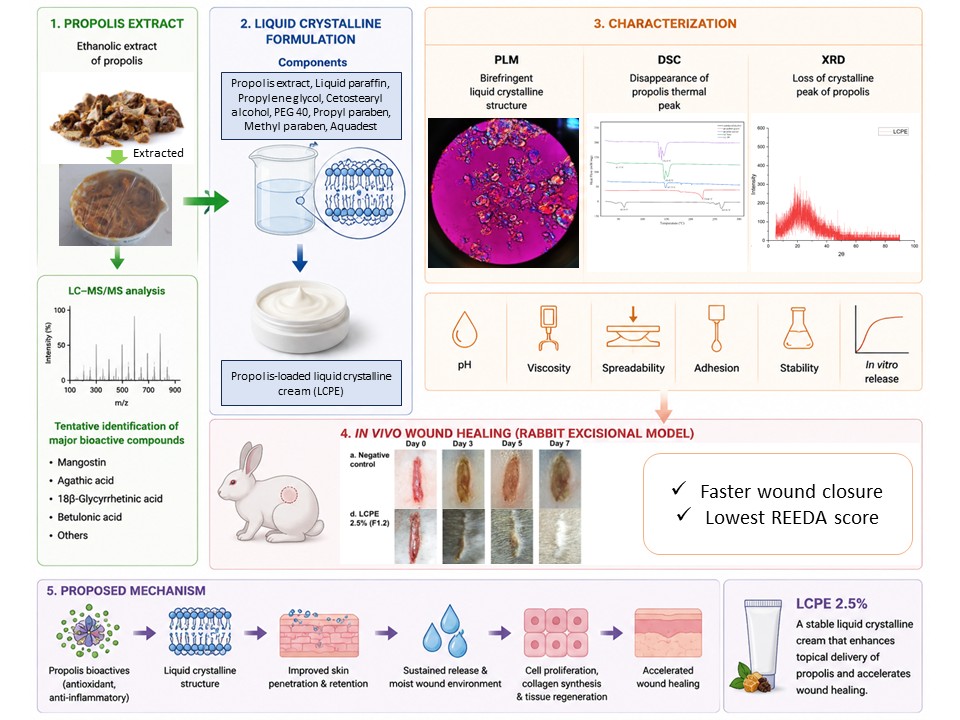
Impaired wound healing remains a major clinical challenge, necessitating the development of effective and biocompatible topical therapies. This study aimed to develop and evaluate a lipid-based liquid crystalline propolis extract (LCPE) cream for wound-healing applications. Propolis was extracted with 70% ethanol using ultrasound-assisted extraction (UAE), yielding 21.21% extract with a total phenolic content of 249.6 ± 20.8 mg GAE/g and antioxidant activity (IC₅₀) of 504 ± 12 ppm. LC–MS/MS analysis the identified major bioactive compounds was mangostin. Liquid crystalline cream bases were optimized using a one-factor-at-a-time (OFAT) approach with varying concentrations of cetostearyl alcohol. The formula demonstrated suitable pH (5.4–5.8), viscosity (10,402–40,742 cps), spreadability, adhesiveness, and physical stability. Polarized light microscopy (PLM) confirmed the formation of anisotropic liquid crystalline structures, while DSC analysis indicated successful incorporation and thermal compatibility of the extract within the system. In vivo wound-healing evaluation using a rabbit excisional wound model demonstrated that LCPE significantly accelerated wound closure and reduced inflammation compared to untreated control group. Among the tested concentrations (1%, 2.5%, and 5%), LCPE 2.5% exhibited the most effective healing performance, as evidenced by faster wound closure and lower REEDA scores. In conclusion, LCPE represents a stable, skin-compatible, and promising topical delivery system for wound healing.
References
Aboulghazi, A., M. Bakour, M. Fadil, and B. Lyoussi (2022). Simultaneous Optimization of Extraction Yield, Phenolic Compounds and Antioxidant Activity of Moroccan Propolis Extracts: Improvement of Ultrasound-Assisted Technique Using Response Surface Methodology. Processes, 10(2); 297.
Adwan, S., M. Qasmieh, F. Al-Akayleh, and A. S. A. Ali Agha (2024). Recent Advances in Ocular Drug Delivery: Insights into Lyotropic Liquid Crystals. Pharmaceuticals, 17(10); 1315.
Ahmad, S. and A. Hafeez (2023). Formulation and Development of Curcumin–Piperine-Loaded S-SNEDDS for the Treatment of Alzheimer’s Disease. Molecular Neurobiology, 60(2); 1067–1082.
Aji, A. P., R. Septiyaningsih, S. Indratmoko, E. Issusilaningtyas, and S. Nasikha (2024). Formula Optimization of Propolis Transfersome Gel, Aloe vera, Gotu Extract: Formula Design, Formulation Evaluation and Cell Regeneration Test in Diabetic Wounds. Jurnal Penelitian Pendidikan IPA, 10(11); 8725–8733.
Al Saqr, A., M. Annaji, I. Poudel, S. Rangari, S. H. Boddu, A. K. Tiwari, and R. J. Babu (2022). Niosomal Formulation of Hydroxytyrosol, a Polyphenolic Antioxidant, for Enhancing Transdermal Delivery across Human Cadaver Skin. Pharmaceutical Development and Technology, 27(2); 155–163.
Baldha, R., G. Chakraborthy, and S. Rathod (2025). Current Status and Future Prospects of Lyotropic Liquid Crystals As a Nanocarrier Delivery System for the Treatment of Cancer. AAPS PharmSciTech, 26(2); 58.
Bankova, V., B. Trusheva, and M. Popova (2021). Propolis Extraction Methods: A Review. Journal of Apicultural Research, 60(5); 734–743.
Batista, C., A. Alves, L. Queiroz, B. Lima, A. Araújo, R. de Albuquerque Júnior, J. Cardoso, et al. (2018). The Photoprotective and Anti-Inflammatory Activity of Red Propolis Extract in Rats. Journal of Photochemistry and Photobiology B: Biology, 180; 198–207.
Bhubhanil, S., C. Talodthaisong, M. Khongkow, K. Namdee, P. Wongchitrat, W. Yingmema, J. A. Hutchison, S. Lapmanee, and S. Kulchat (2021). Enhanced Wound Healing Properties of Guar Gum/Curcumin-Stabilized Silver Nanoparticle Hydrogels. Scientific Reports, 11(1); 21836.
Boke Sarikahya, N., E. Varol, G. Sumer Okkali, B. Yucel, R. Margaoan, and A. Nalbantsoy (2022). Comparative Study of Antiviral, Cytotoxic, Antioxidant Activities, Total Phenolic Profile and Chemical Content of Propolis Samples in Different Colors from Turkiye. Antioxidants, 11(10); 2075.
Bouwstra, J. A., R. W. Helder, and A. El Ghalbzouri (2021). Human Skin Equivalents: Impaired Barrier Function in Relation to the Lipid and Protein Properties of the Stratum Corneum. Advanced Drug Delivery Reviews, 175; 113802.
Campos, J. C., S. D. Ozelin, T. R. Esperandim, M. M. Junqueira, L. T. Souza, F. G. Dias, L. F. Pereira, B. B. Mello, J. A. Aldana-Mejía, P. D. Marcato, et al. (2026). Delivery Systems Containing Brazilian Red Propolis: Safety and Efficacy for Skin Wound Healing. BioNanoScience, 16(1); 46.
Chen, J., H. Wang, L. Mei, B. Wang, Y. Huang, G. Quan, C. Lu, T. Peng, X. Pan, and C. Wu (2020). A Pirfenidone Loaded Spray Dressing Based on Lyotropic Liquid Crystals for Deep Partial Thickness Burn Treatment: Healing Promotion and Scar Prophylaxis. Journal of Materials Chemistry B, 8(13); 2573–2588.
Choi, E. H. (2025). Skin Barrier Function in Neonates and Infants. Allergy, Asthma & Immunology Research, 17(1); 32.
Chow, P. S., R. T. Y. Lim, F. Cyriac, J. C. Shah, A. Z. M. Badruddoza, T. Yeoh, C. K. Yagnik, X. Y. Tee, A. B. H. Wong, V. D. Chia, et al. (2024). The Effect of Process Parameters on the Microstructure, Stability, and Sensorial Properties of an Emulsion Cream Formulation. Pharmaceutics, 16(6); 773.
Ciucanu, C. I., S. Rațiu, G. E. Crîșmariu, S. Olariu, and I. Ciucanu (2024). Accelerated Wound Healing and Reduced Scar Formation Induced by D-Mannose: A Possible Role of Mannose Binding Lectin. Archives of Dermatological Research, 316(8); 600.
Conceição, M., L. F. S. Gushiken, J. A. Aldana-Mejía, M. H. Tanimoto, M. V. d. S. Ferreira, A. C. M. Alves, M. N. Miyashita, J. K. Bastos, F. P. Beserra, and C. H. Pellizzon (2022). Histological, Immunohistochemical and Antioxidant Analysis of Skin Wound Healing Influenced by the Topical Application of Brazilian Red Propolis. Antioxidants, 11(11); 2188.
da Silva, C. S., J. A. de Araujo, T. S. Silveira, K. C. Castro, L. C. Baratto, R. C. Kaminski, G. B. Santos, and K. M. Nunes (2021). Wound Healing Activity of Topical Formulations Containing Mauritia flexuosa Oil. Revista Brasileira de Farmacognosia, 31(2); 225–231.
Damrongrungruang, T., J. Paphangkorakit, S. Limsitthichaikoon, B. Khampaenjiraroch, M. J. Davies, B. Sungthong, and A. Priprem (2021). Anthocyanin Complex Niosome Gel Accelerates Oral Wound Healing: In Vitro and Clinical Studies. Nanomedicine: Nanotechnology, Biology and Medicine, 37; 102423.
do Nascimento, T. G., P. F. da Silva, L. F. Azevedo, L. G. da Rocha, I. C. C. de Moraes Porto, T. F. A. Lima e Moura, I. D. Basílio-Júnior, L. A. M. Grillo, C. B. Dornelas, E. J. d. S. Fonseca, et al. (2016). Polymeric Nanoparticles of Brazilian Red Propolis Extract: Preparation, Characterization, Antioxidant and Leishmanicidal Activity. Nanoscale Research Letters, 11(1); 301.
do Nascimento, T. G., G. D. Redondo, C. T. de Araujo Abreu, V. C. Silva, G. M. Lira, L. A. M. Grillo, M. M. da Conceição, J. D. Freitas, J. S. Souza, J. X. A. Júnior, et al. (2019). Modified Release Microcapsules Loaded with Red Propolis Extract Obtained by Spray-Dryer Technique. Journal of Thermal Analysis and Calorimetry, 138(5); 3559–3569.
Eskandarinia, A., A. Kefayat, M. Agheb, M. Rafienia, M. Amini Baghbadorani, S. Navid, K. Ebrahimpour, D. Khodabakhshi, and F. Ghahremani (2020a). A Novel Bilayer Wound Dressing Composed of a Dense Polyurethane/Propolis Membrane and a Biodegradable Polycaprolactone/Gelatin Nanofibrous Scaffold. Scientific Reports, 10(1); 3063.
Eskandarinia, A., A. Kefayat, M. Gharakhloo, M. Agheb, D. Khodabakhshi, M. Khorshidi, V. Sheikhmoradi, M. Rafienia, and H. Salehi (2020b). A Propolis Enriched Polyurethane-Hyaluronic Acid Nanofibrous Wound Dressing with Remarkable Antibacterial and Wound Healing Activities. International Journal of Biological Macromolecules, 149; 467–476.
Fachri, B. A., P. Sari, S. Yuwanti, and E. Subroto (2020). Experimental Study and Modeling on Supercritical CO₂ Extraction of Indonesian Raw Propolis Using Response Surface Method: Influence of Pressure, Temperature and CO₂ Mass Flowrate on Extraction Yield. Chemical Engineering Research and Design, 153; 452–462.
Fauzee, A. F. B. and R. B. Walker (2020). The Impact of Formulation Variables on the Optimization of Pilot Scale Clobetasol 17-Propionate Creams. Cogent Engineering, 7(1); 1804713.
Gal, A., L. Stan, F. Tăbăran, D. Rugină, A. Cătoi, and S. Andrei (2020). Chemopreventive Effects of Propolis in the MNU-Induced Rat Mammary Tumor Model. Oxidative Medicine and Cellular Longevity, 2020(1); 4014838.
Gorantla, S., R. N. Saha, and G. Singhvi (2022). Exploring the Affluent Potential of Glyceryl Mono Oleate–Myristol Liquid Crystal Nanoparticles Mediated Localized Topical Delivery of Tofacitinib: Study of Systematic QbD, Skin Deposition and Dermal Pharmacokinetics Assessment. Journal of Molecular Liquids, 346; 117053.
Grinn-Gofroń, A., M. Kołodziejczak, R. Hrynkiewicz, F. Lewandowski, D. Bębnowska, C. Adamski, and P. Niedźwiedzka-Rystwej (2025). Antimicrobial Potential of Bee-Derived Products: Insights into Honey, Propolis and Bee Venom. Pathogens, 14(8); 780.
Hemati, H., F. Haghiralsadat, M. Hemati, G. Sargazi, and N. Razi (2023). Design and Evaluation of Liposomal Sulforaphane-Loaded Polyvinyl Alcohol/Polyethylene Glycol (PVA/PEG) Hydrogels As a Novel Drug Delivery System for Wound Healing. Gels, 9(9); 748.
Hernandez-Hernandez, A. B., M. Rodriguez-Canales, P. Dominguez-Verano, U. Nava-Solis, M. A. Rodriguez-Monroy, and M. M. Canales-Martinez (2025). Antibacterial, Antifungal, and Wound-Healing Activities and Chemical Characterization of Propolis from Apis mellifera in Michoacan, Mexico. Molecules, 30(19); 3880.
Homaeigohar, S. and A. R. Boccaccini (2025). Extracellular Matrix (ECM) Mimicking Hybrid and Composite Nanofiber Materials: A General Perspective on Structural and Chemical Biomimicry and Their Role in Wound Healing and Skin Modelling.
Huo, H., Z. Zhou, R. Guo, J. Zhang, M. Li, H. Zeng, D. Zhao, R. P. Terekhov, P. Jiang, Q. Zhou, et al. (2026). Formulation and Evaluation of Hydrogel Based on Brazilian Propolis Ethanol Extract for Promoting Diabetic Wound Healing. BMC Biotechnology, 26(1); 34.
Ibrahim, H.-I. M., M. Thangavelu, and A. Khalifa (2022). Honey-Propolis-Engineered Collagen Peptides As Promising Wound-Healing Matrix in Mouse Model. Molecules, 27(20); 7090.
Jubaidah, S., E. S. Syamsul, H. Wijaya, S. Poddar, et al. (2023). Formulation Cream from Extract of Red Pidada Leaves (Sonneratia caseolaris L.) As a Sunscreen and Analysis of Active Compounds with Liquid Chromatography-High Resolution Mass Spectrometry (LC-HRMS) Method. Research Journal of Pharmacy and Technology, 16(2); 781–785.
Kamali, H., M. Karimi, M. Abbaspour, A. Nadim, F. Hadizadeh, E. Khodaverdi, and F. Eisvand (2022). Comparison of Lipid Liquid Crystal Formulation and Vivitrol® for Sustained Release of Naltrexone: In Vitro Evaluation and Pharmacokinetics in Rats. International Journal of Pharmaceutics, 611; 121275.
Kara, Y., Z. Can, and S. Kolaylı (2022). What Should Be the Ideal Solvent Percentage and Solvent-Propolis Ratio in the Preparation of Ethanolic Propolis Extract? Food Analytical Methods, 15(6); 1707–1719.
Karagecili, H., M. A. Yılmaz, A. Ertürk, H. Kiziltas, L. Güven, S. H. Alwasel, and İ. Gulcin (2023). Comprehensive Metabolite Profiling of Berdav Propolis Using LC-MS/MS: Determination of Antioxidant, Anticholinergic, Antiglaucoma, and Antidiabetic Effects. Molecules, 28(4); 1739.
Karakas, C. Y., C. B. Ustundag, A. Sahin, and A. Karadag (2023). Co-Axial Electrospinning of Liposomal Propolis Loaded Gelatin-Zein Fibers As a Potential Wound Healing Material. Journal of Applied Polymer Science, 140(46); e54683.
Kolaylı, S., H. Sahin, M. Malkoc, H. Cakir, Y. Kara, Ö. Bektas, and K. Kaltalioglu (2022). Does Ethanolic Propolis Extract Affect Blood Clotting Parameters? Progress in Nutrition, 24(1).
Kouhjani, M., A. Saberi, F. Hadizadeh, E. Khodaverdi, M. Karimi, E. Gholizadeh, H. Kamali, and A. Nokhodchi (2023). Development of Sustained Release Formulations Based on Lipid-Liquid Crystal to Control the Release of Deoxycholate: In Vitro and in Vivo Assessment. AAPS PharmSciTech, 24(8); 224.
Kulawik-Pióro, A., A. Ptaszek, and J. Kruk (2019). Effective Tool for Assessment of the Quality of Barrier Creams—Relationships between Rheological, Textural and Sensory Properties. Regulatory Toxicology and Pharmacology, 103; 113–123.
Kumari, S., A. Goyal, M. Garg, A. Antonescu, and R. K. Sindhu (2023). Lyotropic Liquid Crystal System for Drug Delivery of Astaxanthin: Physical Characterization and Enhanced Antioxidant Potential. Crystals, 13(1); 142.
Kurek-Górecka, A., Y. Kara, K. Pokajewicz, I. Ben Hammouda, P. P. Wieczorek, D. Marciniak, R. Balwierz, M. Kłósek, Z. P. Czuba, and S. Kolaylı (2025). Phenolic Content, Volatile Compounds and Antioxidant Activity in Pooled Propolis Samples from Turkey and Poland. European Food Research and Technology, 251(8); 2199–2210.
Kurek-Górecka, A., Ş. Keskin, O. Bobis, R. Felitti, M. Górecki, M. Otręba, J. Stojko, P. Olczyk, S. Kolayli, and A. Rzepecka-Stojko (2022). Comparison of the Antioxidant Activity of Propolis Samples from Different Geographical Regions. Plants, 11(9); 1203.
Li, D., Q. Liu, X. Lu, Z. Li, C. Wang, C.-H. Leung, Y. Wang, C. Peng, and L. Lin (2019). α-Mangostin Remodels Visceral Adipose Tissue Inflammation to Ameliorate Age-Related Metabolic Disorders in Mice. Aging (Albany NY), 11(23); 11084.
Li, L., Y. Wang, Y. Xu, J. Xu, Y. Zhao, Z. Cheng, Y. Fang, Y. Miao, and X. Zhang (2024). ROS-Scavenging Lipid-Based Liquid Crystalline As a Favorable Stem Cell Extracellular Vesicles Delivery Vector to Promote Wound Healing. Journal of Controlled Release, 371; 298–312.
Liaudanskas, M., L. Kubilienė, V. Žvikas, and S. Trumbeckaitė (2021). Comparison of Ethanolic and Aqueous-Polyethylenglycolic Propolis Extracts: Chemical Composition and Antioxidant Properties. Evidence-Based Complementary and Alternative Medicine, 2021(1); 5557667.
Luo, P., L. Shu, Z. Huang, Y. Huang, C. Wu, X. Pan, and P. Hu (2023). Utilization of Lyotropic Liquid Crystalline Gels for Chronic Wound Management. Gels, 9(9); 738.
M. Afonso, A., J. Gonçalves, Â. Luís, E. Gallardo, and A. P. Duarte (2020). Evaluation of the In Vitro Wound-Healing Activity and Phytochemical Characterization of Propolis and Honey. Applied Sciences, 10(5); 1845.
Manginstar, C. O., T. E. Tallei, N. J. Niode, C. L. Salaki, and S. S. Hessel (2024). Therapeutic Potential of Propolis in Alleviating Inflammatory Response and Promoting Wound Healing in Skin Burn. Phytotherapy Research, 38(2); 856–879.
Maroof, K., K. F. Chen, R. F. Lee, B. H. Goh, C. K. Mahendra, L. F. Siow, and S. H. Gan (2023). A Preliminary Study on Phenolics, Antioxidant and Antibacterial Activities of Acacia mangium and Garcinia mangostana Propolis Collected by Geniotrigona thoracica. Food Chemistry Advances, 2; 100255.
Meemongkolkiat, T., S. Puthong, P. Khongkarat, P. Rod-Im, O. Duangphakdee, P. Tuthaisong, P. Phuwapraisirisan, and C. Chanchao (2024). In Vitro Cytotoxic Activity on KATO-III Cancer Cell Lines of Mangiferolic Acid Purified from Thai Tetragonula laeviceps Propolis. Heliyon, 10(9).
Moses, R. L., T. A. Prescott, E. Mas-Claret, R. Steadman, R. Moseley, and A. J. Sloan (2023). Evidence for Natural Products As Alternative Wound-Healing Therapies. Biomolecules, 13(3); 444.
Mulyati, A., A. Sulaeman, S. Marliyati, M. Rafi, and A. Fikri (2020). Phytochemical Analysis and Antioxidant Activities of Ethanol Extract of Stingless Bee Propolis from Indonesia. In AIP Conference Proceedings, Volume 2243. AIP Publishing LLC, page 030014.
Munir, M., M. Zaman, M. A. Waqar, M. A. Khan, and M. N. Alvi (2024). Solid Lipid Nanoparticles: A Versatile Approach for Controlled Release and Targeted Drug Delivery. Journal of Liposome Research, 34(2); 335–348.
Narula, H., B. Saini, R. Swami, T. G. Singh, S. K. Singh, K. R. Paudal, K. Dua, S. Dhiman, and C. P. Dora (2026). QbD-Designed Development and Evaluation of Bexarotene-Loaded Cubosome Gel for Enhanced Skin Permeation in Psoriasis Treatment. Journal of Drug Delivery Science and Technology; 108333.
Nichitoi, M. M., A. M. Josceanu, R. D. Isopescu, G. O. Isopencu, E.-I. Geana, C. T. Ciucure, and V. Lavric (2023). Do Ultrasonic Field Effects upon the Polyphenolics Profile of Propolis Extracts Improve Their Antioxidant and Antimicrobial Activity? Ultrasonics Sonochemistry, 92; 106274.
Noviza, D., S. P. Ardelia, et al. (2026). Design and Formulation of Hydrogel Sponges for Mesenchymal Stem Cell Secretome Delivery. Science and Technology Indonesia, 11(2); 692–700.
Nunes, A., L. Gonçalves, J. Marto, A. M. Martins, A. N. Silva, P. Pinto, M. Martins, C. Fraga, and H. M. Ribeiro (2021). Investigations of Olive Oil Industry By-Products Extracts with Potential Skin Benefits in Topical Formulations. Pharmaceutics, 13(4); 465.
Ohta, T., E. Ishizu-Nagashima, S. Mizuno, R. Miyata, B. Vongsak, and S. Kumazawa (2023). Antiangiogenic Activity of Mangostins Isolated from Thailand Stingless Bee Propolis. Natural Product Communications, 18(9); 1934578X231201019.
Oktosa, M., T. L. Nareswari, E. Syafitri, and N. Adliani (2024). Optimization and Evaluation of the Physical Stability of Shampoo Preparations Containing Virgin Coconut Oil and Aloe vera Extract. Acta Pharmaciae Indonesia: Acta Pharm Indo, 12(1); 11718–11718.
Oryan, A., E. Alemzadeh, and A. Moshiri (2018). Potential Role of Propolis in Wound Healing: Biological Properties and Therapeutic Activities. Biomedicine & Pharmacotherapy, 98; 469–483.
Phuong, D. T. L., N. Van Phuong, N. Le Tuan, N. T. Cong, N. T. Hang, L. N. Thanh, V. T. Hue, N. Q. Vuong, N. T. T. Ha, M. Popova, et al. (2023). Antimicrobial, Cytotoxic, and α-Glucosidase Inhibitory Activities of Ethanol Extract and Chemical Constituents Isolated from Homotrigona apicalis Propolis—In Vitro and Molecular Docking Studies. Life, 13(8); 1682.
Pieprzyk, S., T. Yevchenko, D. Dardas, and A. C. Brańka (2022). Phase Transitions and Physical Properties by a Color Texture Analysis: Results for Liquid Crystals. Journal of Molecular Liquids, 362; 119699.
Rapalli, V. K., S. Banerjee, S. Khan, P. N. Jha, G. Gupta, K. Dua, M. S. Hasnain, A. K. Nayak, S. K. Dubey, and G. Singhvi (2021). QbD-Driven Formulation Development and Evaluation of Topical Hydrogel Containing Ketoconazole Loaded Cubosomes. Materials Science and Engineering: C, 119; 111548.
Ratnaparkhi, M. P. and S. D. Kshirsagar (2026). Formulation and Evaluation of Propolis Solid Dispersion Loaded Anti-Inflammatory Cream with Molecular Docking and In Vivo Animal Study. BioNanoScience, 16(6); 415.
Rezae, F. A., M. Karimi, H. Kamali, and B. Malaekeh-Nikouei (2024). Preparation and In Vitro Characterization of Triamcinolone Acetonide-Loaded Lipid Liquid Crystal Nanocarriers for Ocular Delivery. Advanced Pharmaceutical Bulletin, 15(1); 70.
Rocha-Filho, P. A. and M. Maruno (2025). Study of Formulation, Physical Properties, and Instability Process and In Vitro Evaluation of Transparent Nanoemulsions Containing Sesame Seed Oil (SO) and Raspberry Seed Oil (RO). Cosmetics, 12(2); 32.
Rodrigues, M., N. Kosaric, C. A. Bonham, and G. C. Gurtner (2018). Wound Healing: A Cellular Perspective. Physiological Reviews.
Rosdianto, R. S., N. Zakiyah, R. N. Viviani, F. Saesarria Deisberanda, T. L. Nareswari, Satrialdi, I. Fidrianny, D. R. Adhika, W. X. Waresindo, U. Supratman, et al. (2023). Novel Insight into Pickering Emulsion and Colloidal Particle Network Construction of Basil Extract for Enhancing Antioxidant and UV-B-Induced Antiaging Activities. ACS Omega, 8(18); 15932–15950.
Saad, M. H., S. M. Kandil, A. Farid, G. Safwat, A. A. Diab, and M. Taha (2026). Development and Evaluation of a Propolis, Tea Tree Oil, and Jojoba Oil Nanoemulgel with Enhanced Antioxidant, Anti-Inflammatory, and Wound-Healing Activities. Scientific Reports, 16(1); 16143.
Sh. Ahmed, A., M. Taher, U. K. Mandal, J. M. Jaffri, D. Susanti, S. Mahmood, and Z. A. Zakaria (2019). Pharmacological Properties of Centella asiatica Hydrogel in Accelerating Wound Healing in Rabbits. BMC Complementary and Alternative Medicine, 19(1); 213.
Šic Žlabur, J., M. Brajer, S. Voća, A. Galić, S. Radman, S. Rimac-Brnčić, Q. Xia, Z. Zhu, N. Grimi, F. J. Barba, et al. (2021). Ultrasound As a Promising Tool for the Green Extraction of Specialized Metabolites from Some Culinary Spices. Molecules, 26(7); 1866.
Silvestrini, A. V. P., A. L. Caron, J. Viegas, F. G. Praça, and M. V. L. B. Bentley (2020). Advances in Lyotropic Liquid Crystal Systems for Skin Drug Delivery. Expert Opinion on Drug Delivery, 17(12); 1781–1805.
Simões, A., F. Veiga, and C. Vitorino (2019). Developing Cream Formulations: Renewed Interest in an Old Problem. Journal of Pharmaceutical Sciences, 108(10); 3240–3251.
Sobharaksha, P., H. Mahamongkol, S. Channarong, K. Tansathien, and P. Wongtrakul (2024). Development of Mangiferin-Loaded Anisotropic Emulsion for Cosmetic Applications: A Comprehensive Study on Formulation, Antioxidant Activity, Stability, and Skin Compatibility. Science, Engineering and Health Studies, 18; 24050022.
Spanidi, E., A. Karapetsas, G.-P. Voulgaridou, S. Letsiou, N. Aligiannis, I. Tsochantaridis, S. Kynigopoulos, M. Lambropoulou, I. Mourtzinos, A. Pappa, and K. Gardikis (2021). A New Controlled Release System for Propolis Polyphenols and Its Biochemical Activity for Skin Applications. Plants, 10(2); 420.
Stojko, M., D. Wolny, and J. Włodarczyk (2021). Nonwoven Releasing Propolis as a Potential New Wound Healing Method—A Review. Molecules, 26(18); 5701.
Suhandi, C., G. Wilar, A. Mohammed, S. Mahmoud, M. Muchtaridi, S. Shamsuddin, S. Safuan, R. Lesmana, N. Hasan, F. Zulhendri, and N. Wathoni (2025). Propolis-Based Nanostructured Lipid Carrier of α-Mangostin for Promoting Diabetic Wound Healing in Alloxan-Induced Mice. Journal of Inflammation Research, 18; 7443–7457.
Suksaeree, J., C. Monton, and P. Maneewattanapinyo (2026). Quality by Design Integration of Design of Experiments for Tablet Formulation Optimization and Process Validation. AAPS PharmSciTech, 27(2); 94.
Talat, M., M. Zaman, R. Khan, M. Jamshaid, M. Akhtar, and A. Z. Mirza (2021). Emulgel: An Effective Drug Delivery System. Drug Development and Industrial Pharmacy, 47(8); 1193–1199.
Tang, W., Y. Peng, Y. Dou, Y. Zhang, X. Zhang, L. Wang, M. Li, W. Yan, and Y. Ye (2025). Changes in Skin Barrier over the First Four Days of Life: A Cross-Sectional Study. Pediatric Research, 97(5); 1072–1078.
Tomar, Y., S. Maheshwari, S. Gorantla, and G. Singhvi (2024). Curcumin Loaded Liquid Crystalline Nanoparticles for Enhanced Topical Application: Design, Characterization, Ex Vivo and Dermatokinetic Evaluation. Journal of Drug Delivery Science and Technology, 92; 105391.
Usapkar, P., S. Saoji, P. Jagtap, M. Ayyanar, M. Kalaskar, N. Gurav, S. Nadaf, S. Prasad, D. Laloo, M. S. Khan, R. Chikhale, and S. Gurav (2024). QbD-Guided Phospholipid-Tagged Nanonized Boswellic Acid Naturosomal Delivery for Effective Rheumatoid Arthritis Treatment. International Journal of Pharmaceutics X, 7; 100257.
Vijayakumar, V. and T. Rathinam (2026). Nanofibers in Biomedical Applications: Recent Developments and Challenges. Biomedical Materials & Devices, 4(3); 2983–3000.
Wafy, M. N., E. A. Hassan, S. Saeed, M. S. Khattab, H. O. AbuBakr, A. M. Yassin, and A. M. Abu-Seida (2026). Nanostructured Propolis Ointment and Platelet-Rich Plasma as Novel Biotherapeutics for Cutaneous Wound Repair in an Experimental Canine Model. Discover Nano, 21; 80.
Waghule, T., S. Patil, V. K. Rapalli, V. Girdhar, S. Gorantla, S. K. Dubey, R. N. Saha, and G. Singhvi (2021). Improved Skin-Permeated Diclofenac-Loaded Lyotropic Liquid Crystal Nanoparticles: QbD-Driven Industrial Feasible Process and Assessment of Skin Deposition. Liquid Crystals, 48(7); 991–1009.
Wang, Y., M. Li, X. Wen, H. Tao, K. Wang, R. Fu, H. Tao, F. Wang, N. Chen, and Y. Ni (2023). Conformational Changes and the Formation of New Bonds Achieving Robust Nanoemulsions by Electrostatic Interactions between Whey Protein Isolate and Chondroitin Sulfate. Food Hydrocolloids, 136; 108263.
Wathoni, N., D. P. Sari, I. Suharyani, K. Motoyama, A. F. A. Mohammed, A. Cahyanto, M. Abdassah, and M. Muchtaridi (2020). Enhancement of α-Mangostin Wound Healing Ability by Complexation with 2-Hydroxypropyl-β-Cyclodextrin in Hydrogel Formulation. Pharmaceuticals, 13(10); 290.
Wu, S. J. and X. Zhao (2023). Bioadhesive Technology Platforms. Chemical Reviews, 123(24); 14084–14118.
Yang, J., Y. He, S. Nan, J. Li, A. Pi, L. Yan, J. Xu, and Y. Hao (2023). Therapeutic Effect of Propolis Nanoparticles on Wound Healing. Journal of Drug Delivery Science and Technology, 82; 104284.
Yang, J., A. Pi, L. Yan, J. Li, S. Nan, J. Zhang, and Y. Hao (2022). Research Progress on Therapeutic Effect and Mechanism of Propolis on Wound Healing. Evidence-Based Complementary and Alternative Medicine, 2022; 1–15.
Yazkan, S. N. Ş. and M. H. Ertop (2025). Optimization of Bioactive Compound Extraction from Propolis by Reflux, Maceration and Ultrasound-Assisted Methods and Characterization of the Extracts. Journal of Agricultural Sciences, 31(2); 359–372.
Yue, X., X. Zhang, C. Wang, Y. Huang, P. Hu, G. Wang, Y. Cui, X. Xia, Z. Zhou, X. Pan, and C. Wu (2021). A Bacteria-Resistant and Self-Healing Spray Dressing Based on Lyotropic Liquid Crystals to Treat Infected Post-Operative Wounds. Journal of Materials Chemistry B, 9(39); 8121–8137.
Authors

This work is licensed under a Creative Commons Attribution 4.0 International License.