
Effect of Sputtering Voltage on the Microstructure, Hardness, and Corrosion Resistance of Ni-Cr Coatings on Zirconium for Accident-Tolerant Fuel Applications
Article Sidebar
-
Zirconium Alloy, Ni–Cr Coating, DC Sputtering, Hardness, Corrosion Resistance, Accident-Tolerant Fuel
Abstract
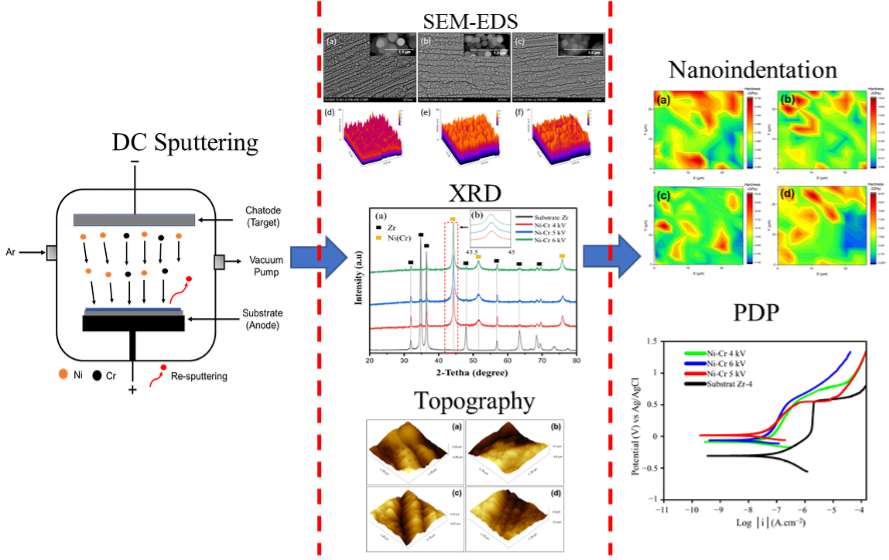
Zirconium alloys are commonly employed as fuel cladding materials in pressurized water reactors; nevertheless, their low corrosion and oxidation resistance under harsh operating circumstances remain a significant barrier for accident-tolerant fuel applications. This work investigates how sputtering voltage affects the microstructural evolution, as well as the mechanical and corrosion performance, of DC-sputtered Ni-20Cr coatings deposited on Zr-4 substrates. The coatings were formed at sputtering voltages of 4, 5, and 6 kV and evaluated by X-ray diffraction, scanning electron microscopy-energy dispersive spectroscopy, microhardness and nanoindentation tests, and potentiodynamic polarization in a simulated PWR primary coolant. The findings show that sputtering voltage has a significant impact on crystallite refinement, coating compactness, and the integrity of the coating-substrate interface, all of which influence the functional performance of coatings. Among the investigated deposition conditions, the coating deposited at 5 kV had the best combination of microstructural, mechanical, and corrosion properties, whereas increasing the sputtering voltage to 6 kV resulted in microstructural degradation, which reduced protective performance despite increasing thickness. These results show a clear relationship between sputtering voltage, microstructural evolution, and the mechanical and corrosion performance of Ni-Cr coatings. The study offers important guidance for optimizing sputtering parameters and illustrates the efficacy of DC-sputtered Ni-Cr coatings for accident-tolerant nuclear fuel cladding.
References
Amaya, M. (2024). The Precipitation and Redistribution of Alloying Elements in Zircaloy-4 Cladding Tube Oxidized in High-Temperature Steam. High Temperature Corrosion of Materials, 101(3); 455–469.
Anders, A. (2017). Tutorial: Reactive High Power Impulse Magnetron Sputtering (R-HiPIMS). Journal of Applied Physics, 121(17).
Basori, B., M. K. Ajiriyanto, R. Kriswarini, H. Hardiyanti, C. Rosyidan, S. D. Yudanto, E. U. M. Situmorang, D. Edbert, D. Nanto, F. B. Susetyo, et al. (2025). Rotating Speed and Magnetic Pole Dependency Assisted on Copper Deposition onto Aluminum Alloy Substrate for Bacterial Eradication Application. Communications in Science and Technology, 10(1); 17–28.
Borowski, P. and J. Myśliwiec (2025). Recent Advances in Magnetron Sputtering: From Fundamentals to Industrial Applications. Coatings, 15(8); 922.
Brachet, J.-C., T. Guilbert, S. Urvoy, E. Rouesne, M. Peyret, T. Vandenberghe, C. Prou, T. Le Hong, and D. Hamon (2025). Some Practical Methodologies to Assess the Overall High-Temperature (One-Sided) Steam Oxidation Protectiveness of Chromium-Based Coatings on a Zirconium-Based Substrate as Enhanced Accident-Tolerant Fuel (E-ATF) Claddings. Journal of Nuclear Materials, 606; 155620.
Cubillos, G. I., E. Romero, and A. Umaña-Perez (2021). ZrN-ZrOxNy vs ZrO2-ZrOxNy Coatings Deposited via Unbalanced DC Magnetron Sputtering. Scientific Reports, 11(1); 18926.
Fan, H. and Y.-H. Huang (2013). Improved Microstructure and Corrosion Resistance of Nanostructured Nickel Coating via Pulsed Jet Plating. Corrosion Engineering, Science and Technology, 48(1); 48–50.
Fan, S., B. Mi, J. Wang, P. Liu, X. Ma, T. Chen, and W. Li (2024). Research Progress on the Preparation of Irradiation-Resistant Coating Based on PVD Technology. Journal of Materials Research and Technology, 32; 4069–4091.
Figueiredo, R. B., M. Kawasaki, and T. G. Langdon (2024). The Role of Grain Size in Achieving Excellent Properties in Structural Materials. Journal of Materials Research and Technology, 30; 3448–3462.
Gill, S. K., J. Sure, Y. Wang, B. Layne, L. He, S. Mahurin, J. F. Wishart, and K. Sasaki (2021). Investigating Corrosion Behavior of Ni and Ni-20Cr in Molten ZnCl2. Corrosion Science, 179; 109105.
Golgovici, F., D. Diniasi, P. P. Dincă, B. Butoi, and I. Demetrescu (2024). Corrosion of Chromium Coating Fabricated on Zircaloy-4 Substrate. Materials, 17(18); 4445.
Greene, J. E. (2017). Review Article: Tracing the Recorded History of Thin-Film Sputter Deposition: From the 1800s to 2017. Journal of Vacuum Science & Technology A: Vacuum, Surfaces, and Films, 35(5); 05C204.
Han, Z., Z. Wang, Z. Wang, S. Tan, A. Wang, Z. Piao, and P. Ke (2024). Tailored High-Temperature Corrosion Behavior of Cr Coatings Using High Power Impulse Magnetron Sputtering on ZIRLO Alloys for Accident-Tolerant Fuel Application. Surface and Coatings Technology, 488; 130941.
Hnilica, J., P. Klein, M. Učík, S. Debnárová, J. Klusoň, and P. Vašina (2024). On Direct-Current Magnetron Sputtering at Industrial Conditions with High Ionization Fraction of Sputtered Species. Surface and Coatings Technology, 487; 131028.
Kashkarov, E., B. Afornu, D. Sidelev, M. Krinitcyn, V. Gouws, and A. Lider (2021). Recent Advances in Protective Coatings for Accident Tolerant Zr-Based Fuel Claddings. Coatings, 11(5); 557.
Kautz, E., B. Gwalani, Z. Yu, T. Varga, K. J. Geelhood, A. Devaraj, and D. J. Senor (2023). Investigating Zirconium Alloy Corrosion with Advanced Experimental Techniques: A Review. Journal of Nuclear Materials, 585; 154586.
Kumar, M., H. Singh, and N. Singh (2013). Study of Ni-20Cr Coatings for High Temperature Applications – A Review. Archives of Metallurgy and Materials, 58(2); 523–528.
Li, G., Y. Liu, Y. Zhang, H. Li, X. Wang, M. Zheng, and Y. Li (2020). High Temperature Anti-Oxidation Behavior and Mechanical Property of Radio Frequency Magnetron Sputtered Cr Coating. Metals, 10(11); 1509.
Li, Q., P. Song, R. Zhang, T. Huang, and D. Kong (2024a). Corrosion Mechanism and Performance of Cr-Coated Zr-4 Alloy in 360°C Water and 1300°C Steam. Journal of Materials Research and Technology, 29; 1524–1534.
Li, Y., B.-Q. Wang, X.-Y. Zhang, S.-J. Wang, C.-Y. Li, H.-L. Yang, R.-R. Su, and T. Liu (2024b). High-Temperature Oxidation Behavior and Degradation Mechanism of Chromium-Coated Zirconium Alloy Cladding: A Review. Tungsten, 7(3); 50–70.
Liu, Z., Q. Zhang, X. Zhang, Z. Yu, X. Zhang, Q. Mao, J. Nie, and Y. Zhao (2024). Electrodeposition of Nanocrystalline Ni and NiCr Alloy Coatings: Effects of Cr Content on Microhardness and Wear Resistance Improvement. Journal of Materials Research and Technology, 30; 3584–3593.
Ma, H. B., J. Yan, Y. H. Zhao, T. Liu, Q. S. Ren, Y. H. Liao, J. D. Zuo, G. Liu, and M. Y. Yao (2021). Oxidation Behavior of Cr-Coated Zirconium Alloy Cladding in High-Temperature Steam above 1200°C. npj Materials Degradation, 5(1); 7.
Metzger, K. E., T. W. Knight, E. Roberts, and X. Huang (2017). Determination of Mechanical Behavior of U3Si2 Nuclear Fuel by Microindentation Method. Progress in Nuclear Energy, 99; 147–154.
Petrović, S., N. Bundaleski, M. Radović, Z. Ristić, G. Gligorić, D. Peruško, M. Mitrić, B. Praček, A. Zalar, and Z. Rakočević (2007). Surface Composition and Structure of Ni–Cr Sputtered Coatings Exposed in Air at Room Temperature. Nuclear Instruments and Methods in Physics Research Section B: Beam Interactions with Materials and Atoms, 256(1); 368–372.
Revenko, A. G., A. L. Tsvetyansky, and A. N. Eritenko (2022). X-Ray Fluorescence Analysis of Solid-State Films, Layers, and Coatings. Radiation Physics and Chemistry, 197; 110157.
Rosyidan, C., B. Kurniawan, B. Soegijono, M. Maulani, L. Samura, F. G. Nababan, V. G. Vidia Putra, and F. B. Susetyo (2024). Nickel Salt Dependency as Catalyst in the Plating Bath on the Film Properties of Cu/Cu-Ni. Science and Technology Indonesia, 9(3); 529–538.
Sidelev, D. V., E. B. Kashkarov, M. S. Syrtanov, and V. P. Krivobokov (2019). Nickel-Chromium (Ni–Cr) Coatings Deposited by Magnetron Sputtering for Accident Tolerant Nuclear Fuel Claddings. Surface and Coatings Technology, 369; 69–78.
Sidelev, D. V., C. Poltronieri, M. Bestetti, M. G. Krinitcyn, V. A. Grudinin, and E. B. Kashkarov (2022). A Comparative Study on High-Temperature Air Oxidation of Cr-Coated E110 Zirconium Alloy Deposited by Magnetron Sputtering and Electroplating. Surface and Coatings Technology, 433; 128134.
Singh, V. and M. Marya (2019). Thermally Assisted Adhesion Enhancement in High-Phosphorous Electroless Nickel Plating. Journal of Materials Engineering and Performance, 28(4); 2147–2157.
Smola, G., R. Gawel, K. Kyziol, M. Miszczak, and Z. Grzesik (2019). Influence of Nickel on the Oxidation Resistance at High Temperatures of Thin Chromium Coatings. Oxidation of Metals, 91(5–6); 625–640.
Ul-Hamid, A. (2021). Synthesis, Microstructural Characterization and Nanoindentation of Zr, Zr-Nitride and Zr-Carbonitride Coatings Deposited Using Magnetron Sputtering. Journal of Advanced Research, 29; 107–120.
Wicaksono, Y. G., Ridwan, A. Saputra, and A. Manaf (2026). Effect of Heat Treatment on the Hardness and Corrosion Rate of Oxide-Coated Zirconium Alloy Prepared via Electroplating with Chromium and Nickel Solutions. Physica Scripta, 101(25); 255908.
Zhao, P., D. Huang, H. Zhang, W. Chen, and Y. Zhang (2023). Synthesis and Properties of Octet NiCr Alloy Lattices Obtained by the Pack Cementation Process. Applied Sciences, 13(3); 1684.
Zinkle, S. J., K. A. Terrani, J. C. Gehin, L. J. Ott, and L. L. Snead (2014). Accident Tolerant Fuels for LWRs: A Perspective. Journal of Nuclear Materials, 448(1–3); 374–379.
Authors

This work is licensed under a Creative Commons Attribution 4.0 International License.