
Structural Modification of Bentonite by Rice Husk Biochar for Enhanced Methylene Blue Removal under Visible Irradiation
Article Sidebar
-
Bentonite–Biochar Composite, Rice Husk Biochar, Methylene Blue Removal, Visible-Assisted Degradation, Wastewater Treatment
Abstract
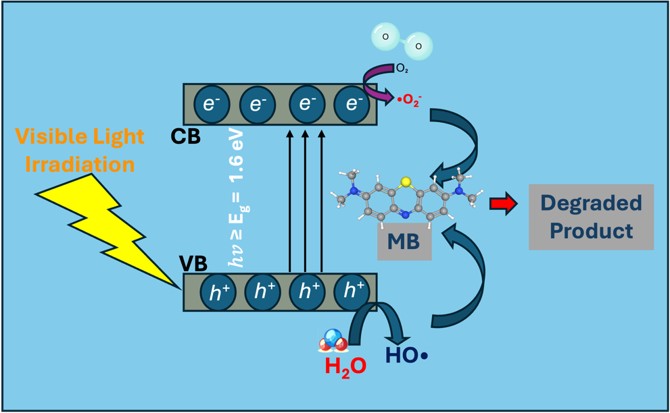
The development of sustainable and low-cost materials for wastewater treatment remains an important environmental challenge. In this study, a bentonite-biochar (Bnt–Bc) composite was prepared through structural modification of bentonite using rice husk–derived biochar followed by KOH-assisted activation. The physicochemical properties of the materials were systematically characterized using XRD, BET, FTIR, SEM, and UV–Vis diffuse reflectance spectroscopy. The results revealed that biochar incorporation modified the interlayer structure of bentonite, resulting in reduced crystallinity, pore structure alteration, and the introduction of additional oxygen-containing functional groups. These structural changes contributed to improved surface reactivity and enhanced interaction with dye molecules. The performance of the materials was evaluated for methylene blue (MB) removal under Visible Light irradiation. The Bnt–Bc composite exhibited significantly higher removal efficiency compared to pristine bentonite and biochar, achieving up to 98% MB removal within 150 min. Kinetic analysis indicated that the removal process followed a pseudo-first-order model. The enhanced performance is attributed to the combined effects of improved adsorption capacity, surface functional groups, and photo-assisted degradation under Visible Light irradiation. This study demonstrates that biochar modified bentonite composites derived from agricultural waste represent a promising and environmentally friendly material for dye-contaminated wastewater treatment.
References
Ajayi, O. A., O. O. Okeniyi, O. A. Adekunle, and Y. M. Sani (2021). Development and Characterization of Rice Husk Ash-Based Photocatalyst for Degradation ofMethylene Blue. Journal of Materials and Environmental Science; 1360–1372
Alburaih, H. A., S. Aman, N. Ahmad, S. R. Ejaz, R. Y. Khosa, A. G. Abid, S. Manzoor, H. M. T. Farid, M. S. Waheed, and T. A. Taha (2023). Synergistic Photodegradation of Methylene Blue by Sm-Doped Fe2O3 Photocatalyst Under Sunlight. Chinese Journal of Physics, 83; 637–649
Ashamary, F., P. C. Neba, S. Harivarsha, A. Raji, P. Annamalai, M. G. Mohamed, P. Kalambate, P. Muthirulan, S.W. Kuo, and D. Manoj (2025). In Situ Synthesis of 3D ZIF-8 on 2D MXene Nanosheets for Efficient Photocatalytic Degradation of Methylene Blue (MB). Materials Advances, 6; 4660–4671
Aziz, S., B. Uzair, M. I. Ali, S. Anbreen, F. Umber, M. Khalid, A. A. Aljabali, Y. Mishra, V. Mishra, Á. Serrano-Aroca, G. A. Naikoo, M. El-Tanani, S. Haque, A. G. Almutary, and M. M. Tambuwala (2023). Synthesis and Characterization of Nanobiochar from Rice Husk Biochar for the Removal of Safranin and Malachite Green fromWater. Environmental Research, 238; 116909
Banat, F., S. Al-Asheh, R. Zomaout, B. Qtaishat, T. Alateat, and S. Almayta (2009). Photodegradation of Methylene Blue Dye Using Bentonite as a Catalyst. Desalination and Water Treatment, 5; 283–289
Behnajady, M. A., N. Modirshahla, and R. Hamzavi (2006). Kinetic Study on Photocatalytic Degradation of C.I. Acid Yellow 23 by ZnO Photocatalyst. Journal of Hazardous Materials, 133; 226–232
Boostani, H. R., Z. Jalalpour, A. Behpouri, E. Bijanzadeh, and M. Najafi-Ghiri (2025). Comparative Efficacy of Individually and Combined Application of Compost, Biochar, and Bentonite on Ni Dynamics in a Calcareous Soil. SOIL, 11; 939–955
Bopape, D. A. (2026). Exploring the Synthesis and Application of ZnO-, TiO2-, CuO-ZnO- and CuO-TiO2 Carbon Sphere (CSs) Nanocomposites for the Photocatalytic Degradation of Methylene Blue (MB) Dye and Ciprofloxacin (CIP) Antibiotic Under Ultraviolet (UV) Irradiation. Journal of Water Process Engineering, 81; 109392
Chakrabarti, S. and B. K. Dutta (2004). Photocatalytic Degradation of Model Textile Dyes inWastewater Using ZnO as Semiconductor Catalyst. Journal of HazardousMaterials, 112; 269–278
Chen, Z.-x., X.-y. Jin, Z. Chen, M. Megharaj, and R. Naidu (2011). Removal of Methyl Orange from Aqueous Solution Using Bentonite-Supported Nanoscale Zero-valent Iron. Journal of Colloid and Interface Science, 363(2); 601–607
Darmawan, A., D. A. Batu Bara, M. Al Fahmi, H. Muhtar, and D. N. Bima (2025). Synergistic Photodegradation of Remazol Black B Dye Using Sulfur-Doped g-C3N4/rGO Composite: The Dual Role of Thiourea. Journal of Water Process Engineering, 72; 107545
Dhar, A. K., H. A. Himu, M. Bhattacharjee, M. G. Mostufa, and F. Parvin (2023). Insights on Applications of Bentonite Clays for the Removal of Dyes andHeavyMetals from Wastewater: A Review. Environmental Science and Pollution Research, 30; 5440–5474
Dhila, H., A. Bhapkar, and S. Bhame (2025). Metal Oxide/Biochar Hybrid Nanocomposites for Adsorption and Photocatalytic Degradation of Textile Dye Effluents: A Review. Desalination andWater Treatment, 321; 101004
Dira, A., A. Ayad, A. Harrou, A. Elmouwahidi, F. Carrasco-Marin, and E. Gharibi (2026). Insight into the Synergistic Adsorption Mechanism of a Novel Biochar-Bentonite Composite for Malachite Green Removal: A DFT-Guided Study. Journal of Water Process Engineering, 83; 109623
Gnanamozhi, P., A. Monamary, S. D. Jereil, J. E. Pauline, J. A. O. Ratnam, A. Ganeshkumar, V. Pandiyan, A. A. Alothman, R. A. Alshgari, and M. Govindasamy (2023). Effective Photocatalytic Degradation of Methylene Blue (MB) and Reactive Red 120 (RR120) Using Al-Substituted ZnO Nanoparticles. Surfaces and Interfaces, 41; 103203
Hanifah, Y. and N. Ahmad (2025). Polyoxometalate-Assisted Layered Double Hydroxide for Facile Photocatalytic Methylene Blue and Malachite Green. Science and Technology Indonesia, 10; 1312–1321
Hass Caetano Lacerda, E., F. C.Monteiro, J. R. Kloss, and S. T. Fujiwara (2020). Bentonite Clay Modified with Nb2O5: An Efficient and Reused Photocatalyst for the Degradation of Reactive Textile Dye. Journal of Photochemistry and Photobiology A: Chemistry, 388; 112084
Hidayat, A. Rahmat, R. C.Nissa, Sukamto, L.Nuraini, M.Nurtanto, andW. S. Ramadhani (2023). Analysis of Rice Husk Biochar Characteristics Under Different Pyrolysis Temperature. In IOP Conference Series: Earth and Environmental Science, volume 1201. page 012095
Jain, R., M. Upadhyaya, A. Singh, and R. P. Jaiswal (2024). TiO2 Nanoparticles Synthesized on Graphene Nanosheets with Varied Crystallinity for Photocatalytic Degradation of MB Dye. Journal of Environmental Chemical Engineering, 12; 113881
Janani, F. Z., H. Khiar, N. Taoufik, A. Elhalil, M. Sadiq, A. V. Puga, S. Mansouri, and N. Barka (2021). ZnO–Al2O3–CeO2–Ce2O3 Mixed Metal Oxides as a Promising Photocatalyst for Methyl Orange Photocatalytic Degradation. Materials Today Chemistry, 21; 100495
Kambo, H. S. and A. Dutta (2015). A Comparative Review of Biochar and Hydrochar in Terms of Production, Physico-Chemical Properties and Applications. Renewable and Sustainable Energy Reviews, (45); 359–378
Li, L., Z. Yin, M. Cheng, L. Qin, S. Liu, H. Yi, M. Zhang, Y. Fu, X. Yang, X. Zhou, et al. (2023). Insights into Reactive Species Generation and Organics Selective Degradation in Fe-Based Heterogeneous Fenton-like Systems: A Critical Review. Chemical Engineering Journal, 454; 140126
Liu, S. Z.,W. Ding, H.W. Zhang, Z. S. Li, K. C. Tian, C. Liu, Z. C. Geng, and C. Y. Xu (2024). Magnetized Bentonite Modified Rice Straw Biochar: Qualitative and Quantitative Analysis of Cd(II) Adsorption Mechanism. Chemosphere, 359; 142262
MacHale, A. R., S. A. Phaltane, H. D. Shelke, and L. D. Kadam (2021). Facile Hydrothermal Synthesis of Cu2SnS3 Nanoparticles for Photocatalytic Dye Degradation of Methylene Blue. Materials Today Proceedings, 43; 2768–2773
Masri, M., G. K. B, A. Hezam, K. Alkanad, T. F. Qahtan, Q. A. Drmosh, F. Masri, K. Prashantha, M. S. H, S. M. Abdu Kaid, Udayabhanu, and K. Byrappa (2025). Boosting the Photocatalytic Efficiency of g-C3N4 for Effective Removal of RhB and MB from Aqueous Medium. Colloids and Surfaces C: Environmental Aspects, 3; 100074
Obaideen, K., N. Shehata, E. T. Sayed, M. A. Abdelkareem, M. S. Mahmoud, and A. G. Olabi (2025). Synergistic Adsorption-Photocatalytic Remediation of Methylene Blue Dye from Textile IndustryWastewater over NiFe LDH Supported on Tyre-Ash Derived Activated Carbon. Applied Surface Science, 679; 161205
Palapa, N. R., A. Amri, and Y. Hanifah (2023). Potential Indonesian Rice Husk forWastewater Treatment Agricultural Waste Preparation and Dye Removal Application. Indonesian Journal of EnvironmentalManagement and Sustainability, 7; 160–165
Priatna, S. J., A. Yuliana, Zulkarnain, E. Melwita, F. S. Arsyad, and R. Mohadi (2024). Removal of Methyl Orange in Aqueous Medium Using ZnO/Bentonite as Semiconductor by Photocatalytic Process. Science and Technology Indonesia, 9; 539–545
Qian, X., H. Han, Y. Chen, and Y. Yuan (2018). Sol–Gel Solvothermal Route to Synthesize Anatase/Brookite/Rutile TiO2 Nanocomposites with Highly Photocatalytic Activity. Journal of Sol-Gel Science and Technology, 85; 394–401
Ramesh, K. and V. Raghavan (2025). Biochar/Bentonite Composite Beads for Controlled Nitrogen Release and Reduced Environmental Impact: From BananaWaste to Sustainable Food Security. Results in Surfaces and Interfaces, 19; 100500
Ren, H., G. Long, Y. Chen, Y. Gao, H. Mao, X. Gong, D. Xue, G. Hu, and B. Wang (2025). Enhanced Methylene Blue Degradation by Graphene Oxide-Encapsulated Nano Zero-Valent Iron Composites: Optimization,Mechanistic Insights, and Environmental Implications. Materials Science in Semiconductor Processing, 185; 108869
Rupngam, T., P. Udomkun, T. Boonupara, and P. Kaewlom (2025). Contrasting Pre- and Post-Pyrolysis Incorporation of Bentonite into Manure Biochar: Impacts on Nutrient Availability, Carbon Stability, and Physicochemical Properties. Agronomy, 15(8); 2015
Salah, M. M., M. S. Hammad, A. L. Fayed, and A. M. Ebid (2025). The Influence of Bentonite Content on the Properties of Its Mixture with Kaolinite. Scientific Reports, 15; 10982
Saravanan, R., S. Karthikeyan, V. K. Gupta, G. Sekaran, V. Narayanan, and A. Stephen (2013). Enhanced Photocatalytic Activity of ZnO/CuO Nanocomposite for the Degradation of Textile Dye on Visible Light Illumination. Materials Science and Engineering C, 33; 91–98
Sewu, D. D., D. S. Lee, H. N. Tran, and S. H. Woo (2019). Effect of Bentonite-Mineral Co-Pyrolysis with Macroalgae on Physicochemical Property and Dye Uptake Capacity of Bentonite/Biochar Composite. Journal of the Taiwan Institute of Chemical Engineers, 104; 106–113
Shu, J., K. Wang, V. K. Sharma, X. Xu, N. Nesnas, and H.Wang (2023). Efficient Micropollutants Degradation by Ferrate(VI)-Ti/Zn LDH Composite under Visible Light: Activation of Ferrate(VI) and Self-Formation of Fe(III)-LDH Heterojunction. Chemical Engineering Journal, 456; 141127
Sun, W., H. Zeng, and T. Tang (2021). Enhanced Adsorption of Anionic Polymer onMontmorillonite by Divalent Cations and the Effect of Salinity. Journal of Physical Chemistry A, 125; 1025–1035
Wang,W., Q. Dong, H. Qiu, H. Li, Y. Mao, Y. Liu, T. Gong, M. Xiang, Y. Huang, C.Wang, et al. (2022). Rapid Reactivation of Aged NZVI/GO by Shewanella CN32 for Efficient Removal of Tetrabromobisphenol A and Associated ReactionMechanisms. Journal of Cleaner Production, 333; 130215
Xu, D. and H. Ma (2021). Degradation of Rhodamine B in Water by Ultrasound-Assisted TiO2 Photocatalysis. Journal of Cleaner Production, 313; 127758
Yontar, A. K., S. Avcioğlu, and S. Çevik (2022). Nature-Based Nanocomposites for Adsorption and Visible Light Photocatalytic Degradation ofMethylene Blue Dye. Journal of Cleaner Production, 380; 135070
Zahara, Z. A., I. Royani, N. R. Palapa, R. Mohadi, and A. Lesbani (2023). Treatment of Methylene Blue Using Ni-Al/Magnetite Biochar Layered DoubleHydroxides Composite byAdsorption. Bulletin of ChemicalReaction Engineering and Catalysis, 18; 659–674
Zhang, P., Z. Shen, L. Jia, and J. Qiu (2026). Biomass-Derived Carbon for Boosting Photocatalysis. Small, 22(8); e12210
Zhao, Y., J. Yao, N. Min, B. Ma,W. Chai, and Y. Ma (2026). Efficient Removal of Cu2+, Pb2+, and Cd2+ by Two Magnetic Biochar-Montmorillonite Composites and the Application in SyntheticWastewater. Separation and Purification Technology; 136996
Zhou, B., J. J.Wang, P. Dangal, S. Lomnicki, A. D. Roy, and J. H. Park (2024). A Novel Sugarcane Residue-Derived Bimetallic Fe/Mn-Biochar Composite for Activation of Peroxymonosulfate in Advanced Oxidation Process Removal of Azo Dye: Degradation Behavior and Mechanism. Journal of Water Process Engineering, 58; 104740
Authors

This work is licensed under a Creative Commons Attribution 4.0 International License.