
The Utilization of Beta, Sigmoid, and Linear Fuzzy Membership Functions Discretization to Classify AISI 1045 Surface Roughness Levels Using the Ensemble of Multiple Naïve Bayes
Article Sidebar
-
AISI 1045, Ensemble, Fuzzy, Multiple Naïve Bayes, Surface Roughness Levels
Abstract
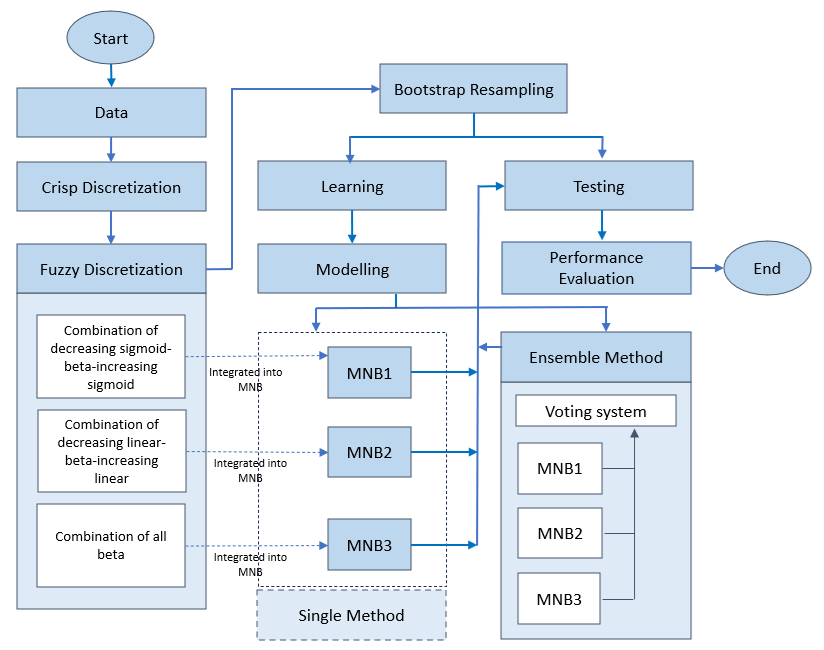
Currently, researchers in various fields are using fuzzy discretization for decision-making. Discretization construction for numerical data involving a combination of fuzzy membership functions is significant because it can affect the performance of the model used. Classification of AISI 1045 surface roughness with satisfactory performance is needed to improve efficiency and extend the service life of AISI 1045 products. This study utilizes three fuzzy membership functions: beta, sigmoid, and linear in constructing fuzzy discretization on machining factors and tangential roughness levels to classify the axial roughness level of AISI 1045. Classification is performed using an ensemble of single naïve Bayes methods integrated with fuzzy discretization. These single methods are distinguished based on the combination of fuzzy membership functions used in the discretization. The results of the study show that the integration of fuzzy discretization through a combination of fuzzy membership functions, namely beta, sigmoid, linear, and fellow beta functions in the MNB method provides different performance, even the performance of MNB with fuzzy discretization using a combination of beta and sigmoid is almost the same or not statistically significantly different from the performance of the ensemble method. However, the ensemble method built provides the best performance for classifying the surface roughness level of AISI 1045, with Accuracy, Precision, Recall, F1-score, AUC, Balanced Accuracy, and G-Mean of 85.42%, 55.33%, 73.14%, 62.63%, 71.71%, 81.71%, and 81.04%, respectively.
References
Agung, S., Y. Budi, and Y. Kiki (2009). Logika Fuzzy Dengan Matlab. Jayapangus Press, 1 edition
Alajmi, M. S. and A. M. Almeshal (2021). Least Squares Boosting Ensemble and Quantum-Behaved Particle Swarm Optimization for Predicting the Surface Roughness in the Face Milling Process of Aluminum Material. Applied Sciences, 11(5); 2126
Algehyne, E. A., M. L. Jibril, N. A. Algehainy, O. A. Alamri, and A. K. Alzahrani (2022). Fuzzy Neural Network Expert System with an Improved Gini Index Random Forest-Based Feature Importance Measure Algorithm for Early Diagnosis of Breast Cancer in Saudi Arabia. Big Data and Cognitive Computing, 6(1); 13
An, Q., S. Huang, Y. Han, and Y. Zhu (2024). Ensemble Learning Method for Classification: Integrating Data Envelopment Analysis with Machine Learning. Computers and Operations Research, 169; 106739
Balasuadhakar, A., S. Thirumalai Kumaran, and M. Uthayakumar (2025). Machine Learning Prediction of Surface Roughness in Sustainable Machining of AISI H11 Tool Steel. Smart Materials in Manufacturing, 3; 100075
Baldin, V., L. R. R. da Silva, R. Davis, M. J. Jackson, F. L. Amorim, C. F. Houck, and A. R. Machado (2023). Dry and MQL Milling of AISI 1045 Steel with Vegetable and Mineral-Based Fluids. Lubricants, 11(4); 175
Bhattacharyya, R. and S. Mukherjee (2020). Fuzzy Membership Function Evaluation by Nonlinear Regression: An Algorithmic Approach. Fuzzy Information and Engineering, 12(4); 412–434
Campión, M. J., R. G. Catalán, E. Induráin, I. Lizasoain, A. Raventos-Pujol, and A. Valero (2018). Geometrical Aggregation of Finite Fuzzy Sets. International Journal of Approximate Reasoning, 103; 248–266
Chen, J., J. Lin, M. Zhang, and Q. Lin (2024). Predicting Surface Roughness in Turning Complex-StructuredWorkpieces Using Vibration-Signal-Based Gaussian Process Regression. Sensors, 24(7); 2117
Chen, Q. and M. Huang (2021). Rough-Fuzzy Model-Based Feature Discretization in Intelligent Data Preprocessing. Journal of Cloud Computing, 10(1); 5
Dai, J., Q. Liu, X. Zou, and C. Zhang (2024). Feature Selection Based on Fuzzy Combination Entropy, Considering Both Global and Local Feature Correlations. Information Sciences, 652; 119753
De Angeli, K., S. Gao, I. Danciu, E. B. Durbin, X.-C. Wu, A. Stroup, et al. (2022). Class Imbalance in Out-of-Distribution Datasets: Improving the Robustness of the TextCNN for the Classification of Rare Cancer Types. Journal of Biomedical Informatics, 125; 103957
Dubey, V., A. K. Sharma, and D. Y. Pimenov (2022). Prediction of Surface Roughness Using Machine Learning Approach in MQL Turning of AISI 304 Steel by Varying Nanoparticle Size in the Cutting Fluid. Lubricants, 10(5); 81
Duran-Rosal, A. M., T. Ashley, J. Perez-Rodriguez, and F. Fernandez-Navarro (2025). Global and Diverse Ensemble Model for Regression. Neurocomputing, 647; 130520
Fernandez, S., T. Ito, L. Cruz-Piris, and I. Marsa-Maestre (2022). Fuzzy Ontology-Based System for Driver Behavior Classification. Sensors, 22(20); 7954
Ganaie, M. A., M. Hu, A. K. Malik, M. Tanveer, and P. N. Suganthan (2022). Ensemble Deep Learning: A Review. Engineering Applications of Artificial Intelligence, 115; 105151
García-Zamora, D., B. Dutta, J. R. Figueira, and L. Martínez (2024). The Deck of Cards Method to Build Interpretable Fuzzy Sets in Decision-Making. European Journal of Operational Research, 319(1); 246–262
Guo, M., S.Wei, C. Han,W. Xia, C. Luo, and Z. Lin (2024). Prediction of Surface Roughness Using Deep Learning and Data Augmentation. Journal of Intelligent Manufacturing and Special Equipment, 5(1); 221–241
Hasan, M. F. and M. A. Sobhan (2020). Describing Fuzzy Membership Function and Detecting the Outlier by Using the Five-Number Summary of Data. American Journal of Computational Mathematics, 10(3); 410–424
Ijaz Malik, M. A., M. A. Kalam, M. A. Mujtaba, and F. Almomani (2023). A Review of Recent Advances in the Synthesis of Environmentally Friendly, Sustainable, and Nontoxic Bio-Lubricants: Recommendations for Future Implementations. Environmental Technology and Innovation, 32; 103366
Imani, M., H. Fakour,W. H. Lan, H. C. Kao, C. M. Lee, Y. S. Hsiao, and C. Y. Kuo (2021). Application of Rough and Fuzzy Set Theory for the Prediction of Stochastic Wind Speed Data Using Long Short-Term Memory. Atmosphere, 12(7); 924
Janková, Z. and E. Rakovská (2022). Comparison of Uncertainty of Different Types of Membership Functions in T2FLS: Case of International Financial Market. Applied Sciences, 12(2); 918
Khan, A. A., O. Chaudhary, and R. Chandra (2024). A Review of Ensemble Learning and Data Augmentation Models for Class Imbalanced Problems: Combination, Implementation, and Evaluation. Expert Systems with Applications, 244; 122778
Köseoğlu, A., F. Altun, and R. Şahin (2024). Aggregation Operators of Complex Fuzzy Z-Number Sets and Their Applications in Multi-Criteria Decision Making. Complex and Intelligent Systems, 10(5); 6559–6579
Kresnawati, E. S., B. Suprihatin, and Y. Resti (2024). The Combinations of Fuzzy Membership Functions on Discretization in the Decision Tree-ID3 to Predict Degenerative Disease Status. Symmetry, 16(12); 1560
La Fé-Perdomo, I., J. Ramos-Grez, R. Mujica, and M. Rivas (2023). Surface Roughness Ra Prediction in Selective Laser Melting of 316L Stainless Steel byMeans of Artificial Intelligence Inference. Journal of King Saud University - Engineering Sciences, 35(2); 148–156
Lu, L., H. Yi, A. Shu, J. Qin, and E. Lu (2023). Deep Learning Classification and Recognition Method for Milling Surface Roughness Combined With Simulation Data. Metrology and Measurement Systems, 30(1); 117–138
Medasani, S., J. Kim, and R. Krishnapuram (1998). An Overview of Membership Function Generation Techniques for Pattern Recognition. International Journal of Approximate Reasoning, 19(3-4); 391–417
Michael, V. (2020). Assessment and Linear Programming under Fuzzy Conditions. Journal of Fuzzy Extension and Applications, 1(3); 189–205
Mohammed, A. and R. Kora (2023). A Comprehensive Review on Ensemble Deep Learning: Opportunities and Challenges. Journal of King Saud University - Computer and Information Sciences, 35(2); 757–774
Muludi, K., R. Setianingsih, R. Sholehurrohman, and A. Junaidi (2024). Exploiting Nearest Neighbor Data and Fuzzy Membership Function to Address Missing Values in Classification. PeerJ Computer Science, 10; 1–20
Otsuki, T., K. Okita, and H. Sasahara (2022). Evaluating Surface Quality by Luminance and Surface Roughness. Precision Engineering, 74; 147–162
Palanikumar, M., N. Kausar, D. Pamucar, V. Simic, and F. T. Tolasa (2024). Various Distances Between Generalized Diophantine Fuzzy Sets Using Multiple Criteria Decision Making and Their Real-Life Applications. Scientific Reports, 14(1); 1–17
Pimenov, D. Y., O. Der, G. C. M. Patel, K. Giasin, and A. Ercetin (2025). State-of-the-Art Review of Energy Consumption in Machining Operations: Challenges and Trends. Renewable and Sustainable Energy Reviews, 224; 116073
Praveen, N., S. K. N G, S. R, C. D. Prasad, H. Soni, V. G, M. Prasad, S. K. T C, U. S. Mallik, and A. A. Aden (2025). Effect of CNC Turning Parameters on MRR, Cutting Force, and Surface Roughness for Ternary Shape Memory Alloys (SMAs). Results in Engineering, 26; 104876
Qasim, A., S. Nisar, A. Shah, M. S. Khalid, and M. A. Sheikh (2015). Optimization of Process Parameters for Machining of AISI-1045 Steel Using Taguchi Design and ANOVA. Simulation Modelling Practice and Theory, 59; 36–51
Resti, Y., C. Irsan, A. Neardiaty, C. Annabila, and I. Yani (2023). Fuzzy Discretization on the Multinomial Naïve BayesMethod forModelingMulticlass Classification of Corn Plant Diseases and Pests. Mathematics, 11(8); 1761
Resti, Y., I. Yani, D. Puspitasari, I. Thamrin, and M. A. Ade Saputra (2025). Ensemble Method of Multiple Decision Trees with Crisp and Fuzzy Discretization for Axial Surface Roughness Prediction. Science and Technology Indonesia, 10(3); 678–689
Ross, N. S., P. M. Mashinini, C. Sherin Shibi, M. K. Gupta, M. E. Korkmaz, G. M. Krolczyk, and V. S. Sharma (2024). A New Intelligent Approach to Surface Roughness Measurement in Sustainable Machining of AM-316L Stainless Steel With Deep Learning Models. Measurement, 230; 114515
Rutkowski, L. (2004). Flexible Neuro-Fuzzy Systems: Structures, Learning and Performance Evaluation. In Handbook of Industrial Robotics. Kluwer Academic Publishers, pages 771–786
Ruzova and B. Haddadi (2025). Surface Roughness and Its Measurement Methods - Analytical Review. Results in Surfaces and Interfaces, 19; 100441
Saatchi, R. (2024). Fuzzy Logic Concepts, Developments, and Implementation. Information, 15(10); 656
Sani, S. M. (2019). Design of Fuzzy Membership Functions for Predicting Students’ Knowledge Performance. European Journal of Electrical Engineering and Computer Science, 3(6); 1–6
Siripath, N., N. Jantepa, S. Sucharitpwatskul, and S. Suranuntchai (2024). Integrating Taguchi Method and Finite Element Modelling for Precision Ball Joint Manufacturing with AISI 1045 Medium Carbon Steel. International Journal of Technology, 15(6); 1801–1822
Stojković, M., M. Madić, M. Trifunović, and R. Turudija (2022). Determining the Optimal Cutting Parameters for Required Productivity for the Case of Rough External Turning of AISI 1045 Steel with Minimal Energy Consumption. Metals, 12(11); 1793
Sukindar, N. A., A. S. H. Md Yasir, M. D. Azhar, M. A. Md Azhar, N. F. H. Abd Halim, M. H. Sulaiman, A. S. H. Ahmad Sabli, and M. K. A. Mohd Ariffin (2024). Evaluation of the Surface Roughness and Dimensional Accuracy of Low-Cost 3D-Printed Parts Made of PLA–Aluminum. Heliyon, 10(4); e25508
Thamrin, I. (2019). Analysis of the Effect of the Cutting Speed on Specific Cutting Energy in the Turning Process. In IOP Conference Series: Materials Science and Engineering, volume 620. page 012117
Trung, D. D. (2020). Influence of Cutting Parameters on Surface Roughness During Milling AISI 1045 Steel. Tribology in Industry, 42(4); 658–665
Tzotzis, A., P. Maropoulos, and P. Kyratsis (2025). A Dynamic Surface Roughness Prediction System Based on Machine Learning for the 3D-Printed Carbon-Fiber-Reinforced-Polymer (CFRP) Turning. Journal of Intelligent Manufacturing; 1–27
Wainer, J. (2024). An Empirical Evaluation of Imbalanced Data Strategies from a Practitioner’s Point of View. Expert Systems with Applications, 256; 124863
Wang, C. (2015). A Study of Membership Functions on Mamdani-Type Fuzzy Inference System for Industrial Decision-Making. Ph.D. thesis, Lehigh University
Wang, C., E. Moylan, and D. Levinson (2024). Ensemble Methods for Route Choice. Transportation Research Part C: Emerging Technologies; 104803
Yani, I., Marwani, D. Puspitasari, and Y. Resti (2025a). The Symmetric Pattern Fuzzy Discretization in Predicting Plastic Type for a Sorting System Using Decision Tree Methods. Science and Technology Indonesia, 10(3); 789–801
Yani, I., I. Thamrin, D. Puspitasari, Barlin, and Y. Resti (2025b). Ensemble Method of Triple Naïve Bayes for Plastic Type Prediction in Sorting System Automation. Applied Sciences, 15(11); 6201
Yanis, M., A. S. Mohruni, S. Sharif, and I. Yani (2019). Optimum Performance of Green Machining on Thin-Walled Ti6Al4V Using RSM and ANN in Terms of Cutting Force and Surface Roughness. Jurnal Teknologi, 81(6); 51–60
Zhao, M. and N. Ye (2024). High-Dimensional Ensemble Learning Classification: An Ensemble Learning Classification Algorithm Based on High-Dimensional Feature Space Reconstruction. Applied Sciences, 14(5); 1956
Authors

This work is licensed under a Creative Commons Attribution 4.0 International License.