
Molecular Interaction and Crystalline Structure Reorganization of C. esculenta and M. leucadendra Extract-Loaded CS/PVA Electrospun Nanofibers
Article Sidebar
-
Electrospun Nanofibers, Chitosan/PVA, Colocasia esculenta, Melaleuca leucadendra, Molecular Interactions
Abstract
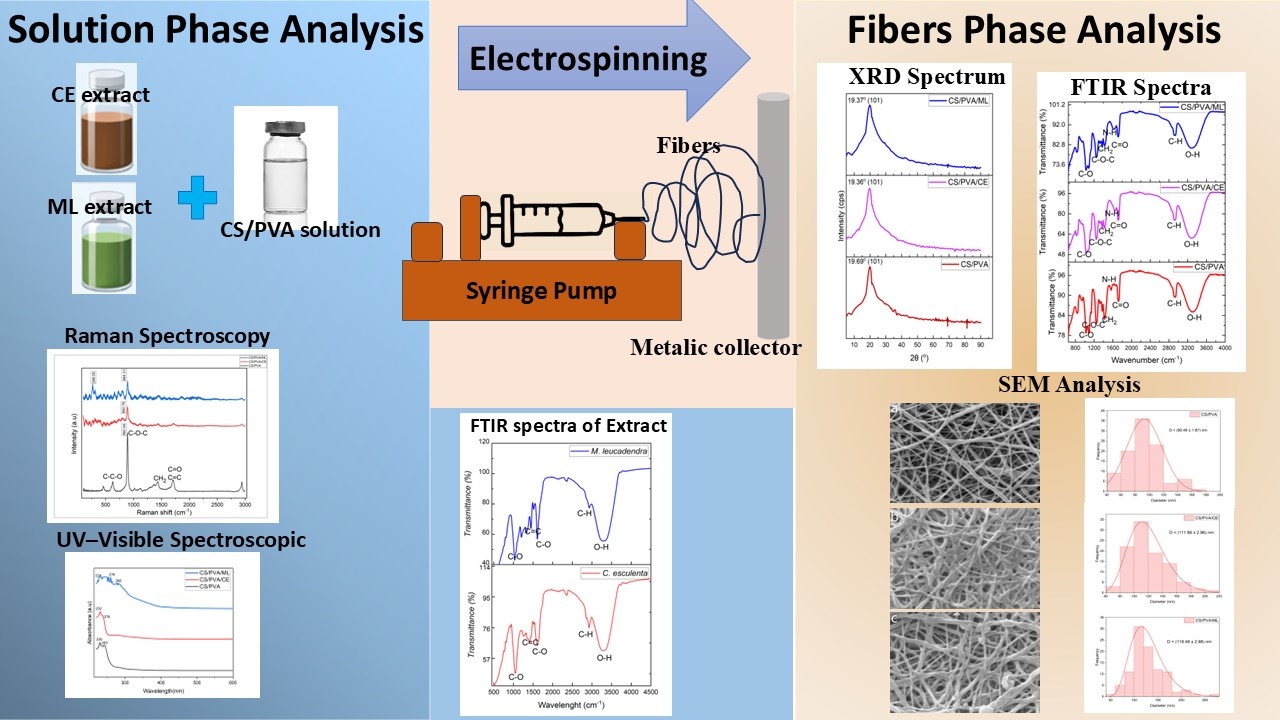
Understanding the molecular-to-structural evolution of extract-loaded electrospun systems is essential for rationally designing biofunctional nanomaterials. In this study, chitosan/polyvinyl alcohol (CS/PVA) electrospun nanofibers incorporated with Colocasia esculenta (CE) and Melaleuca leucadendra (ML) extracts were systematically investigated to elucidate the correlation between precursor solution interactions and resulting fiber morphology. Raman and UV-Visible spectroscopy were employed to probe molecular interactions and electronic transitions in electrospinning solutions. Extract incorporation induced vibrational band broadening and intensity suppression in Raman spectra, accompanied by increased absorbance and a red shift in UV–Visible spectra, particularly in the ML-containing system, indicating enhanced hydrogen bonding and greater electronic delocalization. Following electrospinning, structural characterization using XRD, FTIR, and SEM revealed progressive crystallinity reduction, peak shifting toward lower diffraction angles, hydrogen-bond-driven band broadening, and morphological evolution from smooth 90.86 ± 1.87 nm fibers (CS/PVA) to thicker 111.89 ± 2.96 nm fibers (CS/PVA/CE) and 118.48 ± 2.98 nm fibers (CS/PVA/ML). No separate crystalline extract phase was detected, confirming molecular-level dispersion within the polymer matrix. The ML-modified system exhibited the highest degree of amorphization and structural reorganization. These results establish a direct structure–property–function relationship, demonstrating that extract-induced modulation of intermolecular interactions governs crystalline organization, electrospinning dynamics, and nanofiber morphology. This study provides mechanistic insight into crystallinity engineering in plant-extract-loaded polymer systems and offers a scalable strategy for designing advanced bioactive electrospun nanomaterials.
References
Alfikro, I., Jorena, O. C. Satya, E. Koriyanti, F. Monado, and I. Royani (2024). Assessment of Different Crosslinking Mechanisms on PVA-Based Membranes to Achieve Water Resistance with Iron Imprinting Sites. Chimica Techno Acta, 11(3), 6–13.
Alibwaini, Y. A., O. M. Hemeda, T. Sharshar, A. H. Ashour, A. W. Ajlouni, E. A. Arrasheed, A. M. A. Henaish, and R. El-Shater (2022). Study of the PEG Content Effect on Some Properties of the PVA/PEG-EY Films Using the Raman, Positron Annihilation and Impedance Spectroscopies. Optik, 254, 168591.
Almafie, M. R., R. Dani, L. Marlina, J. Jauhari, and I. Sriyanti (2024). Preparation of PAN/PVDF Nanofiber Mats Loaded with Coconut Shell Activated Carbon and Silicon Dioxide for Lithium-Ion Battery Anodes. Science and Technology Indonesia, 9(2), 427–447.
Amur, S. A., Q. Khuhro, N. A. Soomro, Y. Oshima-Franco, A. Amur, K. H. Thebo, and A. Nadeem (2025). Biochemical Characterization of Bioactive Compounds in Citrullus colocynthis (L.) Schrad Seed Extract Using GC–MS Analysis and Their Potential Biological Applications. South African Journal of Botany, 185, 654–666.
Anaya-Mancipe, J. M., V. M. Queiroz, R. F. Dos Santos, R. N. Castro, V. S. Cardoso, A. B. Vermelho, M. L. Dias, and R. M. Thiré (2023). Electrospun Nanofibers Loaded with Plantago major L. Extract for Potential Use in Cutaneous Wound Healing. Pharmaceutics, 15(4), 1047.
Angel, N., L. Guo, F. Yan, H. Wang, and L. Kong (2020). Effect of Processing Parameters on the Electrospinning of Cellulose Acetate Studied by Response Surface Methodology. Journal of Agriculture and Food Research, 2, 100015.
Archana, M. S., C. S. C. Lekha, S. Deepa, and N. Kalarikkal (2025). A Novel Mesoporous Taurine-Doped Polyaniline/PVA Electrospun Composite Nanofiber: Comprehensive Study. Results in Surfaces and Interfaces, 20, 100610.
Aruan, N. M., I. Sriyanti, D. Edikresnha, T. Sucianti, M. M. Munir, and Khairurrijal (2017). Polyvinyl Alcohol/Soursop Leaves Extract Composite Nanofibers Synthesized Using Electrospinning Technique and Their Potential as Antibacterial Wound Dressing. Procedia Engineering, 170, 31–35.
Azmana, M., S. Mahmood, A. R. Hilles, A. Rahman, M. A. B. Arifin, and S. Ahmed (2021). A Review on Chitosan and Chitosan-Based Bionanocomposites: Promising Material for Combatting Global Issues and Its Applications. International Journal of Biological Macromolecules, 185, 832–848.
Baro, M. R., M. Das, A. Kalita, B. Das, and K. Sarma (2023). Exploring the Anti-Inflammatory Potential of Colocasia esculenta Root Extract in In-Vitro and In-Vivo Models of Inflammation. Journal of Ethnopharmacology, 303, 116021.
Barroso-Solares, S., F. Lopez-Moya, T. Fraile, A. C. Prieto, L. Lopez-Llorca, and J. Pinto (2025). Chitin and Chitosan Quantification in Fungal Cell Wall via Raman Spectroscopy. Spectrochimica Acta Part A: Molecular and Biomolecular Spectroscopy, 334, 125928.
Carvalho, M. T. B., H. G. Araújo-Filho, A. S. Barreto, L. J. Quintans-Júnior, J. S. S. Quintans, and R. S. S. Barreto (2021). Wound Healing Properties of Flavonoids: A Systematic Review Highlighting the Mechanisms of Action. Phytomedicine, 90, 1–15.
Cui, C., S. Sun, S. Wu, S. Chen, J. Ma, and F. Zhou (2021). Electrospun Chitosan Nanofibers for Wound Healing Application. Engineered Regeneration, 2, 82–90.
Duan, M., J. Sun, Y. Huang, H. Jiang, Y. Hu, J. Pang, and C. Wu (2023). Electrospun Gelatin/Chitosan Nanofibers Containing Curcumin for Multifunctional Food Packaging. Food Science and Human Wellness, 12(2), 614–621.
Dzigbor, A., D. Neglo, C. O. Tettey, and P. Alormassor (2025). Total Phenolic Content, Antioxidant Activity, GC-MS Characterization, and Antimicrobial Activity of Leaf and Flower Extracts of Porophyllum ruderale. Pharmacological Research - Natural Products, 7, 100243.
Fahimirad, S., H. Abtahi, P. Satei, E. Ghaznavi-Rad, M. Moslehi, and A. Ganji (2021). Wound Healing Performance of PCL/Chitosan Based Electrospun Nanofiber Electrosprayed with Curcumin Loaded Chitosan Nanoparticles. Carbohydrate Polymers, 259, 117640.
Fitria, S., M. R. Almafie, I. Alfikro, F. Monado, I. Sriyanti, and I. Royani (2025). Synthesis and Characterization of Polyvinyl Alcohol (PVA) Nanofiber Membranes with Annona muricata and Terminalia catappa Leaf Extract. Science and Technology Indonesia, 10(3), 837–846.
Gómez, D. A., J. Coello, and S. Maspoch (2019). The Influence of Particle Size on the Intensity and Reproducibility of Raman Spectra of Compacted Samples. Vibrational Spectroscopy, 100, 48–56.
Idjan, M. K. N. A., Fatmawati, M. R. Almafie, R. Dani, Subandrate, A. Fudholi, and I. Sriyanti (2025). Physicochemical Properties and Antioxidant Activity of PVP/CA Membranes Nanofiber Loaded Arcangelisia flava L. Merr. Stem Extract Using Electrospinning Technique. Next Materials, 8, 100839.
Islam, M., A. Javed, Z. U. Rahman, Y. O. Al-Ghamdi, and S. A. Khan (2024). Antibacterial Composite Films of Oxidized Alginate-Chitosan-ZnO Anchored Cu Nanoparticles for the Degradation of Organic Pollutants. International Journal of Biological Macromolecules, 278, 134764.
Jin, E., M. Wu, S. Wang, Z. Qiao, M. Li, and W. Linghu (2022). Preparation and Application Performance of Graft-Quaternization Double Modified Chitosan Electrospun Antibacterial Nanofibers. Materials Today Communications, 31, 103712.
Juncos Bombin, A. D., N. J. Dunne, and H. O. McCarthy (2020). Electrospinning of Natural Polymers for the Production of Nanofibres for Wound Healing Applications. Materials Science and Engineering C, 114, 110994.
Luo, B., H. Yang, J. Luo, K. Yu, P. Li, J. Wei, and H. Zhong (2025). Optimization of Natural Deep Eutectic Solvent Extraction Process and Activity Study of Total Flavonoids from Dalbergia benthami Prain. Journal of Applied Research on Medicinal and Aromatic Plants, 49, 100662.
Maleki, H., M. Doostan, K. Khoshnevisan, H. Baharifar, S. A. Maleki, and M. A. Fatahi (2024). Zingiber officinale and Thymus vulgaris Extracts Co-Loaded Polyvinyl Alcohol and Chitosan Electrospun Nanofibers for Tackling Infection and Wound Healing Promotion. Heliyon, 10(1), e23719.
Miksusanti, M., E. F. Apriani, A. Ahmadi, S. Shiyan, D. P. Wijaya, and V. A. Risanli (2025). Formulation and Characterization of Sambiloto Extract Orally Dissolving Films: A Dual Mechanism for Probiotic Growth and Antibacterial Action. International Journal of Applied Pharmaceutics, 17(2), 198–203.
Naeimi, A., M. Payandeh, A. R. Ghara, and F. E. Ghadi (2020). In Vivo Evaluation of the Wound Healing Properties of Bio-Nanofiber Chitosan/Polyvinyl Alcohol Incorporating Honey and Nepeta dschuparensis. Carbohydrate Polymers, 240, 116315.
Putri, A. N., A. K. Soesantyo, and E. D. Iftitah (2025). Effect of Edible Coating Material Composition Based on Chitosan-Gelatin-CaCl₂ and Cinnamon (Cinnamomum verum) Essential Oil on the Protection of Cocoa Beans (Theobroma cacao L.) During Storage. Science and Technology Indonesia, 10(2), 528–537.
Qin, Z., S. Wang, L. Wang, J. Yao, G. Zhu, B. Guo, J. Militky, M. Venkataraman, and M. Zhang (2022). Nanofibrous Membranes with Antibacterial and Thermoregulatory Functions Fabricated by Coaxial Electrospinning. Journal of Industrial and Engineering Chemistry, 113, 373–379.
Sari, W. F., S. Haryati, and R. Mohadi (2025). Development of Nanofiber Made of Nanocellulose with Oil Encapsulation of Eucalyptus. Science and Technology Indonesia, 10(4), 1074–1086.
Sethuram, L. and J. Thomas (2023). Synthesis, Fabrication and Biosafety Profiles of Biobased Microemulsions Reinforced Electrospun Nanofibers for Wound Dressing Applications. Nano-Structures & Nano-Objects, 33, 100940.
Sun, Y., Y. Yu, D. Li, W. Kong, and F. Yang (2022). Preparation and Characterization of Carex meyeriana Kunth Cellulose Nanofibers by Electrospinning. Scientific Reports, 12(1), 1–14.
Xiao, L., J. Liu, M. Z. Hua, and X. Lu (2025). Rapid Determination of Total Phenolic Content and Antioxidant Capacity of Maple Syrup Using Raman Spectroscopy and Deep Learning. Food Chemistry, 463, 141289.
Xing, J., M. Zhang, X. Liu, C. Wang, N. Xu, and D. Xing (2023). Multi-Material Electrospinning: From Methods to Biomedical Applications. Materials Today Bio, 21, 100710.
Yan, J., S. He, L. Chen, H. Chen, and W. Wang (2023). Characterization, Antioxidant and Antibacterial Activities of Gelatin-Chitosan Edible Coated Films Added with Cyclocarya paliurus Flavonoids. International Journal of Biological Macromolecules, 253, 127664.
Yang, Y., C. Peng, D. Zeng, Z. Yang, X. Wang, S. Zhang, Y. Bai, L. Kuang, L. Guo, Y. Qin, H. Xiong, J. Wan, C. Yin, T. Ai, Q. Rui, H. Liu, S. Peng, and J. Liu (2024). Electrospinning Is a Potential Way for Preparing Edible Plant Protein-Based Nanofibers with Porous Surface Using Safflower Seed Meal. Food Hydrocolloids, 146, 109201.
Zhao, W., S. Cao, H. Cai, Y. Wu, Q. Pan, H. Lin, J. Fang, Y. He, H. Deng, and Z. Liu (2022). Chitosan/Silk Fibroin Biomimic Scaffolds Reinforced by Cellulose Acetate Nanofibers for Smooth Muscle Tissue Engineering. Carbohydrate Polymers, 298, 120056.
Zou, X., S. Jiang, Z. Luo, T. Wang, F. Chen, J. Ju, S. Lin, W. Jin, J. Yin, and C. Yang (2025). A Safe and High-Precision Detection Method for Hydrogen Leakage Analysis of Underground Gas Storage Based on Stimulated Raman Spectroscopy of H₂. Fuel, 400, 135743.
Authors

This work is licensed under a Creative Commons Attribution 4.0 International License.