
Development of a Potential Prebiotic Film Based on Sago Flour and Kepok Plantain Peel Starch with Prebiotic Properties to Support Lactobacillus plantarum Growth
Article Sidebar
-
Prebiotic Film, Kepok Plantain Peel Starch, Lactobacillus plantarum, Probiotic Viability, Sago Starch
Abstract
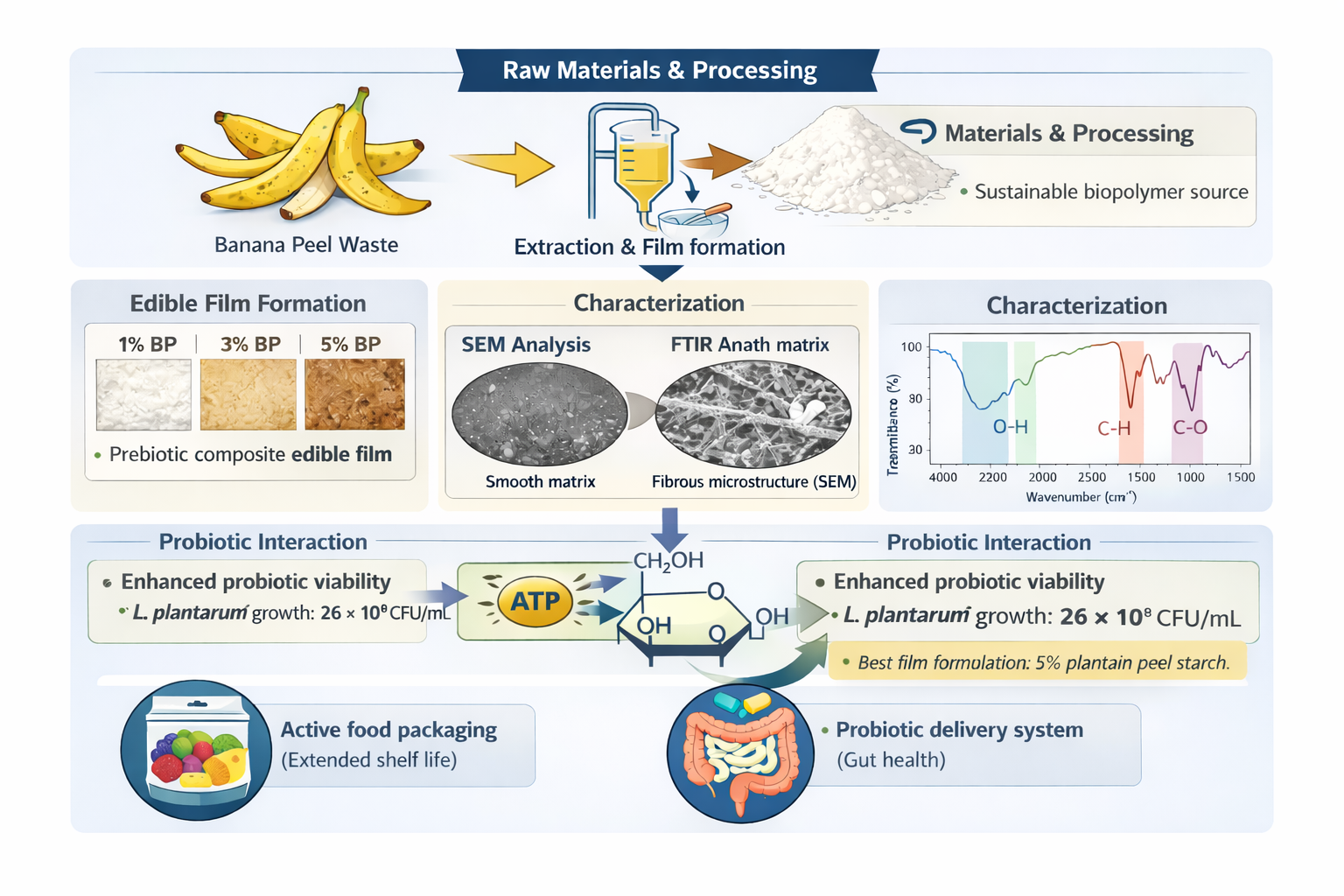
Innovative prebiotic carriers that can be directly integrated into foods are increasingly sought for functional food development. This study developed prebiotic starch films using sago flour and starch from kepok plantain (Musa paradisiaca) peel, designed as intrinsic prebiotic components rather than packaging. Films were formulated with 1%, 3%, and 5% plantain peel starch and characterized for physicochemical properties, morphology, and their prebiotic effect on Lactobacillus plantarum. Higher starch concentrations increased film thickness (0.13–0.18 mm) and moisture content (11.42–16.24%), while significantly decreasing water solubility (55.31–41.14%) (p < 0.05). Tensile strength was low (0.17–0.27MPa) and elongation high (89.28–178.10%). FTIR confirmed polysaccharide functional groups; SEM revealed heterogeneous fibrous structures. Resistant starch in films (1.89–3.76%) was lower than raw starch (38.91%) due to gelatinization. The 5% starch film supported the highest L. plantarum viability (26 × 108 CFU/mL), compared to 3% (23 × 108 CFU/mL) and 1% (21 × 108 CFU/mL), demonstrating that plantain peel starch acts as an effective intrinsic prebiotic without commercial prebiotics. The composite film shows potential as active packaging or a probiotic carrier in functional foods, although mechanical and water barrier optimization is still required.
References
Anggraeni, S., L. Susiana, R. Astutik, N. Istighosah, and Y. Puspitasari (2025). The Effect of Consumption of Kepok Banana (Musa paradisiaca Formatipyca) on Reducing the Intensity of Nausea, Vomiting in 1st Trimester GravidaWomen. Journal of Nursing Practice, 8(4); 896–903
Behera, S., R. Ray, and N. Zdolec (2018). Lactobacillus plantarum with Functional Properties: An Approach to Increase Safety and Shelf-Life of Fermented Foods. BioMed Research International, 2018; 9361614
Behiry, S., M. Okla, S. Alamri, M. El-Hefny, M. Salem, I. Alaraidh, H. Ali, S. Al-Ghtani, J. Monroy, and A. Salem (2019). Antifungal and Antibacterial Activities of Musa paradisiaca L. Peel Extract: HPLC Analysis of Phenolic and Flavonoid Contents. Processes, 7(4); 215
Chandrasekar, C., H. Krishnamachari, S. Farris, and D. Romano (2023). Development and Characterization of Starch-Based Bioactive Thermoplastic Packaging Films Derived from Banana Peels. Carbohydrate Polymer Technologies and Applications, 5; 100328
Chen, Y., J.Wang, L. Xu, Y. Nie, Y. Ye, J. Qian, F. Liu, and L. Zhang (2024). Effects of Different Plasticizers on the Structure, Physical Properties, and Film Forming Performance of Curdlan Edible Films. Foods, 13; 3930
Coimbra, P., S. Alarico, N. Empadinhas, M. Braga, and M. Gaspar (2023). Sustainable Starch-Based Edible Films with Agrifood Residues as Potential Carriers for the Probiotic Lactobacillus rhamnosus. Innovative Food Science & Emerging Technologies, 88; 103452
Daza, L., V. Eim, and H. Váquiro (2021). Influence of Ulluco Starch Concentration on the Physicochemical Properties of Starch–Chitosan Biocomposite Films. Polymers, 13(23); 4232
Do, D., J. Singh, I. Oey, and H. Singh (2022). Probing the Double-Layered Cotyledon Cell Structure of Navy Beans: Barrier Effect of the Protein Matrix on In Vitro Starch Digestion. Nutrients, 15(1); 105
Elvinna and N. Sadek (2024). Utilization of Banana Peel as Functional Ingredient in Pudding: Physicochemical and Sensory Aspects. IOP Conference Series: Earth and Environmental Science, 1324; 012117
Emaga, T. H., C. Robert, S. N. Ronkart, B. Wathelet, and M. Paquot (2008). Dietary Fibre Components and Pectin Chemical Features of Peels during Ripening in Banana and Plantain Varieties. Bioresource Technology, 99(10); 4346–4354
Esfandiari, Z., B. Hassani, I. Sani, A. Talebi, F. Mohammadi, S. Zomorodi, M. Kaveh, E. Assadpour, S. Khodaei, H. Eghbaljoo, H. Gholizadeh, M. Sani, and S. Jafari (2025). Characterization of Edible Films Made with Plant Carbohydrates for Food Packaging: A Comprehensive Review. Carbohydrate Polymer Technologies and Applications, 11; 100979
Ferreira-Villadiego, J., J. García-Echeverri, M. Vidal, J. Pasqualino, P. Meza-Castellar, and H. Lambis-Miranda (2018). Chemical Modification and Characterization of Starch Derived from Plantain (Musa paradisiaca) PeelWaste, as a Source of Biodegradable Material. Chemical Engineering Transactions, 65; 763–768
Guarino, M., A. Altomare, S. Emerenziani, C. Rosa, M. Ribolsi, P. Balestrieri, P. Iovino, G. Rocchi, and M. Cicala (2020). Mechanisms of Action of Prebiotics and Their Effects on Gastro-Intestinal Disorders in Adults. Nutrients, 12(4); 1037
Gutiérrez, T. J. and K. Álvarez (2016). Physico-Chemical Properties and in Vitro Digestibility of Edible Films Made from Plantain Flour with Added Aloe vera Gel. Journal of Functional Foods, 26; 750–762
Han, X., Y. Ma, S. Ding, J. Fang, andG. Liu (2023). Regulation of Dietary Fiber on Intestinal Microorganisms and Its Effects on Animal Health. Animal Nutrition, 14; 356–369
Hao, Y., J. Li, J.Wang, and Y. Chen (2024). Mechanisms of Health Improvement by Lactiplantibacillus plantarum Based on Animal and Human Trials: A Review. Fermentation, 10; 73
Hassan, U., H. Hassan, O. Ushie, A. Ibrahim, and N. Tabe (2018). Exploring the Potentials of Banana (Musa sapietum) Peels in Feed Formulation. International Journal of Advanced Research in Chemical Science, 5; 10–14
Huang, X., H. Liu, Y. Ma, S. Mai, and C. Li (2022). Effects of Extrusion on Starch Molecular Degradation, Order–Disorder Structural Transition and Digestibility—A Review. Foods, 11; 2538
Indrianti, N., Y. Pranoto, and A. Abbas (2018). Preparation and Characterization of Edible Films Made from Modified Sweet Potato Starch Through Heat Moisture Treatment. Indonesian Journal of Chemistry, 18(4); 679–687
Irmayanti and C. Anwar (2024). Synthesis of Biodegradable Plastic fromWak Banana Peel Starch with Glycerol as Plasticizer. Food Processing: Techniques and Technology, 54(3); 546–557
Ji, J., W. Jin, S. Liu, Z. Jiao, and X. Li (2023). Probiotics, Prebiotics, and Postbiotics in Health and Disease. MedComm, 4(6); e420
Karnwal, A., G. Kumar, R. Singh, M. Selvaraj, T. Malik, and A. R. M. Al Tawaha (2025a). Natural Biopolymers in Edible Coatings: Applications in Food Preservation. Food Chemistry: X, 25; 102171
Karnwal, A., A. Rauf, A. Y. Jassim, M. Selvaraj, A. R. M. S. Al-Tawaha, P. Kashyap, D. Kumar, and T. Malik (2025b). Advanced Starch-Based Films for Food Packaging: Innovations in Sustainability and Functional Properties. Food Chemistry: X, 29; 102662
Kaur, B., K. Venkatrao, P. Panesar, H. Chopra, and A. Anal (2022). Optimization of Ultrasound-Assisted Enzymatic Extraction of Resistant Starch from Green Banana Peels and Its Structural Characterization. Journal of Food Science and Technology, 59(12); 4663–4672
Khamsaw, P., S. Sommano, M.Wongkaew,W.Willats, C. Bakshani, S. Sirilun, and P. Sunanta (2024). Banana Peel (Musa ABB cv. NamWa Mali-Ong) as a Source of Value-Adding Components and the Functional Properties of Its Bioactive Ingredients. Plants, 13(5); 593
Kusuma, V. and E. Zubaidah (2016). The Evaluation of Lactobacillus casei and Lactobacillus plantarum Growth in the Fermented Banana Peel Flour Medium. Journal of Food and Agroindustry, 4(1); 100–108
Legowo, A., Y. Pramono, A. Hintono, and B. Setiani (2025). Microbiological and Physics Testing Encapsulation of Lactobacillus plantarum with Kepok Banana Flour. International Journal of Advances in Applied Sciences, 14(1); 19–27
Luca, L. and M. Oroian (2021). Influence of Different Prebiotics on Viability of Lactobacillus casei, Lactobacillus plantarum and Lactobacillus rhamnosus Encapsulated in Alginate Microcapsules. Foods, 10(4); 710
Munir, H., H. Alam, M. Nadeem, R. Almalki, M. Arshad, and H. Suleria (2024). Green Banana Resistant Starch: A Promising Potential as Functional Ingredient against Certain Maladies. Food Science & Nutrition, 12(6); 3787–3805
Ningrum, R., D. Sondari, P. Amanda, B. Widyaningrum, D. Burhani, F. Akbar, and Y. Sampora (2020). Properties of Edible Film From Modified Sago Starch Precipitated By Butanol. Indonesian Journal ofMaterial Science, 21(4); 164
Pak, E., S. Ghaghelestani, and M. Najafi (2020). Preparation and Characterization of a New Edible Film Based on Persian Gum with Glycerol Plasticizer. Journal of Food Science and Technology, 57(9); 3284–3294
Pan, J., C. Li, J. Liu, Z. Jiao, Q. Zhang, Z. Lv, W. Yang, D. Chen, and H. Liu (2024). Polysaccharide-Based Packaging Coatings and Films with Phenolic Compounds in Preservation of Fruits and Vegetables—A Review. Foods, 13; 3896
Pires, J., C. Paula, V. Souza, A. Fernando, and I. Coelhoso (2021). Understanding the Barrier andMechanical Behavior of Different Nanofillers in Chitosan Films for Food Packaging. Polymers, 13(5); 721
Precup, G., C. Pocol, B. Teleky, and D. Vodnar (2022). Awareness, Knowledge, and Interest about Prebiotics—A Study among Romanian Consumers. International Journal of Environmental Research and Public Health, 19(3); 1208
Putri, A., V. Johan, and R. Efendi (2023). Addition of Cinnamon Extract in Making Edible Film of Sago Starch as Packaging for Lempok Durian. IOP Conference Series: Earth and Environmental Science, 1182(1); 012062
Rahma, L., A. Srisa, P.Wongphan, M. Nakphaichit, S. Sablani, and N. Harnkarnsujarit (2025). Pregelatinized Starch-Based Edible Films as Effective Carriers for Bacillus coagulans: Influence of Starch Type on Film Properties and Probiotic Viability. Foods, 14(14); 2424
Rahmawati, S., Y. Yassaroh, A. Restafara, T. Santoso, P. Ningsih, Afadil, and Suherman (2025). Biodegradable Edible Films Derived from Banana Peels Infused with Extract from Moringa oleifera. International Journal of Design and Nature and Ecodynamics, 20(1); 107–113
Ratna, R., M. Mutia, D. Darwin, A. Munawar, F. Fitriani, and L. Handayani (2024). Utilization of Tofu LiquidWaste for the Manufacture of Bioplastic Food Packaging. Case Studies in Chemical and Environmental Engineering, 10; 100830
Sa’diyah, S., Y. Hariyadi, M. Ubaidillah, and V. Sari (2024). Screening of the Antimicrobial Activity of Indonesian Plantain (Musa spp.) against Pathogenic Bacteria. Biodiversitas, 25(4); 1368–1374
Sarš ¯ uns, K., N. Anspoka, D. Stivrin,a, A. Kons, V. Zabolotnii, K. B¯erzin,š, R. Meija, R. Viter, and A. B¯erzin,š (2026). Core–Shell Electrospun Fibers for Enhanced Dissolution and Stability of Amorphous Empagliflozin. European Journal of Pharmaceutics and Biopharmaceutics, 224; 115095
Serratos, I., J. Torres, J. Téllez, D. Roy, A. Estrada, N. López, H. González, S. Borgne, K. Sánchez-Sánchez, and R. Fonseca (2025). Banana Peel Based Cellulose Material for Agriculture and Aquiculture: Toward Circular Economy. Polymers, 17; 1230
Shanuke, D., N. B. D. Ranasinghage, A. U. Illippangama, J. Kulathunga, and M. D. Bandara (2025). Co-Encapsulation of Probiotics and Prebiotics: Techniques and Applications in Food Fortification. Food Science & Nutrition, 13(6); e70426
Shin, Y., S. Han, J. Kwon, S. Ju, T. Choi, I. Kang, and S. Kim (2023). Roles of Short-Chain Fatty Acids in Inflammatory Bowel Disease. Nutrients, 15(20); 4466
Shoukat, L., S. Javed, M. Afzaal, N. Akhter, and Y. Shah (2024). Starch-Based Encapsulation to Enhance Probiotic Viability in Simulated Digestion Conditions. International Journal of Biological Macromolecules, 283(1); 137606
Sinaga, M., E. Zaidar, and R. Bulan (2020). Production and Characterization of Edible Film from A Mixture of Tapioca Flour, Yellow Pump (Cucurbita moschatal D), Chitosan, and Glycerine for Application as A Layer Cake Packing. Journal of Chemical Natural Resources, 2(2); 121–131
Tan, C., N. Arifin, and M. Sabran (2024). Banana Peels as Potential Prebiotic and Functional Ingredient. Journal of Nutrition and Food, 19; 119–126
Urango, A. and E. Silva (2025). Impact of Adding Dietary Fibers and Maltodextrin on the Mechanical, Morphological, Optical, Barrier and Thermal Properties of Potato Starch-Based Edible Films. Innovative Food Science & Emerging Technologies, 102; 104012
Valdés, A., M. Ramos, A. Beltrán, A. Jiménez, and M. Garrigós (2017). State of the Art of Antimicrobial Edible Coatings for Food Packaging Applications. Coatings, 7; 56
Vilela, A., B. Gonçalves, C. Gonçalves, F. Cosme, and T. Pinto (2026). Novel Applications of Starch and Starch Derivatives in the Food and Alcoholic Beverages Industry: A Review. Foods, 15(2); 277
Warkoyo,W., M. Haris, and V.Wahyudi (2022). The Physical, Mechanical, Barrier Characteristics, and Application of Edible Film from Yellow Sweet Potato and Aloe Vera Gel. agriTECH, 42(4); 390–399
Wernisch, B., M. Al Otmi, E. Beauvais, and J. Sampath (2024). Evolution of Free Volume Elements in Amorphous Polymers Undergoing Uniaxial Deformation: AMolecular Dynamics Simulations Study. Molecular Systems Design & Engineering, 9(2); 214–225
Yaghoubi, M., K. Alirezalu, F. Hadi, M. Marcinkowska-Lesiak, M. Ismail-Fitry, A. Abd El-Aty, E. Oz, and F. Oz (2025). Probiotic-Incorporated Active Packaging Solutions forMeat and Meat Products: A Review of Benefits and Recent Applications. Trends in Food Science & Technology, 156; 104848
Zaini, H., J. Roslan, S. Saallah, E. Munsu, N. Sulaiman, and W. Pindi (2022). Banana Peels as a Bioactive Ingredient and Its Potential Application in the Food Industry. Journal of Functional Foods, 92; 105054
Authors

This work is licensed under a Creative Commons Attribution 4.0 International License.